Alexander III of Macedon, known to history as Alexander the Great, was not only a military genius but also a cultural sponge. As he carved his way through the Persian Empire and beyond, he absorbed local traditions, languages, styles of governance, and, of course, cuisines. Born into the rugged hills of northern Greece, Alexander grew up eating hearty but humble Macedonian food: barley bread, olives, cheese, and roasted meats. But once he crossed into the sophisticated heartlands of the Achaemenid Empire, he encountered a food culture that was far older, richer, and more refined than anything he had known before.
While most of our knowledge of Alexander’s campaigns comes from later sources like Arrian, Plutarch, and Quintus Curtius Rufus, these texts are sprinkled with clues about his evolving lifestyle. Plutarch, for instance, tells us that Alexander adopted the Persian style of dress and court protocol after conquering Persepolis. Alongside this came the elaborate banquets of the Persian court, which featured roasted game, rice dishes seasoned with rare spices, and fruit syrups used in glazes and sauces. One particular moment often referenced is the symbolic burning of the royal palace at Persepolis, an act said to be both celebratory and destructive. Before the flames, however, there were likely days of feasting and celebrations filled with music, gold vessels, and aromatic foods like honey-roasted birds.
This blog post is my attempt to bring that world to life on a plate. While we don’t have direct cookbooks from Alexander’s time, Persian culinary traditions have deep roots. Dishes like fesenjān—a rich pomegranate and walnut stew—or zereshk polo—saffron rice with barberries—descend from the ancient techniques of the Achaemenid and later Sassanid empires. My interpretation is grounded in the historical ingredients that were common in Persian kitchens by 330 BCE: saffron from the plateau of Iran, coriander and cumin imported via overland routes, date honey and fruit juices for glazing, and the prized pheasant, hunted for both food and sport.
A Taste of Conquest: Alexander in Persia
When Alexander defeated Darius III and took over the Persian Empire, he stepped into a world that was far more complex and luxurious than the one he had come from. Persian kings lived in monumental palaces, surrounded by gardens known as paradises, which is the very origin of the word. In these gardens, feasting was both political and symbolic. Hosting elaborate meals was a way to show dominion over nature, over enemies, and even over one’s own court. The Achaemenids had long practiced a cuisine that emphasized harmony between sweet and savory, between fruit and meat, and between herbs and rich glazes.
Plutarch describes how Alexander began to adopt Persian customs, and while there was controversy among his Macedonian companions about his “softening,” it is undeniable that he found value in the refinement of the empire he had conquered. Quintus Curtius Rufus recounts that after taking Babylon, Alexander spent weeks absorbing the culture of the city, which was renowned for its knowledge of astronomy, medicine, and cuisine. Babylon had become a melting pot of ancient Mesopotamian, Assyrian, and Persian flavors, and we can safely assume that Alexander’s tables were filled with dishes previously unknown to his Greek companions.
Game birds like pheasant were especially prized in the Persian world. The bird’s meat was considered both noble and healthful, mentioned in later Persian texts like the Book of Dishes (Kitab al-Ṭabīkh) as a delicacy for the elite. While that book was written centuries later during the Abbasid Caliphate, it draws heavily from older Zoroastrian and Sasanian traditions that likely began during the Achaemenid period. Roasted pheasant, seasoned with sweet glazes of grape or pomegranate must, would have been well within the reach of Alexander’s chefs once he took control of the Persian kitchens.
Interpreting a Lost Recipe
Because no cookbook survives from the 4th century BCE Greek or Persian world, modern historians and food writers rely on fragments, archaeological evidence, and extrapolations from later texts. For instance, Xenophon’s Cyropaedia gives a detailed fictionalized account of Persian banquets, including lavish meat dishes and the use of fruits and spices. Herodotus also mentions the Persian fondness for luxury and their tendency to “adopt the best customs from every nation.” If we apply that principle to their foodways, it’s likely that their royal kitchens experimented with combinations of honey, fruits, and spice long before Alexander arrived.
To construct this dish, I turned to the fundamentals of Persian cooking that have endured for millennia. Honey, widely used in both religious and culinary contexts, was often blended with fruit juices or syrups to create complex glazes. Pomegranate juice, still a staple in Iranian kitchens today, adds acidity and symbolism as it represents fertility, blood, and royalty. Saffron, perhaps the most luxurious of spices, was already cultivated in Persia during this period. And coriander and cumin? These spices trace their use back to Babylonian tablets over 3,000 years ago, where they were recorded as common flavorings in stews and meat dishes.
My version brings all of these together into a glaze that’s brushed repeatedly over the pheasant as it roasts. Every 15 minutes, I open the oven, basted the bird, and watched as the sugars caramelized and the skin tightened. The fragrance filled my kitchen with something that felt ancient, like a cross between a Roman feast and a Zoroastrian New Year. And while I can’t claim historical perfection, the end result captures the essence of what Alexander may have eaten during those long, triumphant nights after conquest.
Cooking the Pheasant: A Regal Centerpiece
Cooking pheasant for the first time felt like a bold undertaking, and maybe that’s appropriate. After all, Alexander was only twenty-two when he set out to conquer the largest empire the world had ever seen. I treated the bird with care—rinsing it, patting it dry, and trussing it to ensure even roasting. The glaze, a blend of honey, pomegranate, saffron water, coriander, cinnamon, and cumin, was brushed on in layers to create a sticky, aromatic crust. Roasted at a moderate 375°F, it required frequent basting to keep it from drying out—pheasant is leaner than chicken and needs a gentle hand.
Ancient feasting was as much about symbolism as sustenance. Pheasant represented nobility and skill, as it required both hunting and careful preparation. In Zoroastrian contexts, meals were shared communally and often aligned with the seasons, spiritual festivals, or royal achievements. Sitting down to eat this dish, I felt a little of that sacred weight. The basting, the slow roasting, the care mirrored the deliberate pacing of ancient rituals, when food was more than fuel.
The Side Dishes: Ancient Rice and Pomegranate-Herb Sauce
The rice in this dish is simple but powerful. Persian cuisine has always placed enormous emphasis on the perfection of rice, and even today, techniques for tahdig or jeweled rice are passed down like sacred texts. In this case, I opted for something earlier- rice cooked gently in water, oil, salt, and a touch of turmeric. After steaming, it’s finished with a drizzle of saffron water for aroma and color. The result is a golden base that complements the sweetness of the glaze without overwhelming it.
Turmeric has been used in Persian medicine and food for centuries, mentioned in early Ayurvedic and Arabic texts and likely traded along the same routes that Alexander’s army marched through. Combined with saffron, it gives the rice both warmth and elegance, which is a perfect backdrop for the bird. I topped mine with fresh herbs, just as ancient sources recommend for balancing richer dishes. Mint, coriander, and parsley are all attested in Middle Eastern gardens from the 1st millennium BCE onward.
The sauce is my version of an early fesenjān, adapted without walnuts. Onions are gently sautéed, then reduced with pomegranate juice, honey, coriander, and salt, finished with a handful of chopped herbs. The tartness of the pomegranate balances the honey glaze, and the freshness of the herbs cuts through the richness of the meat. It felt like a necessary third element, which is a bridge between the rice and pheasant, tying the plate together the way Alexander once tried to unite the cultures of East and West.
If you’re enjoying my work, check out Eats History Shop!
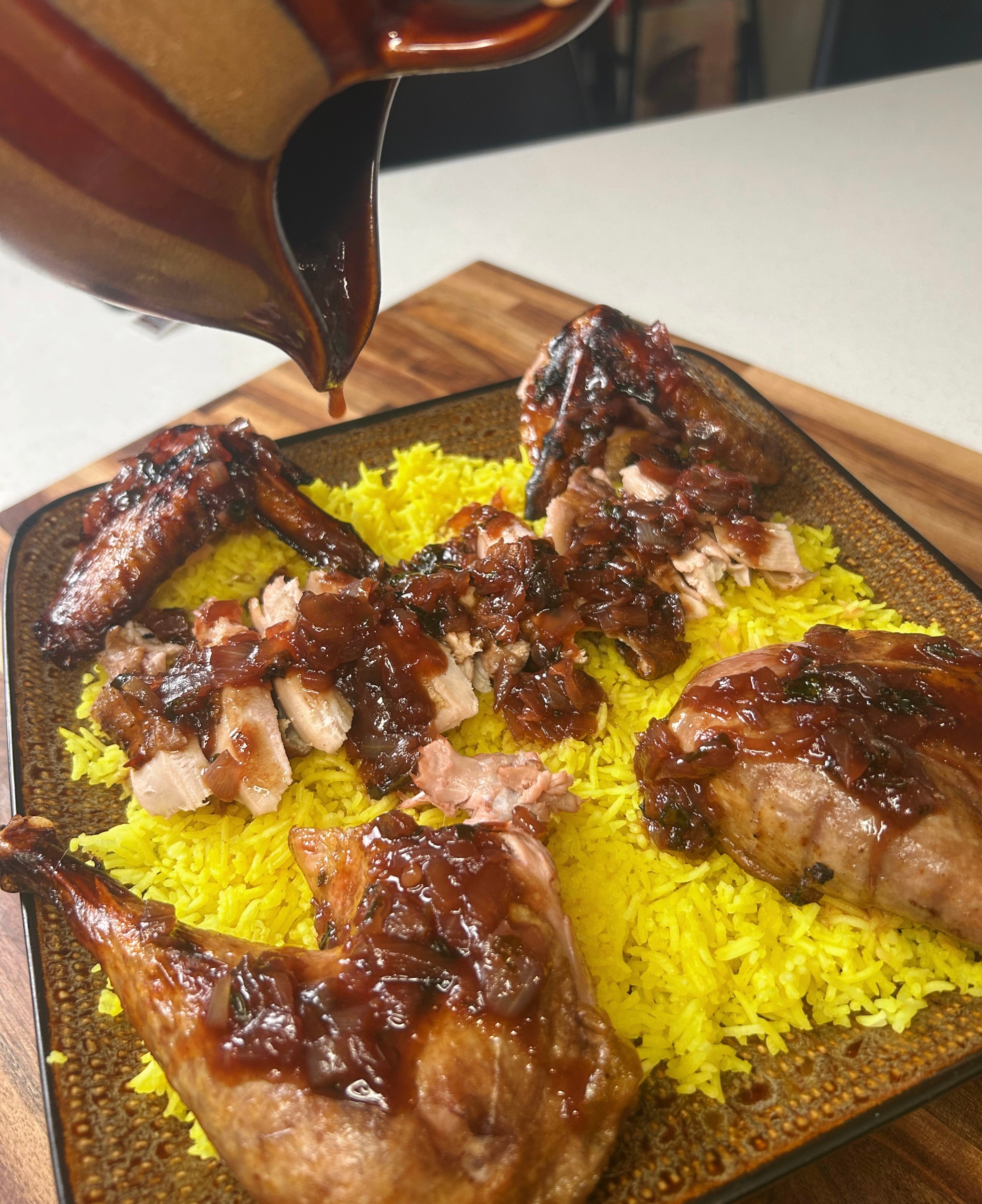
Honey-Roasted Pheasant with Saffron Rice & Pomegranate Sauce
Ingredients
1 whole pheasant, cleaned and trussed
- 2 tbsp honey wildflower or date honey preferred
- 1 tbsp olive oil or rendered fat
- 1 tsp ground coriander
- ½ tsp ground cinnamon
- ½ tsp ground cumin
- 1 pinch saffron threads crushed and steeped in 2 tbsp warm water
- ½ tsp salt
- Juice of ½ pomegranate
- Optional Dried rose petals for garnish
Saffron-Turmeric Rice
- 1 cup short or medium grain rice
- 1½ cups water
- 1 tsp salt
- 1 tbsp olive oil
- ¼ tsp turmeric
- 1 pinch saffron steeped in 2 tbsp warm water
- Optional Chopped fresh herbs: parsley, mint, or coriander
Pomegranate-Herb Sauce
- 1 tbsp olive oil
- 1 small shallot or mild onion finely minced
- ¾ cup pomegranate juice
- 1 tsp date syrup or honey
- ½ tsp ground coriander
- 1 pinch salt
- Handful of chopped herbs: parsley mint, and/or cilantro
Instructions
- Preheat the oven to 375°F (190°C).
- In a small bowl, mix the honey, olive oil, saffron water, pomegranate juice, coriander, cinnamon, cumin, and salt to create the pheasant glaze.
- Place the cleaned and trussed pheasant on a roasting rack or in an oven-safe dish.
- Brush the pheasant all over with the glaze.
- Roast the pheasant for 45–55 minutes, basting every 15 minutes, until the skin is golden and juices run clear. Internal temperature should reach 160°F in the thigh.
- Remove from oven and let rest for 10 minutes. Garnish with dried rose petals if desired.
- While the pheasant roasts, rinse the rice under cold water until the water runs clear.
- In a pot, bring 1½ cups water, salt, olive oil, and turmeric to a boil. Add rice, reduce heat to low, cover, and simmer for 15–18 minutes or until water is absorbed.
- Once rice is done, stir in the saffron water and fluff gently. Top with fresh herbs if using.
- For the sauce, heat olive oil in a small pan over medium heat. Add minced shallot and cook until soft and translucent.
- Add pomegranate juice, date syrup or honey, coriander, and salt. Stir and simmer gently for 10–12 minutes until slightly thickened.
- Remove from heat and stir in the fresh chopped herbs. Serve warm with the pheasant and rice.
Video
Notes
- Don’t skip the basting: Pheasant is lean and can dry out so baste every 15 minutes keeps the meat juicy and flavorful.
- Saffron + turmeric = golden color: Saffron adds floral depth while turmeric gives the rice a warm hue and earthy base. Use both for richness and balance.
- Sauce ties it all together: The pomegranate-herb sauce isn’t just a garnish; it brings acidity and brightness to complement the sweet glaze on the pheasant.