To dine with Charlemagne is to eat at the intersection of power, pragmatism, and early medieval reality. This was not the world of Renaissance banquets or Roman excess. The Carolingian court sat closer to the land, the hunt, and the monastery than to marble halls and silver platters. Food was expected to sustain warriors, monks, and administrators alike, and it reflected a society still organizing itself after the collapse of Roman infrastructure in Western Europe.
If you’re enjoying my recipes, check out my e-cookbooks, not 40% Off!

Charlemagne ruled an empire that stretched across much of modern France, Germany, northern Italy, and beyond. Feeding such a realm required order, discipline, and efficiency. While later legends portray lavish feasts, the historical record suggests a ruler who valued moderation and structure. Meals at court were substantial but restrained, shaped by seasonality, Christian fasting rules, and the realities of early medieval agriculture.
This dish, braised rabbit legs served over a barley and lentil pottage, is not a direct transcription of a named recipe from Charlemagne’s table. Instead, it is a historically informed reconstruction. It reflects what the Carolingian elite likely ate and how they ate it, using ingredients and techniques documented in the period. It is a meal that fits the world Charlemagne inhabited.
Charlemagne and the Carolingian World
Charlemagne, crowned Emperor of the Romans in 800 CE, presided over what historians call the Carolingian Renaissance. This was not a rebirth of luxury but a revival of administration, literacy, and order. Monasteries became centers of record-keeping and agriculture. Royal estates were organized with precision. Food production was part of governance.

Our understanding of Charlemagne’s daily life comes from sources such as Einhard’s Vita Karoli Magni, which emphasizes his discipline and sobriety. Einhard notes that Charlemagne ate simply and avoided excess. He preferred roasted meats but did not indulge heavily, drank wine in moderation, and valued health over indulgence. This does not suggest austerity but balance.
The Carolingian court traveled frequently. Meals had to be practical and adaptable. Hunting supplied fresh meat when possible. Estate farms provided grains, legumes, and vegetables. Imported luxury foods were rare. The cuisine of Charlemagne’s era was deeply tied to what could be grown, raised, or hunted locally.
What Do We Know About Charlemagne’s Diet
There are no surviving cookbooks from Charlemagne’s reign comparable to Roman or later medieval texts. However, we can reconstruct dietary habits from estate records, monastic rules, and narrative sources. Charlemagne issued detailed capitularies, including the Capitulare de Villis, which outlined what royal estates should produce.
These documents list grains such as barley and wheat, legumes like lentils and peas, herbs, vegetables, and livestock. Meat consumption was common among elites, particularly from hunting. Game animals including deer, boar, and hare appear frequently in records and later medieval continuities strongly suggest similar practices in the Carolingian period.

Christian fasting rules also shaped diet. On many days meat was restricted, which elevated the importance of grains and legumes. Pottages made from barley and lentils would have been daily staples, eaten by peasants and nobles alike. Meat was added when available, not as excess but as nourishment.
Why Rabbit and the Role of Hare in the Early Middle Ages
Rabbit and hare occupied an important place in early medieval diets. While the European rabbit became more fully domesticated later, wild hare was widely hunted across Charlemagne’s empire. Archaeological evidence and hunting law traditions show hare as a common game animal for the elite.
Hare was valued for its lean meat and availability. It could be hunted year-round in many regions and did not require the infrastructure needed to raise large livestock. For a traveling court, this mattered. A hunted hare could be cooked the same day, often stewed or braised to tenderize the meat.

Choosing rabbit for this dish reflects that historical role. Braising would have been a practical technique to soften lean game meat, especially when cooking over hearths rather than precise ovens. Butter, onions, garlic, herbs, wine, and stock were all available within Carolingian lands, particularly in monastic and royal kitchens.
Pottage as the Backbone of Medieval Eating
Pottage was the backbone of medieval cuisine. It was not a single recipe but a category. A thick porridge or stew made from grains and legumes, simmered slowly and adapted to whatever ingredients were available. Barley and lentils were especially common due to their hardiness and storage qualities.
In Charlemagne’s time, pottage was eaten daily across all social classes. The difference between peasant and noble versions lay in additions. Elites added meat, fats, and better seasoning. Serving braised rabbit over pottage elevates a staple into a courtly dish without departing from historical plausibility.
The pottage in this dish provides earthiness and sustenance. It grounds the meal in the agricultural reality of the Carolingian world. The rabbit does not dominate the plate. It complements it.
The Cooking Process: Practical and Purposeful
The cooking method reflects early medieval practicality. Browning rabbit legs in butter adds richness and depth, while seasoning with salt would have been common in elite kitchens where preserved salt was available. Removing the meat allows onions and garlic to soften and develop sweetness.
Deglazing with white wine and stock reflects Carolingian access to viticulture, especially in regions like Gaul. Wine was a standard cooking liquid. Herbs such as thyme and bay were widely known and used, particularly in monastic gardens.
Braising the rabbit slowly would have produced tender meat infused with aromatic liquid. This method requires patience rather than precision, fitting the rhythm of hearth cooking. Served over pottage, the sauce becomes part of the dish rather than a separate element.
Tasting the Carolingian Table
This dish is subtle rather than bold. The rabbit is tender and clean-tasting, enriched by butter and wine but not overwhelmed by spice. The herbs add warmth and restraint, not intensity. The pottage absorbs the braising liquid, becoming deeply savory.

What stands out most is how complete the dish feels. It is nourishing, balanced, and satisfying without excess. You can imagine it feeding a ruler concerned with longevity, discipline, and clarity rather than indulgence.
As a modern eater, this dish feels surprisingly relevant. It is hearty without heaviness. Flavorful without distraction. It reflects a worldview where food supports life and leadership rather than spectacle.
Dish Rating: 8.2 / 10
Recipe: Braised Rabbit Legs on Barley Lentil Pottage
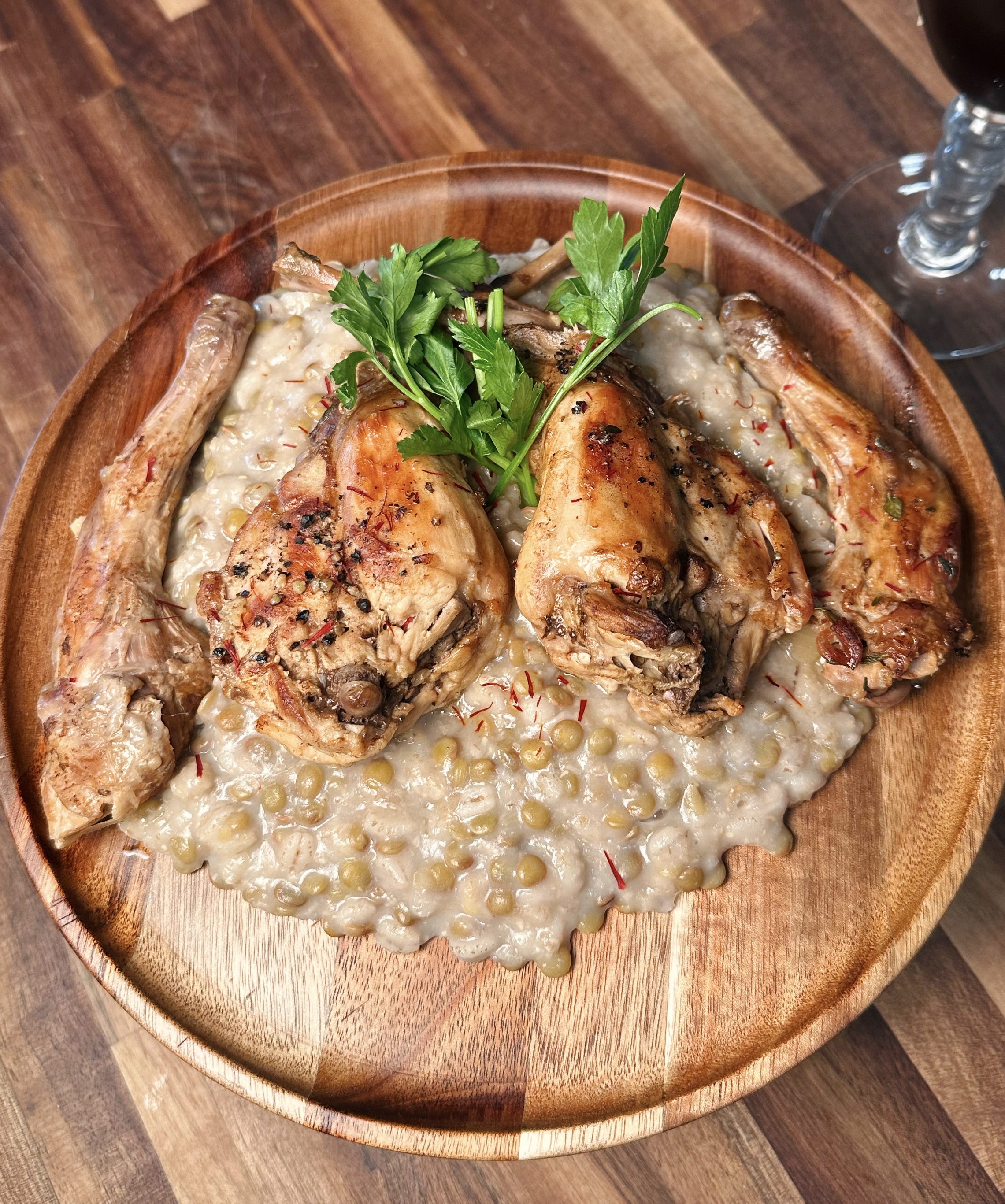
Braised Rabbit Legs on Barley Lentil Pottage
Ingredients
Braised Rabbit
- 2 rabbit legs
- 2 tablespoons butter
- Salt to taste
- 1 small onion finely chopped
- 2 cloves garlic minced
- ½ cup dry white wine
- ½ cup stock
- 2 sprigs thyme
- 1 bay leaf
Barley Lentil Pottage
- ½ cup pearl barley
- ½ cup lentils
- 3 cups water or light stock
Salt, to taste
Instructions
Pottage
- Rinse barley and lentils. Add to a pot with water or stock and a pinch of salt. Simmer gently for 45 to 60 minutes until thick and tender. Stir occasionally and add liquid as needed. Keep warm.
Rabbit
- Season rabbit legs with salt. Melt butter in a pan over medium heat and brown the rabbit legs on all sides. Remove and set aside.
- Add onion and garlic to the pan and cook until soft and lightly golden. Deglaze with white wine, scraping the pan. Add stock, thyme, and bay leaf.
- Return rabbit to the pan. Cover and braise gently for 35 to 45 minutes until tender. Remove herbs before serving.
To Serve
- Spoon pottage onto plates and top with rabbit legs and braising liquid.
Video
Notes
- Rabbit Texture: Rabbit is lean and benefits from slow, gentle braising. Avoid high heat after browning to keep the meat tender.
- Pottage Consistency: The pottage should be thick but spoonable. Add small amounts of water or stock as needed during cooking.
- Historical Simplicity: Resist adding extra spices or vegetables. The restrained ingredient list reflects early medieval cooking and allows the natural flavors to come through.