In the spring of 1746, the Jacobite army was falling apart. Bonnie Prince Charlie’s Highland warriors had marched as far south as Derby, turned around, won a battle at Falkirk, and were now running short of everything. Money, men, and food. According to the National Trust for Scotland, in the weeks before the decisive Battle of Culloden, Jacobite soldiers were surviving on rations of just three biscuits a day. Across the field, the Duke of Cumberland’s government troops were marching from Aberdeen in good order, well-fed and rested.
The Highlanders lost.
What those same men ate when they were not starving on campaign, when they were home in the glens and preparing for the kind of hard physical life that made them one of the most feared fighting forces in Europe, was a diet built on two things above almost everything else. Bannock and crowdie. Bread and cheese. Made from barley, oats, and milk. Cooked on a flat stone over a peat fire. Carried in a pack across the Highlands for days at a time.
I made both from scratch and ate them together with a bit of strawberry jam. Here is what I found.
If you’re enjoying my content, check out my e-cookbooks at Eats History shop!
The Highlands Before Culloden Changed Everything
The Scottish Highlands before the 18th century were a world almost entirely separate from the lowland culture of Edinburgh and the anglicized south. The clan system organized every aspect of life. A chief held land, dispensed justice, and could call his tenants to military service at any time. In return he owed them protection. The relationship was feudal but also deeply personal in a way that English feudalism rarely was. When the chief fought, the clan fought with him.

The Highland warrior of the medieval and early modern period was not a professional soldier in the European mold. He was a farmer and a herdsman who was also expected to be dangerous when called upon. The clan economy was built around cattle, grazed on the high summer pastures in a practice called transhumance, and around the cultivation of oats and barley in the thin soil of the glens. These two things, livestock and grain, produced essentially everything a Highland family ate.
Contemporary English and Lowland Scottish observers frequently remarked on the physical condition of Highland men. They were described as lean, hardened, and capable of extraordinary endurance. What those observers often noted alongside the physical description was the diet: oatmeal in various forms, dairy products from the cattle, and very little else by the standards of southern cooking. No wheat bread. No rich sauces. No wine. What looked like poverty from the outside was a nutritional system that had been refining itself in a specific landscape for centuries.
Bannock: Scotland’s Oldest Bread, Documented Since the 8th Century
The word bannock comes from the Old Celtic bannuc, derived from the Latin panicium, meaning anything baked or bread. The first documented use of the word in Scotland appears in early glosses to the 8th-century scholar Aldhelm, who died in 709 CE. That means bannock has been mentioned in written records for over 1,300 years, and it was already a well-established food when those records were made. This is not a dish that was invented. It was already old when history first looked at it.
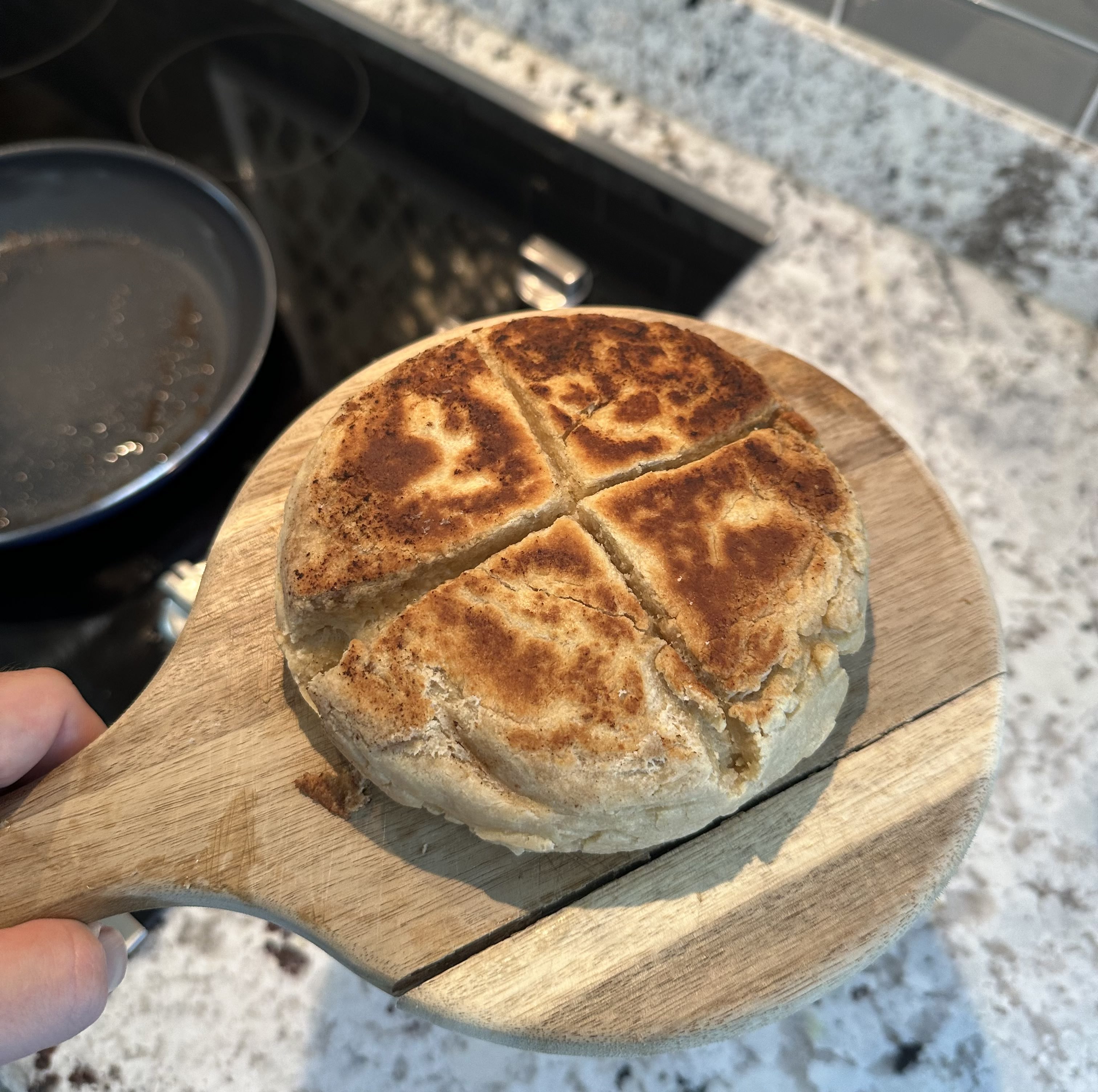
The original bannock was simple to the point of austerity. Barley or oatmeal, water or buttermilk, and sometimes a little fat. Mixed into a round flat cake and cooked on a bannock stane, a large flat piece of sandstone placed directly in front of the fire. No oven. No yeast. No leavening at all in the earliest versions. Just grain, liquid, heat, and time. The result was dense, filling, and built to last.
Robert Burns cemented the bannock’s place in Highland culture permanently in his 1794 poem Bannocks O’ Bear Meal, written in celebration of the Jacobite spirit. He wrote directly of the Highland warrior’s bread: “Here’s to the Highlandman’s bannocks o’ barley. Wha, in a brulzie, will first cry a parley? Never the lads wi’ the bannocks o’ barley.” Burns was writing 48 years after Culloden, but he was drawing on a tradition that stretched back long before the ’45. The barley bannock was not just food. It was an identity marker. The bread of people who lived hard and fought hard.
Bannock was also ritual food. Special versions were made for Beltane on the first of May and for Lammas at the start of the harvest season. The Beltane bannock was divided into sections and pieces were drawn from a bag blindly, with the person who drew the marked piece considered symbolically sacrificed to the fire. Even the superstitions were practical. Stirring bannock batter counterclockwise was thought to bring bad luck, a rule that conveniently also kept the gluten from overdeveloping.
Crowdie: The Cheese That Might Be Older Than Scotland Itself
Crowdie is Scotland’s oldest surviving cheese and possibly its most ancient food product. Its origins are genuinely contested between two periods of Scottish prehistory: the Viking era, which reached Scotland’s coasts around 800 CE, and the time of the Picts, the tribal confederation of northern Scotland who first appear in historical records in the late 3rd century. The Vikings brought sophisticated dairy preservation techniques from Scandinavia, including the method of making lactic acid cheeses by souring milk and hanging the curds in muslin to drain. But Pictish settlements show evidence of dairy processing that predates the Norse arrival by centuries. The honest answer is that nobody knows exactly when crowdie began.
What is known is how it was made and why it persisted. Every Highland crofter family with a cow had access to fresh milk. Most of that milk was skimmed for cream, which was churned into butter. The remaining skimmed milk, rather than being discarded, was left to sour naturally on a windowsill or near the fire, then gently warmed until the curds separated from the whey, and then hung in a muslin cloth to drain. Salt was added. Sometimes a little cream was stirred back in. The result was a soft, fresh, slightly acidic cheese that could be made from essentially nothing and eaten within days.

The word crowdie itself tells you how central this was to Highland life. It originally referred to oatmeal porridge, the absolute baseline staple of the Scottish diet. Over time the word became so synonymous with daily sustenance that it transferred to the cheese as well, and any commonly eaten food might have the word crowdie attached to it. When a word becomes a generic term for food itself, you know the thing it describes was eaten at almost every meal.
Robert Burns wrote about crowdie too. His poem Crowdie Ever Mair documents the lament of a poor man struggling to feed his family, using crowdie as the symbol of basic survival. The cheese was so ingrained in Highland daily life that Burns could use it as a single-word stand-in for the concept of having enough to eat.
Crowdie nearly disappeared entirely after the Second World War, when crofting traditions declined and industrial dairy production made homemade cheese seem obsolete. Its survival is credited to one woman: Susannah Stone, who farmed near Tain in the Scottish Highlands and had been making it traditionally her whole life. In 1962 she made too much and offered the surplus to a local grocer. It sold. She and her husband began producing it commercially as Highland Fine Cheeses, and the oldest cheese in Scotland found its way back onto Scottish tables.
What the Warriors Actually Ate in the Field
The Highland warrior on campaign carried his food with him. This was not a logistical system with supply lines and quartermaster stores. It was a man with a bag of oatmeal and the capacity to supplement it from whatever the landscape provided. Multiple historical accounts describe Highland soldiers carrying nothing but a skin bag of oatmeal on campaign, which they mixed with water from streams to make a cold paste or a quick porridge. It was calorie-dense, lightweight, and required no cooking equipment.

Bannock served as the more substantial version of this portable ration. A round of bannock bread, made before leaving home and carried in a pack, would last several days and provided the kind of slow-burning carbohydrate energy that sustained hard physical exertion. When the army was near a settlement and could acquire milk, crowdie would have been made fresh and eaten alongside the bread. The pairing was not culinary ambition. It was practical nutrition. The carbohydrate of the bannock and the protein and fat of the crowdie together formed a complete meal from two ingredients.
The contrast with what happened at Culloden in April 1746 is striking. By that point the Jacobite army had been on campaign for months. Their supply lines had collapsed. The night before the battle, they attempted a surprise night march to attack Cumberland’s camp at Nairn. The march failed because the men were too hungry and exhausted to maintain the pace. They turned back at dawn. Hours later, fighting on empty stomachs after a sleepless night, they were destroyed in less than an hour. The National Trust for Scotland records that soldiers were on three biscuits a day in the weeks prior. What broke the Highland army at Culloden was not the Highland charge or the bayonets of the government troops. It was logistics. It was food.
The Verdict
The bannock I made uses a mix of barley and oat flour, buttermilk, a touch of baking soda, and salt, all combined into a dough, rested briefly, shaped into a round and scored into four sections on top, then pan-fried in butter. The crowdie is whole milk simmered to just below a boil, white vinegar added to curdle it, drained through cheesecloth, and finished with salt.

The bannock is the genuine surprise here. I went in expecting something dense and functional, the kind of bread you eat because you have to, not because you want to. What I got was something that sits exactly between an American biscuit and a scone. Not dry at all. The buttermilk gives it a subtle tang and keeps the crumb tender even though there is almost no fat in the dough itself. The barley flour adds a nutty depth that plain oat would not. Pan-frying in butter gives the crust a richness that makes the whole thing feel almost indulgent for what is essentially just grain and liquid.
The crowdie is mild, fresh, slightly acidic, and genuinely excellent. It tastes cleaner than cream cheese and lighter than ricotta. The texture is soft and spreadable but with enough body that it holds its shape when you put it on the bread. Alone it is good. On a warm piece of bannock with a spoon of strawberry jam, it becomes something worth making again.
The combination of all three together, bannock, crowdie, and jam, is the kind of thing that would disappear completely from a plate at a breakfast table. It is also the kind of thing that a Highland crofter’s family would have eaten every morning for generations before anyone thought to write it down or call it anything special. That is the tell. The food that has been made the same way for a thousand years without anyone seeing a reason to change it is usually the food that is actually right.
Rating: 7.9/10
— Donnie

Highland Bannock and Crowdie
Ingredients
Bannock
- 1 cup barley flour
- 1/2 cup oat flour
- 1/2 tsp baking soda
- 1/2 tsp salt
- 3/4 cup buttermilk plus more if needed
- 2 tbsp butter for the pan
Crowdie
- 4 cups whole milk
- 3 tbsp white wine vinegar
- 1/2 tsp salt or to taste
Instructions
Bannock:
- Combine barley flour, oat flour, baking soda, and salt in a bowl. Make a well in the center and pour in the buttermilk. Mix until a soft dough forms. It should not be sticky but it should be pliable. Add a little more buttermilk a tablespoon at a time if the dough feels dry or crumbly.
- Turn the dough onto a lightly floured surface and bring it together gently. Do not overwork it. Shape it into a round about 1 inch thick and roughly the diameter of your pan. Score the top into four sections with a knife, cutting about halfway through. Rest for 10 minutes.
- Melt butter in a cast iron pan over medium-low heat. Place the bannock in the pan. Cover with a lid and cook for 8 to 10 minutes until the bottom is deep golden. Flip carefully and cook another 8 to 10 minutes covered until cooked through. A skewer inserted in the center should come out clean.
- Rest for 5 minutes before breaking apart at the scored sections. Serve warm.
Crowdie:
- Pour milk into a heavy-bottomed pot over medium heat. Warm it slowly, stirring occasionally, until it just reaches a simmer. Small bubbles will form around the edge. Do not boil.
- Remove from heat. Add the white wine vinegar and stir gently once or twice. Let it sit undisturbed for 5 minutes. The milk will curdle and separate into white curds and thin yellowish whey.
- Line a colander with a double layer of cheesecloth and set it over a bowl. Pour the curds and whey in gently. Let it drain at room temperature for 30 to 45 minutes. The longer it drains the firmer the cheese will be.
- Transfer the curds to a bowl. Add salt and stir to combine. Taste and adjust. Serve immediately or refrigerate for up to 3 days.
Video
Notes
- Barley flour can be found at most health food stores or ordered online. Do not substitute all-purpose flour. The barley is the flavor.
- The crowdie whey that drains off is worth keeping. It can be used in bread dough, soup stock, or drunk straight. The Highlanders wasted nothing.
- A traditional Scottish variation rolls the finished crowdie in toasted pinhead oatmeal and cracked black pepper before serving, which is called Black Crowdie or Gruth Dhu. Highly recommended if you want to take it further.