There is a recipe contest that took place in 1904 that I think about more than any reasonable person should. Mrs. John E. Cook of New Castle, Pennsylvania entered a recipe contest co-sponsored by Better Homes and Gardens and Knox Gelatin. She called her dish Perfection Salad. It had several typical elements of a salad: shredded cabbage, celery, red pepper and chopped green olives. But Mrs. Cook added a special twist by wrapping these ingredients inside a soft, jiggly blanket of gelatin spiked with lemon juice and vinegar, and molding everything into a shimmery blob. She called for the molded salad to be diced and served with mayonnaise in cases made of red or green peppers, and she liked to eat it alongside fried oysters.
Although the judges, one of whom was Fannie Farmer herself, awarded Mrs. Cook only third place, no one even remembers the two recipes that beat hers. She won a $100 sewing machine. The recipes that actually beat her have been lost to history. And Perfection Salad went on to become one of the most recognized dishes in 20th century American food culture, launching a decades-long national obsession with putting things inside gelatin that had absolutely no business being there.
I made it. I regret it. Rating: 0/10. Let me explain.
The Woman Behind the Wobble: Who Was Mrs. John E. Cook?
Here is the first dark joke embedded in this entire story: we do not know her first name. There is little indication that fame or fortune followed Mrs. Cook. No mention of her third-place triumph was made in local newspapers. Not even her first name appears to be known. The woman who sparked one of the most distinctive food trends in American history is remembered only as Mrs. John E. Cook of New Castle, Pennsylvania. Her husband’s name. Her husband’s town. A sewing machine prize.
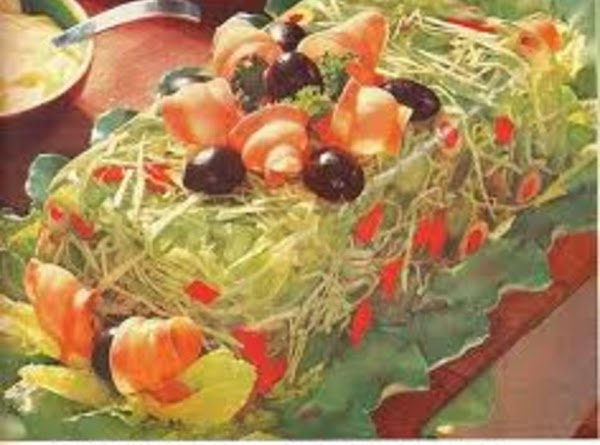
What we do know is that she was practical. She hailed the salad as an economical use of week-old produce that might otherwise go bad. She wasn’t trying to create art. She was trying not to waste the cabbage. She wrote in her contest entry that it was especially fine with fried oysters and that she planned to serve it at her next church supper. Which means somewhere in New Castle, Pennsylvania in 1904, a church congregation sat down to wobbly vinegar cabbage gelatin and presumably said grace first.
The cruel irony is that she made something objectively unpleasant, came third, and accidentally invented a genre of food that Americans spent the next seventy years inflicting on each other at potlucks. If she had won first place, perhaps no one would have made it again. Finishing third apparently creates legacy.
From Royal Tables to Church Basements: The Unlikely History of Gelatin
To understand how Perfection Salad happened, you need to understand what gelatin meant in 1904, because it did not mean what it means now.
Gelatin dishes date back to medieval Europe, but because the process of rendering collagen from animal bones and clarifying it was exceptionally time-consuming, elaborately molded centerpieces were served only on the tables of nobility. For centuries, a beautifully molded gelatin dish was a status symbol of the highest order. You needed staff, equipment, time, and money. Ordinary people did not eat gelatin. Gelatin was for kings.
In America, the story goes back at least to Thomas Jefferson’s diplomatic mission to France in the 1780s. At the Library of Congress is a recipe he wrote down for nutmeg and lemon-spiked wine jelly. Thomas Jefferson was writing down gelatin recipes. This was elevated, aspirational food. Then in 1894 Knox’s Sparkling Granulated Gelatin, a powder that dissolved instantly, hit the market, and suddenly anyone with a pot of boiling water could make what previously only royalty could eat. The democratization of gelatin was complete. The problems began immediately.
America Loses Its Mind: The Savory Jell-O Craze
What followed Mrs. Cook’s entry into that fateful contest was one of the most baffling food trends in modern history, and it lasted fifty years. By the 1950s the craze had reached its peak. Ingredients were chosen based on how they looked suspended in the mold. Fresh strawberry slices and marshmallows were floaters, while canned fruits and fresh grapes were sinkers. And like some kind of unholy birthday cake, Jell-O salad was often served with a frosting of mayonnaise spread across the top.
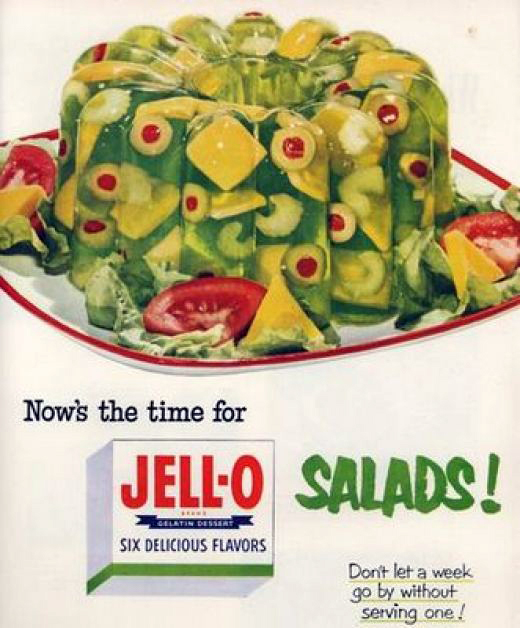
People were sorting their food by buoyancy. This was considered sophisticated.
The reason it happened was actually more interesting than the food itself. Food historian Laura Shapiro explains that around the turn of the century, many women in the emerging American middle class began linking the changes brought into their homes by industrialization to the domestic work they performed every day. This spirit of domestic reform embraced efficiency, purity, cleanliness, and order. Jellied salads, unlike tossed ones, were mess-free, never transgressing the border of the plate. In Shapiro’s words: a salad at last in control of itself.
In the 1950s, Jell-O salads were seen as a marker of sophistication, elegance, and status, indicating that a housewife had time to prepare Jell-O molds and that her family could afford a refrigerator. Owning a refrigerator was the flex. The Jell-O mold was proof you had one. Things had gotten completely out of hand, and Jell-O even introduced dedicated vegetable flavors including celery, Italian salad, and seasoned tomato, all discontinued by the mid-1970s when their popularity declined. Celery-flavored Jell-O existed. It was a product someone made and sold. People bought it.
By the mid-1970s, Jell-O salads had fallen out of fashion. Americans became more conscious of their sugar intake and grew wary of salads that tasted like candy. The rise of Julia Child and the popularization of French cooking in the United States made the Jell-O salad appear less elegant and frankly embarrassing. Julia Child killed it. Which means somewhere in the world a French cookbook is responsible for preventing untold quantities of mayonnaise-frosted vegetable gelatin from being eaten. Julia Child saved us. We did not deserve her.
I Made It. Here Is What Happened.
The recipe is genuinely simple, which almost makes it worse, because there is no complexity to hide behind. You dissolve gelatin in boiling water, add cold water, lemon juice, white vinegar, a teaspoon of sugar, and half a teaspoon of salt. Then you wait for it to partially set, fold in shredded cabbage, diced celery, red pepper, and chopped green olives, pour it into a mold or loaf pan, and refrigerate until firm. Then you unmold it. Then you put mayonnaise on top.
The unmolding is genuinely impressive as a physical event. It slides out in a single quivering mass and sits on the plate vibrating gently, the vegetables visible through the translucent gelatin like specimens in a laboratory sample. It looks exactly like what it is: a salad that has been trapped in something. The cabbage is in there. The celery is in there. The olives are in there. They are not escaping. They have been captured and set.
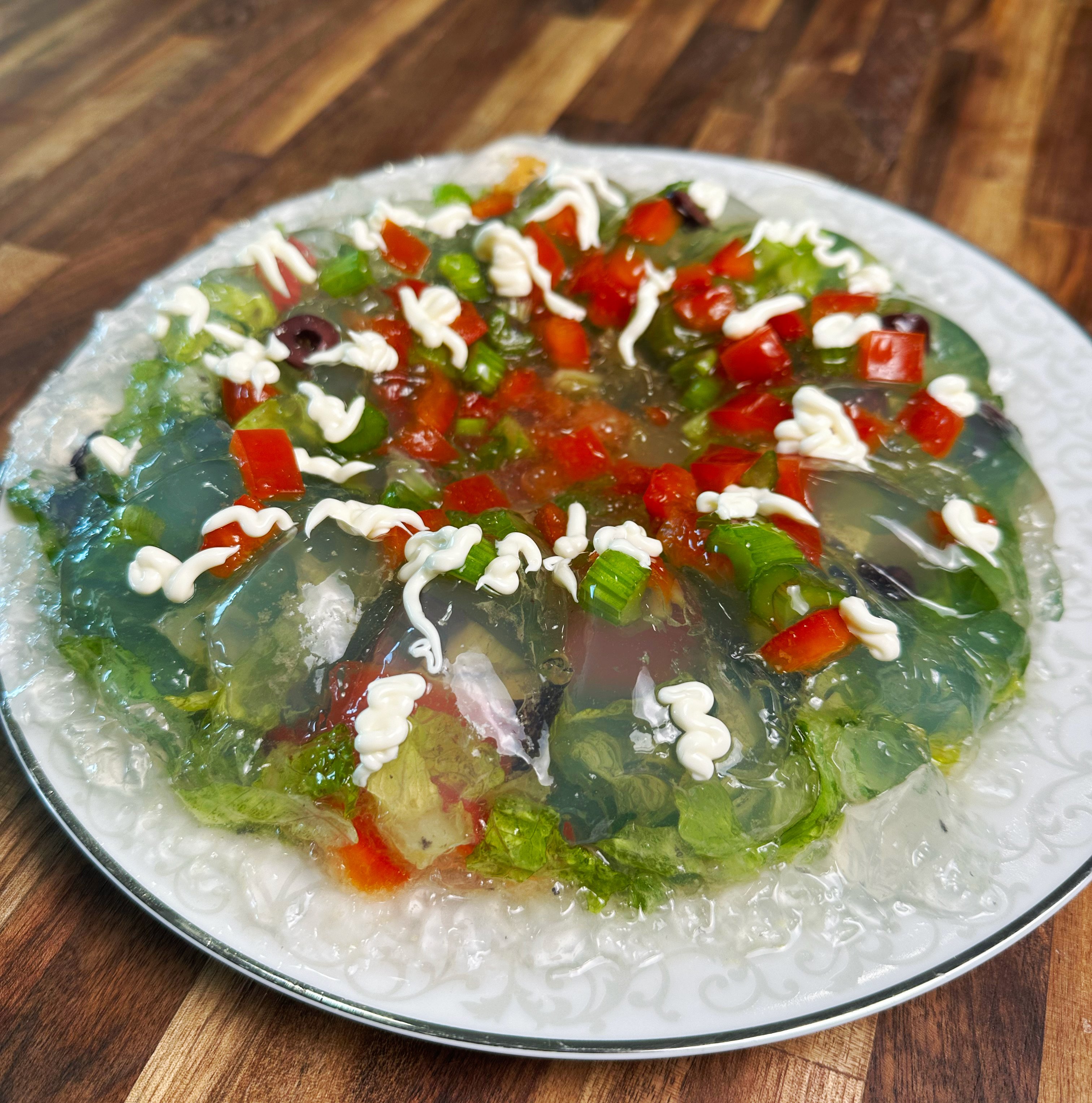
I spread the mayonnaise on top as instructed. Mrs. Cook served it this way. Fannie Farmer judged it this way. I did not feel good about it.
The smell, I want to say, is forward. The vinegar and lemon come through the gelatin in a way that is aggressively present. The texture on the palate is something I would describe as a cold, acidic shiver. The cabbage inside is still crisp, which you feel before you taste anything, which somehow makes everything worse. It is not unpleasant in any single dimension — the flavors individually are fine, the vegetables are fresh, the gelatin is well-set — but the combination is something your brain refuses to process as food. It keeps insisting it must be something else. It is not something else. It is Perfection Salad.
The Review: Zero Out of Ten, No Notes
Rating: 0/10.
I want to be fair to Mrs. Cook. She was not trying to make something delicious. She was trying to make something practical, pretty, and economical. Food historian Laura Shapiro has noted that flavor was never the point of the domestic science movement. The Jell-O mold valued cleanliness, order, and efficiency. It held its shape. It used up the cabbage. It did not make a mess. By the standards of 1904, this was a success.
By every other standard available to me, sitting in my kitchen holding a slice of vinegar coleslaw suspended in gelatin with mayonnaise on top, this is a 0 out of 10. There is nothing wrong with it technically. It is made correctly. It is exactly what it is supposed to be. That is precisely the problem.
James Beard, writing in his 1972 American Cookery, observed that Mrs. Cook’s third-place victory had “unleashed a demand for congealed salads that has grown alarmingly, particularly in the suburbs,” but grudgingly admitted the jellied salad does have its delights.
James Beard was a more generous man than I am. I found no delights. I found vinegar cabbage in a state of suspension. The sewing machine was the correct prize for this dish. I would also prefer a sewing machine.
The Recipe (If you dare)
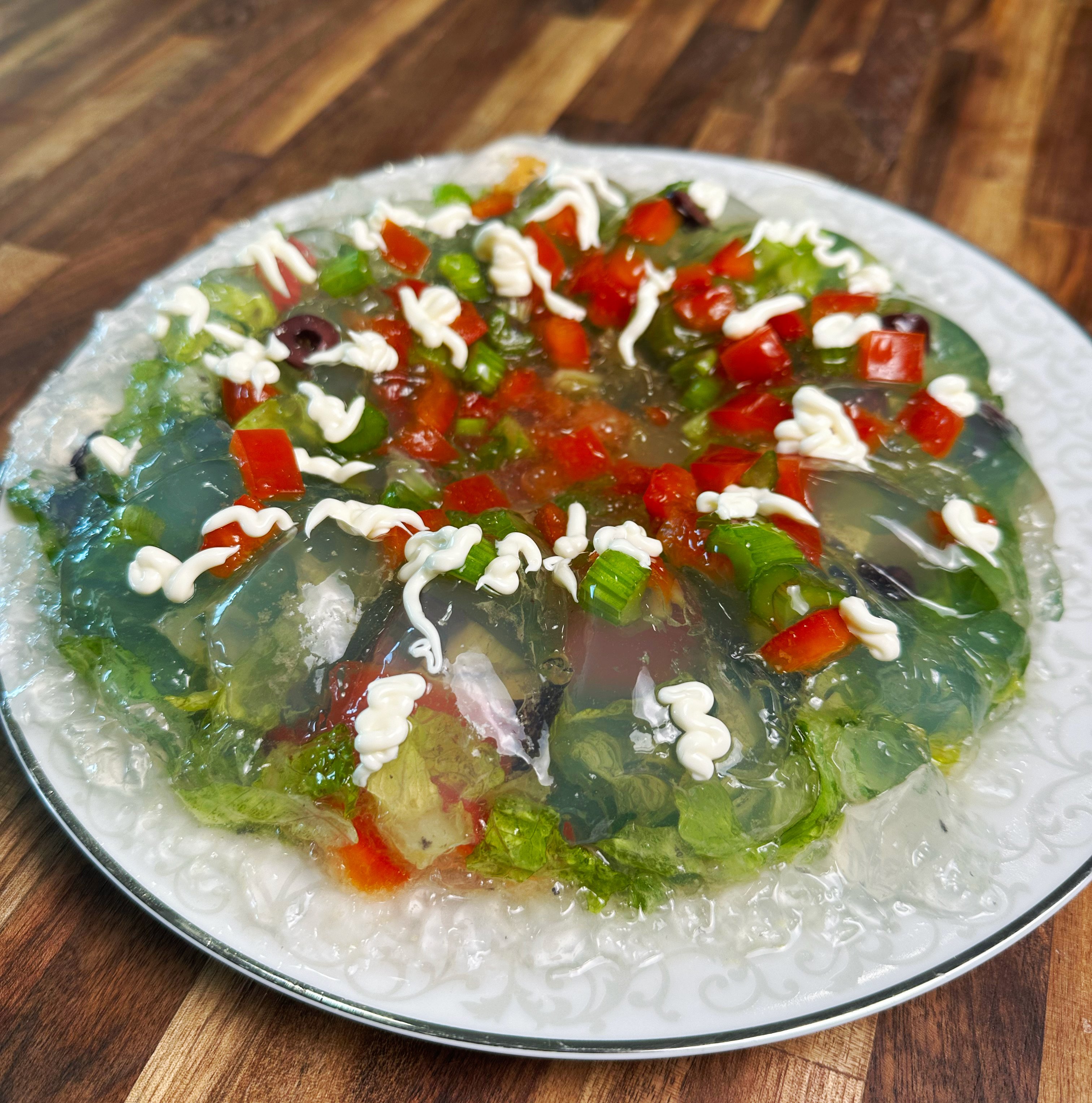
Perfection Salad – 1904
Ingredients
- 2 packet unflavored Knox gelatin
- 2 cup boiling water
- 2 cup cold water
- 2 tbsp lemon juice
- 2 tbsp white vinegar
- 1 tsp sugar
- ½ tsp salt
- 1 cup shredded cabbage
- ½ cup diced celery
- ¼ cup diced red pepper
- 2 tbsp chopped green olives
- Mayonnaise to serve
Instructions
- Dissolve the gelatin in the boiling water and stir until completely clear. Add the cold water, lemon juice, vinegar, sugar, and salt. Stir to combine. Refrigerate until the mixture begins to thicken to the consistency of unbeaten egg whites, about 45 minutes to an hour. Check it frequently. You want it thick enough to hold the vegetables suspended, not fully set.
- Fold in the cabbage, celery, red pepper, and olives. Pour into a lightly oiled loaf pan or mold. Refrigerate until fully set, at least 3 hours and ideally overnight.
- To unmold, run a thin knife around the edge, place a plate over the top, and invert. It will come out. Give it a moment. The unmolding is the best part of this dish, which tells you something.
- Spread mayonnaise on top before serving, as Mrs. Cook instructed. Serve with fried oysters if you want to do this properly. Serve with dignity if you still have any.
- The vegetables will be crisp. The gelatin will wobble. The vinegar will be present. Someone at the table will say “oh, interesting.” Nobody will ask for seconds.
- This was, in 1904, considered Perfection.
Video
Notes
- The Partial Set is Everything: Do not skip the partial setting step and do not rush it. If you pour the vegetables into fully liquid gelatin they will all sink to the bottom and you will end up with a clear gelatin cap on top and a vegetable brick on the bottom, which is somehow even less appealing than the intended result. You want the gelatin at the consistency of unbeaten egg whites — thick enough to hold the vegetables suspended throughout but still loose enough to pour. Check it every 15 minutes after the first half hour. It moves fast once it starts going.
- Oil the Mold: Lightly coat your loaf pan or mold with a neutral cooking spray or a thin wipe of vegetable oil before pouring in the mixture. This is the difference between a clean, dramatic unmolding and standing over your sink running warm water over a pan for ten minutes while the gelatin slowly loses its will to live. The unmolding moment is genuinely the highlight of making this dish. Do not sacrifice it by skipping the oil. Place your serving plate on top of the pan, flip it in one confident motion, and give it a few seconds. It will release. That wobble is everything Mrs. Cook was going for.
- Make It the Day Before: This dish is dramatically better after a full overnight set than after the minimum three hours. The flavors from the vinegar and lemon settle into the gelatin more evenly, the vegetables hold their crispness longer, and the structure is firm enough to slice cleanly rather than collapsing into a heap on the plate. It also means you can make it the day before whatever meal you are serving it at, which in 1904 was considered excellent domestic planning and in 2024 simply means you have one less thing to do on the day. Mrs. Cook herself noted it was practical. She was not wrong about that part.