There is a drink that Plato drank. Aristotle drank it. Cicero drank it. Marcus Aurelius drank it. Every one of them came out describing a revelation so profound it permanently altered their understanding of life and death. Every one of them kept their oath of secrecy and took the details to their graves.
The drink is called kykeon. The word means mixture in ancient Greek. The documented ingredients are barley, water and mint. The experience it produced inside the sanctuary at Eleusis, according to every ancient account, was unlike anything that could be achieved by those three ingredients alone.
I made the documented version. Toasted barley powder cooked with water, honey and fresh mint. It tastes like drinking minty oatmeal. I rated it 1.8 out of 10. Whatever was happening at Eleusis, I do not think this was the entire picture. Here is the full story.
The Sources: Where Kykeon Appears in the Ancient Record
Kykeon appears across a remarkable range of ancient Greek texts, in the Homeric works including the Iliad, Odyssey and Hymn to Demeter, in the medical books particularly the Corpus Hippocraticum, in Galen’s writings on its primary component alphita, and in comedy and satirical literature including Characters by Theophrastus and Peace by Aristophanes. The appearance of kykeon across such a diverse range of sources tells you that this was not an obscure ritual drink known only to initiates. It was a widely understood and widely consumed beverage that happened to also play a central role in the most important religious ritual in the ancient world.
The Iliad
The earliest documented appearance of kykeon in Greek literature is in Homer’s Iliad, composed around the 8th century BC. In Book 11, verses 635 to 641, a woman mixes kykeon for Nestor’s tired friends and the wounded Machaon, the son of Asclepius the god of healing. In this version the woman mixes Pramnian wine and grates over it a goat’s milk cheese with a brazen rasp and sprinkles white flour upon it, then bids them drink as soon as she has prepared the potion. This is kykeon in its everyday form, a nourishing mixture of wine, cheese and barley flour given to weary soldiers. There is nothing mysterious about it here. It is food.
The Odyssey
In the tenth book of the Odyssey, Circe the witch makes a kykeon spiced with dangerous herbs and honey for Odysseus’s companions. The influence of the drink transforms them into swine. This is the first documented suggestion that kykeon could be mixed with additional substances that produced extraordinary effects, a detail that would later become central to the academic debate about what was actually in the Eleusinian version.
The Homeric Hymn to Demeter
At the end of the 7th century BC a recipe for kykeon without wine appeared in the Homeric Hymn to Demeter, where it provides the mythological foundation for the consumption of kykeon at the Eleusinian Mysteries. The exact lines, 208 to 211, are the most important food-related passage in ancient Greek religious literature: she gave her kykeon to drink, having mixed barley-meal with water and tender pennyroyal. This is the recipe. Barley. Water. Pennyroyal mint. Three ingredients. The goddess Demeter, in her grief over the loss of Persephone, refused wine and accepted this instead. The initiates at Eleusis ritually recreated this moment every year for nearly two thousand years.
Galen and the Medical Tradition
The physician Galen, writing in the 2nd century AD, documents kykeon in his medical texts with specific attention to its primary component, which he calls alphita, meaning roasted barley powder. Variations included additions like goat cheese, honey, thyme or even wine, adapting it for different social contexts from everyday meals to symposia. Galen’s documentation confirms that kykeon existed on a spectrum from a simple everyday grain drink to an elaborately prepared ritual beverage, and that the barley was typically roasted before being ground into the meal that formed the base of all versions.
Aristophanes and Theophrastus
In Aristophanes’ Peace, Hermes recommends kykeon to the hero who ate too much dry fruit and nuts, noting its digestive properties. Theophrastus in his Characters depicts a peasant who goes to the public assembly drunk on kykeon. These comic references confirm that kykeon was sufficiently familiar to Athenian audiences that jokes about it needed no explanation, and that the line between a ceremonially prepared ritual drink and an everyday peasant beverage was not always clear.
The Eleusinian Mysteries: The Greatest Secret of the Ancient World
To understand kykeon’s role in the Eleusinian Mysteries it is necessary to understand what the Mysteries were, because they were unlike anything else in the ancient world and their influence extended far beyond the religious sphere.
The Eleusinian Mysteries were annual celebrations held in the autumn approximately twenty kilometres west of Athens at a sanctuary dedicated to the goddesses Demeter and Persephone. They were the most important religious rites in ancient Greece, celebrated continuously for nearly two thousand years from approximately 1600 BC until the sanctuary was destroyed by the Visigoth king Alaric in 396 AD. That is nearly two millennia of unbroken annual practice, making the Eleusinian Mysteries one of the longest continuously observed religious traditions in the history of Western civilisation.
The mythological foundation of the Mysteries was the story of Demeter and Persephone. Persephone, the daughter of Demeter the goddess of grain and harvest, was abducted by Hades and taken to the underworld. Demeter, devastated by the loss of her daughter, wandered the earth refusing to let anything grow. Famine threatened all life. Eventually Persephone was allowed to return to the upper world for part of each year, and in her joy Demeter allowed the earth to become fertile again. The seasons were born. The Mysteries commemorated this cycle of death and return, and the initiates who participated in them were understood to gain a special relationship with death, an understanding of what lay beyond it, and a freedom from the fear of mortality that marked the uninitiated.
The Mysteries were divided into the Lesser Mysteries, held in spring at Agrae, and the Greater Mysteries, held in late September and lasting nine days. Participation required prior initiation at the Lesser Mysteries. The Greater Mysteries began with a procession from Athens to Eleusis along the Sacred Way, a journey of approximately twenty kilometres that initiates made on foot, carrying torches and singing hymns. Before the culminating ritual, initiates underwent a period of fasting. After the nine-day fasting period initiates would utter the sacred formula: I have fasted, I have drunk the kykeon. The drinking of the kykeon was not incidental to the Mysteries. It was the central documented ritual act of the entire ceremony.
Who Attended
The attendees of the Eleusinian Mysteries constitute one of the most remarkable lists in the history of human intellectual life. Participation was open to any Greek speaker who had not committed murder, which meant the Mysteries crossed every social and class boundary that otherwise structured Greek society. Slaves and free people participated together. Men and women participated together. Greeks from every city-state participated together. The only requirement was initiation and the ritual purity established by the fasting and the procession.
The documented initiates include Plato, Aristotle, Sophocles, Pindar, Cicero, Marcus Aurelius, Hadrian and Alcibiades. Cicero wrote that Athens had given humanity nothing more valuable than the Eleusinian Mysteries. Sophocles described the initiates as thrice happy, those who have seen these rites before going to Hades, for they alone have life there. Pindar wrote that whoever has seen these things knows the end of life and its divine beginning. These are not the words of people who attended a disappointing ceremony.
What the Mysteries Revealed
Nobody who was initiated ever said precisely. The oath of secrecy sworn by every initiate was maintained with extraordinary consistency across two thousand years of participation by hundreds of thousands of people. No initiate ever published a direct account of what happened inside the Telesterion, the great hall at Eleusis where the culminating ritual took place. The silence is itself one of the most remarkable documented facts about the ancient world. Tens of thousands of people, including some of the most articulate and prolific writers in human history, saw something in that hall and chose to keep quiet about it for the rest of their lives.
What ancient sources do tell us is the emotional register of the experience. Words like revelation, transformation, altered relationship with death and the certainty of a good afterlife appear consistently. The experience inside the Telesterion was clearly visionary in character, producing states of consciousness that initiates described as unlike anything available through normal means. The question of how a drink of barley, water and mint produced those states is the question that has never been fully answered.
The Ergot Theory
In 1978 Albert Hofmann, the chemist who first synthesised LSD, co-authored a book called The Road to Eleusis with R. Gordon Wasson and Carl Ruck. Their argument was that the barley used in the kykeon was infected with ergot, a fungus that grows on grain and contains compounds chemically related to LSD. Hofmann demonstrated that ergot alkaloids could be extracted in water, which would make them available in the kykeon. The symptom profile of the initiates’ accounts, visionary experience, altered consciousness, a sense of profound revelation about death, aligns with what is known about the effects of ergot alkaloids when carefully dosed.
In the 2020s researchers found remains of ergot inside a ceremonial vase and in the dental tartar of an individual at a sanctuary in Spain associated with similar rites, the first direct chemical evidence supporting this hypothesis. The evidence is not conclusive and the theory remains contested among classicists. But the Spanish discovery is genuinely significant and represents the closest thing to physical proof of the ergot hypothesis that has yet been produced.
The honest position is that we do not know with certainty what was in the Eleusinian kykeon. We know its documented ingredients. We know the effects it produced. We cannot fully explain those effects with the documented ingredients alone. The gap between those two things is where the Eleusinian Mysteries have lived for two and a half thousand years.
My Version and My Honest Rating
I made the version documented in the Homeric Hymn to Demeter. Toasted barley, crushed into a coarse powder, cooked with water, honey and fresh mint, cooled and garnished with additional mint.
The result tastes like drinking minty oatmeal. It is thick, slightly grainy, mildly sweet from the honey and herb-forward from the mint. There is a slight nuttiness from the toasted barley that is not unpleasant. The overall experience is somewhere between a warm grain porridge and a herbal infusion and it is not something I would choose to drink voluntarily under normal circumstances.
Whatever Plato experienced at Eleusis after nine days of fasting, a twenty kilometre procession by torchlight, and intense ritual preparation in the sanctuary of Demeter and Persephone, I am confident it was more significant than what I experienced drinking minty oatmeal on a Tuesday afternoon in my kitchen. The preparation, the context, the fasting, the ritual, the belief, the community of hundreds of fellow initiates all contributed to whatever happened in that hall. The kykeon was the vehicle. The journey was everything else.
Rating: 1.8 / 10
The Recipe: Ancient Greek Kykeon
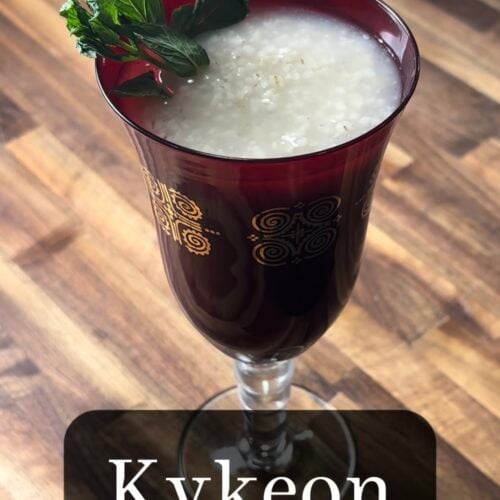
Ancient Greek Kykeon
Ingredients
- 4 tbsp pearled barley toasted then crushed to a coarse powder
- 2 cups water
- 1 tbsp raw honey
- Small handful of fresh mint approximately 6 to 8 leaves — the Homeric Hymn to Demeter specifies pennyroyal mint specifically, botanical name Mentha pulegium. Standard garden mint is the most accessible substitute. Pennyroyal is available at some herb nurseries if you want the historically precise version
- Extra fresh mint leaves for garnish
Instructions
Toast the barley
- Place the pearled barley in a dry heavy pan over medium heat. Toast, stirring constantly, for 5 to 7 minutes until the barley is golden brown and fragrant with a nutty aroma. Watch it carefully. It will go from golden to burnt very quickly in the final minutes. The toasting converts the starches in the barley and develops the characteristic nutty, malty quality that defines kykeon.
Crush the barley
- Allow the toasted barley to cool slightly. Transfer to a food processor or mortar and pestle and grind to a coarse powder. You are not aiming for a completely fine flour. A slightly rough, grainy texture is correct and historically accurate. The Greek term alphita refers specifically to coarsely ground barley meal rather than a fine flour.
Cook the kykeon
- Bring the water to a gentle simmer in a small saucepan. Add the crushed toasted barley powder gradually, stirring continuously as you add it to prevent lumping. The mixture will thicken as the barley powder hydrates. Add the honey and stir until dissolved. Add the fresh mint leaves and continue to cook gently, stirring, for 5 to 7 minutes until the mixture is smooth, slightly thickened and the mint has fully infused the liquid.
Cool and serve
- Remove from heat and allow to cool to room temperature or slightly below. The kykeon was consumed after breaking a long fast and would have been served at roughly room temperature or cool rather than piping hot. Remove and discard the mint leaves. Pour into cups or bowls. Garnish with fresh mint leaves. Drink slowly.
Video
Notes
- Pennyroyal mint, the specific variety documented in the Homeric Hymn to Demeter, has a significantly more intense, almost medicinal mint flavour than standard garden mint. It is worth sourcing if you want the most historically precise version. Note that pennyroyal should not be consumed in large quantities as it contains pulegone, which is toxic at high doses. The small amount used as a flavouring in this recipe presents no risk but do not use pennyroyal essential oil as a substitute.
- The honey is an addition drawn from the Odyssey version of kykeon rather than the Hymn to Demeter version, which specifies only barley, water and mint. Adding honey is historically documented in kykeon preparations and makes the drink considerably more palatable. Whether the Eleusinian version contained honey is not known.
- The nine-day fast is the element of context that my kitchen recreation most conspicuously lacked. Every ancient account of the transformative quality of the Eleusinian experience must be understood against the background of nine days of fasting, a twenty-kilometre procession by torchlight, and an intense ritual preparation in a sanctuary that had been operating as one of the most significant religious sites in the ancient world for over a thousand years before the initiate arrived. The kykeon was the final act of that preparation. How it tasted after nine days of fasting, in the middle of the night, in the great hall at Eleusis, surrounded by hundreds of fellow initiates and the full weight of ancient Greek religious culture, is genuinely impossible to replicate in a domestic kitchen on a Tuesday. The 1.8 out of 10 should be understood with that in mind.