I gotta be honest, this recipe is so simple and easy to make, I had to double-take when researching the recipes for this one. You look at the ingredient list, you think this cannot possibly be as good as people say, and then you make it, and you understand immediately why an entire country has been eating it at every birthday party and wedding for eighty years.
Brigadeiro is that recipe. Three ingredients, one pan, twenty minutes, and the result is something that tastes like a genuinely indulgent chocolate truffle. Rich, fudgy, slightly caramelised, rolled in chocolate sprinkles and placed in a small cupcake liner. It is simultaneously one of the easiest things I have made for this channel and one of the most satisfying to eat. I rated it 8.2 out of 10 and I mean that without qualification. The story behind it is equally good.
The Historical Setting: Post-War Brazil and the Condensed Milk Revolution
To understand where Brigadeiro came from you need to understand Brazil in the mid-1940s, because the specific historical moment produced the specific ingredients and the specific political context that made the sweet possible.
Brazil had been living under the Estado Novo, an authoritarian regime led by Getúlio Vargas, since 1937. Democratic elections had been suspended. In 1945, after eight years without genuine democratic participation, Brazil was preparing for its first free presidential election in over a decade, and it was historic for another reason: it was the first national election in which all Brazilian women could vote. The political energy in Rio de Janeiro, then the capital, was extraordinary.

At the same time, the aftermath of the Second World War meant that rationing was still affecting everyday life in Brazil. Fresh milk and refined sugar were scarce. Imported luxuries like nuts and dried fruits were difficult to obtain. What was abundantly available, and had been since Nestlé opened its first Brazilian factory in 1921, was sweetened condensed milk, sold under the Brazilian brand Leite Moça. By the 1940s condensed milk was a pantry staple across Brazil and the creative foundation of every resourceful home cook who needed to make something sweet without the ingredients that rationing had made scarce.
The condensed milk, the political moment and the scarcity of alternatives converged in the mid-to-late 1940s to produce something that could be made from what was available, transported without refrigeration, sold at campaign rallies and parties, and eaten in a single satisfying bite. The Brigadeiro was born from the intersection of wartime resourcefulness and democratic enthusiasm, which is a more interesting origin story than most confections can claim.
The Campaign: Eduardo Gomes and the Sweet That Outlasted the Election
One of the presidential candidates in the 1945 election was Eduardo Gomes, an Air Force officer with the military rank of brigadier, which in Portuguese is brigadeiro. Gomes was already a national figure before his candidacy, having survived a famous military uprising in 1922 on Rio de Janeiro’s Copacabana beach in which nearly all of his fellow officers were killed. He was known as O Tenente, the lieutenant, and later as O Brigadeiro, and he had a reputation as a handsome bachelor that his campaign was happy to exploit. The campaign slogan, coined by his women supporters, was vote no brigadeiro bonito e solteiro, vote for the brigadier who is handsome and single.

The women who supported Gomes began selling a chocolate condensed milk sweet at his campaign rallies and fundraising parties. The popular and most widely told account credits a Rio de Janeiro confectioner named Heloísa Nabuco de Oliveira with creating the specific recipe to support the campaign. More cautious food historians note that the first known published recipe specifically called Brigadeiro appeared in O Cruzeiro magazine in 1949, four years after the election, written by Helena B. Sangirardi, who presented it as an already existing sweet rather than a new creation. The most honest assessment is that the sweet emerged from Brazilian home cooking in the 1940s, probably predating the campaign somewhat, and became permanently associated with Gomes’s name through the fundraising rallies and the catchy campaign slogan.
What is not disputed is the outcome. Eduardo Gomes lost the election to Eurico Gaspar Dutra. The Brigadeiro won everything else.
How Brigadeiro Took Over Brazil
The trajectory from campaign sweet to national icon is straightforward once you understand what the Brigadeiro offered. It required no oven. It needed only three ingredients that were widely available even under rationing conditions. It could be made in a single pan on a stovetop in under twenty minutes. It transported without refrigeration. It was inexpensive enough to serve at a children’s birthday party and delicious enough to serve at a wedding. And it tasted extraordinary.
Brazilian birthday culture embraced it completely. By the 1950s a children’s birthday party without Brigadeiro was unthinkable. The rolls of fudge-coated chocolate spheres arranged in small paper cups became as definitional to Brazilian birthday celebrations as the cake itself, and in many homes more so. The custom of making Brigadeiro at home as a family activity, rolling the warm fudge mixture into balls together, became a ritual embedded in the experience of Brazilian childhood in a way that has not diminished across three generations.

The gourmet variation emerged in the 1990s and 2000s as Brazilian confectioners began treating the Brigadeiro with the same creative ambition that pastry chefs applied to European truffles and pralines. Specialty Brigadeiro shops, brigaderias, opened across Brazilian cities selling variations flavoured with passion fruit, pistachio, guava, coffee, lemon, strawberry, sea salt, peanuts and dozens of other combinations, all built on the same three-ingredient base of condensed milk, butter and cocoa. The original three-ingredient recipe spawned a gourmet industry. Today over fifty documented variations exist in Brazilian restaurants and specialty shops, and the Brigadeiro has spread internationally through Brazilian diaspora communities across the United States, Europe and Japan, where it is increasingly recognised as one of the defining examples of Brazilian culinary culture.
The campaign sweet invented to elect a handsome brigadier who lost his election in 1945 has become one of the most internationally recognised Brazilian foods in the world. Eduardo Gomes is a footnote. The Brigadeiro is a national institution.
My Rating
I want to be direct about what surprised me here. I went into this recipe expecting something pleasant and simple. What I got was genuinely, unexpectedly indulgent in a way that four-ingredient recipes almost never are.
The texture is the revelation. The slow cooking of the condensed milk with cocoa and butter produces a fudge that sets firmly enough to roll but remains yielding and almost creamy in the mouth rather than waxy or grainy the way commercial chocolate truffles often are. The flavour has a caramelised depth from the condensed milk that plain chocolate ganache does not produce, a faint sweetness that sits underneath the cocoa rather than competing with it. The chocolate sprinkle exterior adds a faint crunch and a textural contrast that makes each bite more interesting than it would be plain.
For as simple as these are they really do taste like indulgent chocolate truffles. The comparison is not an exaggeration. If you served these at a dinner party without identifying them as three-ingredient condensed milk sweets, most people would assume they were something considerably more technically demanding.
Rating: 8.2 / 10
The Recipe: Brazilian Brigadeiro
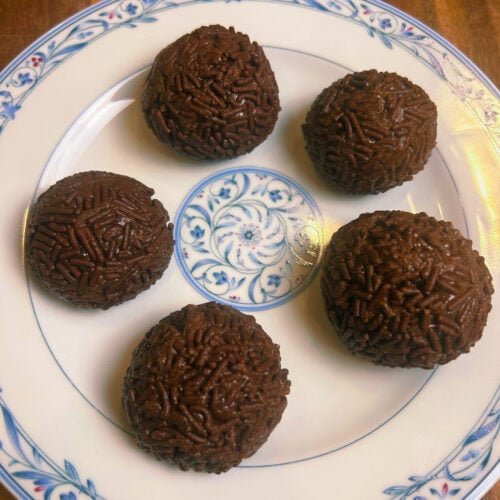
Brazilian Brigadeiro
Ingredients
- 1 can sweetened condensed milk 14 oz — Nestlé’s Leite Moça is the historically specific Brazilian brand and still the most widely used. Any full-fat sweetened condensed milk works
- 3 tbsp unsweetened cocoa powder sifted — sift it to prevent lumps. The quality of the cocoa matters more than in most recipes because the flavour is so concentrated. Use the best Dutch process cocoa you can find
- 1 tbsp unsalted butter plus a little extra for your hands when rolling
- Chocolate sprinkles for coating — the traditional Brazilian coating. Finely chopped nuts desiccated coconut or cocoa powder are documented alternatives
Instructions
Cook the brigadeiro
- Combine the condensed milk, sifted cocoa powder and butter in a medium heavy-bottomed saucepan over low heat. The heat must be low throughout the entire cooking process. High heat will cause the mixture to scorch on the bottom and produce a grainy, burnt result that cannot be corrected.
- Stir continuously with a wooden spoon or heat-resistant spatula, scraping the bottom and sides of the pan constantly. Do not stop stirring. The mixture will look thin and liquid for the first several minutes and then begin to thicken noticeably around the 10 to 12 minute mark.
- The brigadeiro is ready when you drag your spatula through the centre of the mixture and it holds a clear trail for 2 to 3 seconds before slowly filling back in. The mixture should also begin to pull away slightly from the sides and bottom of the pan. This typically takes 15 to 20 minutes over low heat. Do not rush it by increasing the heat.
Cool completely
- Transfer the cooked brigadeiro mixture to a lightly buttered plate or shallow dish and spread into an even layer approximately 1cm thick. Allow to cool to room temperature, then refrigerate for at least 1 hour until completely firm and cold. The mixture must be fully cold before rolling or it will stick to your hands and lose its shape.
Roll and coat
- Spread the chocolate sprinkles on a shallow plate. Lightly butter your hands to prevent sticking. Scoop approximately one tablespoon of the chilled brigadeiro mixture and roll quickly between your palms into a smooth ball. Roll the ball immediately in the chocolate sprinkles until completely coated. Place in a small paper cupcake liner. Repeat with the remaining mixture.
Serve and store
- Serve at room temperature for the best texture. Brigadeiros stored in the refrigerator will be firmer and slightly less yielding than at room temperature. Store in an airtight container at room temperature for up to two days or refrigerated for up to one week. They can be frozen for up to six months.
Video
Notes
- The continuous stirring is not optional and cannot be interrupted. Leaving the pan unattended for even a minute will result in a scorched bottom layer that flavours the entire batch with a bitter burnt note. Set a timer, stay at the stove and stir.
- Low heat throughout is equally non-negotiable. The condensed milk will burn at temperatures that seem moderate on a standard stovetop. If you see any darkening or smell anything scorching, remove from heat immediately, reduce your burner, and continue.
- The quality of the cocoa powder has an outsized effect on the finished flavour because the recipe is so simple that there is nothing else to mask a mediocre cocoa. Dutch process cocoa produces a smoother, deeper, less acidic chocolate flavour than natural cocoa and is the standard choice in Brazilian Brigadeiro recipes.