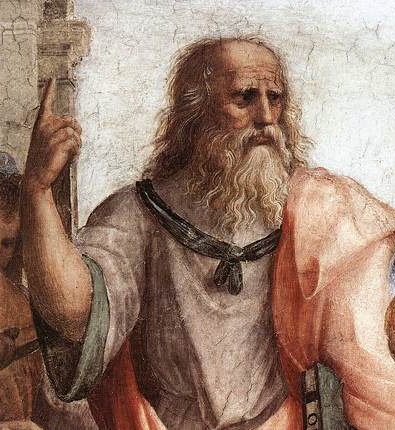
Plato never wrote a cookbook, but in The Republic he gave us one of the most enduring images of food in history. He described what he called the “healthy city,” a community sustained not by luxury but by simple meals shared among citizens. Instead of feasts and banquets, he pictured a table of barley bread, olives, cheese, beans, onions, and a little wine. It was food that nourished without excess, and for Plato, it symbolized justice itself.

Food in this vision was not a distraction or indulgence. It was a foundation. Families would gather to break bread and share conversation, strengthening the bonds of community. Plato saw this simplicity not as poverty, but as the proper diet of a people who lived in harmony with themselves and with nature. A healthy city was built on humble meals and steady moderation, not extravagant banquets.
By beginning with food, Plato signaled something larger. He understood that the way a people eats reflects the way a people lives. His ideal diet was more than sustenance. It was philosophy on a plate.
The Healthy City
Plato’s description of the healthy city is clear. He writes that the citizens will “feast on barley-meal and wheat-meal, baking the noble barley-cakes and kneading loaves of wheat-flour” (Republic, 372a). With their bread they will enjoy “relishes of salt, olives, cheese, onions, greens, and figs” (Republic, 372b). It is a vision of abundance without extravagance, a diet that sustains but never overreaches.

In this city, wine is permitted but carefully measured, enough to bring joy but not enough to breed excess. There are no sauces or spices to stimulate desire, no meat feasts to inspire indulgence. Instead, there is a rhythm of balance. The city is not poor, but neither is it chasing luxuries. It is, in Plato’s words, healthy.
What makes this description remarkable is how ordinary it sounds. Yet that ordinariness is the point. Plato was holding up simplicity as the true key to a just and sustainable society. A civilization that keeps its appetites in check can avoid the fever of greed and ambition.
Glaucon’s Objection and Plato’s Warning
Plato’s student Glaucon could not resist mocking this idea. He scoffed that such a diet would leave people living “like pigs.” To him, the absence of delicacies meant the absence of dignity. Surely a city needed luxury, music, fine dining, and extravagance to be worth living in.

Plato’s reply was sharp. Once you add luxury, he said, you create what he called a “fevered city” (Republic, 372e). This city, full of appetite, cannot contain itself. Its citizens want more, eat more, and demand more. With that demand comes expansion. Fields must be taken, neighbors must be conquered, wars must be fought. In the quest for abundance, justice dissolves.
The argument is not really about bread or cheese. It is about desire. A civilization that does not restrain its appetites will inevitably overreach. What begins with indulgence ends with conquest. Plato warned that the collapse of societies often begins at the dinner table.
Food as the Mirror of Civilization
Plato understood that food is more than fuel. It is a mirror of how we live together. A simple diet reflects balance with nature and community. A diet of excess reflects imbalance and instability. The health of the body and the health of the state are linked.
He argued that unchecked hunger leads to unchecked ambition. Citizens who demand feasts will demand luxuries in every part of life, and their leaders will be tempted to provide them, even at the cost of justice. What seems like harmless indulgence eventually reshapes politics and society. Appetite becomes policy.
Seen this way, food becomes philosophy. The barley cake and the olive are not just dishes. They are symbols of moderation and balance. Plato’s diet was a lesson in how restraint at the table nurtures restraint in the soul, and how restraint in the soul nurtures justice in the state.
Lessons for Our Modern World
When we look at our own society, it is hard not to see Plato’s prophecy. Our grocery stores are filled with processed sugars and endless rows of packaged indulgences. Our fast-food chains stretch across nations, selling abundance that leaves us both overfed and undernourished. Our waste bins overflow with untouched meals.

By Plato’s measure, we do not live in the healthy city. We live in the fevered one. We are surrounded by abundance, but never satisfied. The endless pursuit of more strains our environment, our economies, and even our politics. Comfort becomes expectation, and expectation becomes demand.
Plato’s words cut through time with startling relevance. He warned that appetite without restraint leads to conflict, and our modern struggles with climate, resources, and inequality show the truth of his vision. Our diet tells the story of our civilization, and it is not a flattering one.
Moderation as Philosophy
Plato’s ideal diet was never about calories or nutrients. It was about moderation. Bread, cheese, olives, and figs are symbols of living within the limits of what the earth offers. They represent a way of life rooted in balance, humility, and respect.
As he put it, “when excess and luxury prevail, they breed injustice” (Republic, 373d). By keeping the table simple, he believed we could keep the soul simple. A soul trained in moderation would not be ruled by passion or greed, and a state led by such souls would be just.
This is why Plato began his discussion of the ideal society with food. To him, the stomach was the foundation of the soul, and the soul was the foundation of the state. If you wanted to build a just city, you had to begin with a just meal.
My Recreation of Plato’s Meal
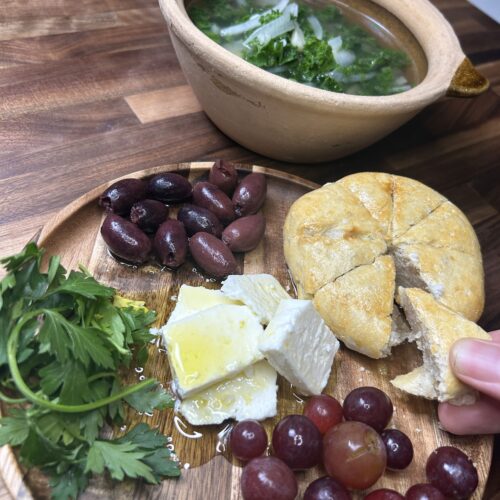
To bring this vision to life, I recreated what such a humble Ancient Greek meal might have looked like. I baked a small barley cake, rustic and earthy, made from barley flour, olive oil, water, and a little salt. It was simple but filling, the kind of bread that sustained ancient families for centuries.
Alongside the bread, I made a vegetable soup of onion, garlic, and kale. It is not rich or spiced, but it is nourishing and grounding. To the table I added some feta cheese drizzled with olive oil, a bowl of briny olives, fresh grapes, and a handful of parsley for fragrance and freshness.
Taken together, this plate is not a feast. It is a meditation. It reflects the idea that food need not overwhelm the senses to be satisfying. It feeds the body while reminding the soul of the virtue of balance. I gave it a solid 7.6/10.
My Takeaway: Plato’s Prophecy on a Plate
Plato’s diet is not a prescription. He was not telling every city to live on barley and olives. He was pointing to a principle: that moderation sustains civilizations, and indulgence destroys them. Food was his metaphor for justice, and appetite his metaphor for power.
When we eat with restraint, we live with restraint. When we eat with excess, we live with excess. Over time, the excess of the table becomes the excess of the state. The collapse of civilizations often begins with something as ordinary as dinner.
So when we sit at the table today, Plato invites us to see more than what is on our plate. He asks us to see the reflection of our civilization. Are we healthy, or are we fevered? Are we balanced, or are we consuming ourselves? The answer might be found in a simple loaf of barley bread and a handful of olives.
If you’re enjoying my recipes, check out Eats History Shop!
Recipe: Plato’s Ideal Meal
Plato’s Ancient Greek Meal
Ingredients
Barley Cake
- 1 cup barley flour
- 2 tablespoons olive oil
- ½ teaspoon salt
- ¼ –⅓ cup water enough to form a dough
Vegetable Soup
- 1 medium onion chopped
- 2 cloves garlic minced
- 2 cups kale chopped
- 1 tablespoon olive oil
- 3 cups water or light vegetable broth
- Salt to taste
Accompaniments
- 4 oz feta cheese
- 1 tablespoon olive oil to drizzle over feta
- ½ cup olives
- 1 cup fresh grapes
- Fresh parsley for garnish
Instructions
- Make the Barley Cake: Mix the barley flour, olive oil, salt, and water into a soft dough. Flatten into a small cake and cook on a hot skillet or bake until firm and lightly browned.
- Cook the Soup: Heat olive oil in a pot and sauté onion and garlic until softened. Add kale, broth, and a pinch of salt. Simmer until the greens are tender.
- Prepare Accompaniments: Drizzle olive oil over the feta cheese. Plate with the cheese, olives, grapes, and parsley.
- Serve: Arrange everything together for a balanced meal that reflects Plato’s vision of the “healthy city.”