In the twilight of the Late Bronze Age, a mysterious force swept across the eastern Mediterranean, leaving shattered cities and collapsed empires in its wake. They were known only as the Sea Peoples—raiders, migrants, or conquerors who appeared suddenly around 1200 BCE. To this day, historians debate who they were and where they came from. But their impact was undeniable. They helped bring down the great powers of the ancient world—and ushered in the Iron Age.
I’ve always been fascinated by the collapse of civilizations. What causes an empire to fall? In the case of the Bronze Age, it wasn’t just one thing. Earthquakes, climate change, invasions, and internal unrest all played a part. But one of the most visible and violent elements of that collapse was the arrival of the Sea Peoples. Their raids were recorded in stone and echoed across centuries of silence.
This recipe is my tribute to that chaotic and transformative period. While we can never know exactly what the Sea Peoples ate, we can draw from archaeological digs and cultural continuities in the Levant and Mediterranean. What we’re left with is a dish that feels ancient: rustic lentils simmered with onions and garlic, a flaky white fish steamed atop the stew, and a flatbread to scoop it up with your hands. It’s not fancy, but it speaks of endurance and simplicity.
They Came from the Sea
In Egyptian inscriptions, they are called the “peoples of the sea,” a coalition of warriors and families who attacked by land and ship. Their sudden arrival threw the great kingdoms of the time into disarray. Ramesses III carved a vivid account into the walls of Medinet Habu around 1177 BCE, describing how the Sea Peoples “burned the cities” and how “no land could stand before their arms.” These weren’t isolated raids. They were waves of coordinated attacks that disrupted every trade route in the eastern Mediterranean.
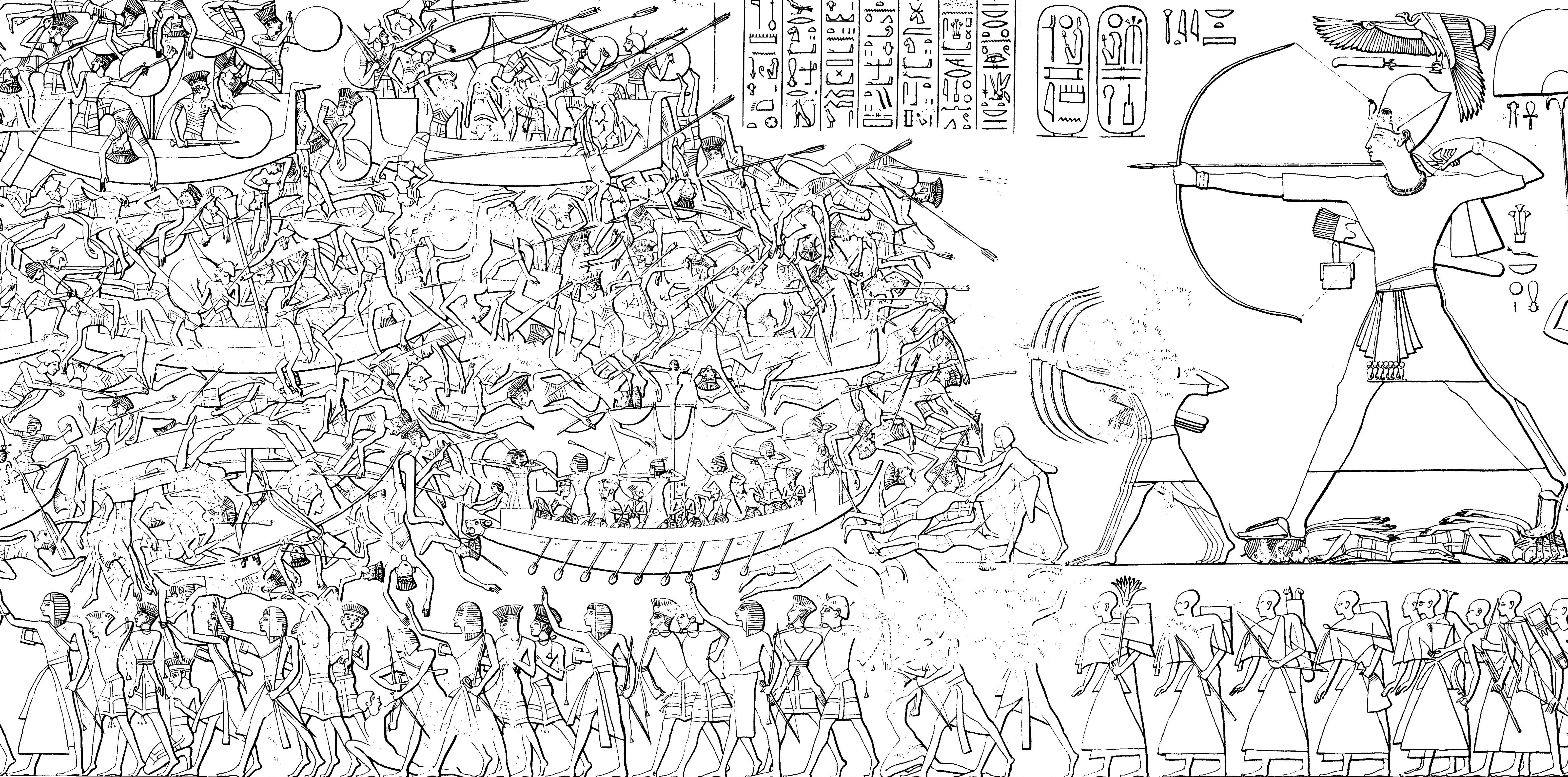
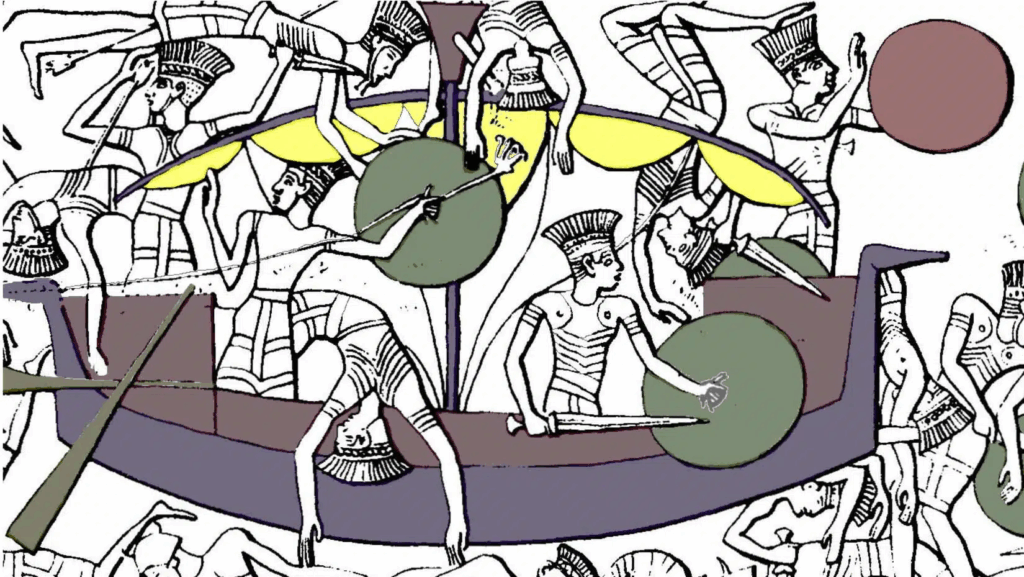
They came in oared ships with high prows and carried round shields and short swords. Their invasion patterns stretched from Anatolia down the Levant coast into Egypt. Ugarit, a thriving port city in modern Syria, was one of the many Bronze Age cities reduced to ashes. The tablets found there, frozen in fire, reveal desperate pleas for help—too late to be answered.
The Sea Peoples didn’t just pillage; they tried to settle. Many brought their families, animals, and belongings. This is what made them especially dangerous. They weren’t just pirates; they were migrants, possibly fleeing their own homelands which had fallen into famine or civil war. Their movement was like a tsunami—unrelenting, transformative, and beyond the capacity of any single empire to contain.
What makes their story even more compelling is that they were, in many cases, absorbed into the very lands they invaded. Some became the Philistines, others possibly settled in Sicily or Sardinia. They came as destroyers, but many stayed as farmers and traders. Their meals, then, likely adapted to the ingredients and traditions of the regions they now called home.
The Mystery of Their Identity
Who were they? That question has haunted historians for over a century. The Sea Peoples are mentioned in Egyptian, Hittite, and Levantine records, but always as outsiders but were never self-named. They may have been displaced Mycenaean Greeks, Luwians from Anatolia, or people from the Balkans. Some theories even suggest Trojan refugees following the destruction of their city.
Their names—Sherden, Shekelesh, Peleset, and others all appear in Egyptian texts, but we don’t know exactly what those labels meant. Some were likely pirate clans. Others may have been organized confederations. The Philistines, for example, are believed to be one Sea People group who settled in Gaza and Ashkelon, where they established fortified cities and distinctive pottery styles.
Archaeological digs at Ashkelon, Ekron, and Tell es-Safi have uncovered evidence of cultural blending. Pottery styles resembling Mycenaean ware appear alongside local Canaanite forms. Large hearths and domestic structures suggest permanent settlement. This hints at a complex story—one where conquest evolved into coexistence and new societies emerged from the rubble of the old.
What we can be sure of is this: they changed the world. They destroyed some of history’s earliest empires, but they also helped shape the cultures that followed.
The End of the Bronze Age
The Bronze Age had vast trade routes stretched from Mesopotamia to Egypt, from Cyprus to the Aegean. Tin and copper flowed like rivers, feeding the demand for bronze tools and weapons. Cities like Ugarit, Troy, and Hattusa were part of an international web. When the Sea Peoples arrived, that web collapsed.
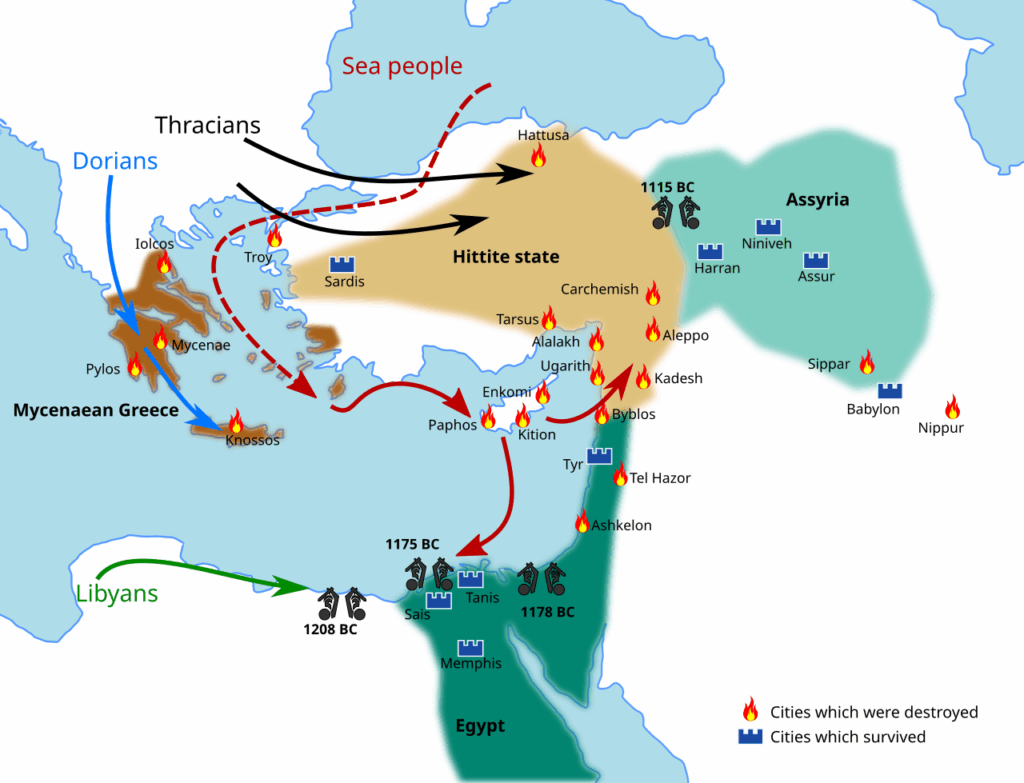
What followed was a dark age. Writing systems disappeared. Monumental architecture ceased. It would take centuries for literacy and statecraft to return to their former heights. It’s no exaggeration to say that the Sea Peoples helped pull the curtain down on an entire era. From their landing in the Levant to their battles with the Egyptians, their shadow looms over the story of the ancient world.
Yet in this destruction, seeds of new civilizations were sown. The Greeks, Israelites, and Phoenicians emerged in the Iron Age that followed. New agricultural systems and regional powers developed. What we call “the collapse” may also have been a transformation, a necessary fall before the rise of the classical world.
What Did the Sea Peoples Eat?
They didn’t leave behind cookbooks, but their trash heaps did. Archaeological sites in ancient Philistine cities have yielded fish bones (especially tilapia), lentil remains, barley, and cooking implements like clay ovens and hearths. Analysis of storage jars and carbonized seeds suggests a Mediterranean diet rich in legumes, grains, and small fish.
Lentils were one of the earliest domesticated crops in the Levant, and they’ve remained a staple ever since. They’re cheap, easy to grow, and full of protein. Combining them with fish from the nearby sea would have created a complete and satisfying meal. Clay pots uncovered at Ashkelon show burn patterns consistent with stewing, a technique that would tenderize legumes and flavor them with fish or bone broth.
Flatbread was ubiquitous. Barley was easier to grow than wheat and could be ground into flour, mixed with water and fat, and cooked on stones or in rudimentary ovens. Bread was likely eaten with every meal, sometimes used as a scoop, sometimes dipped into stews, and sometimes stuffed with whatever foraged herbs or dried fruits were available.
Food tells us not only what people had access to, but how they lived. The Sea Peoples likely ate on the move or in temporary encampments. Their meals had to be portable, hearty, and efficient. But once they settled, these foods became part of the culinary DNA of the region, surviving in the hummus, pita, and fish stews of today.
Tasting a Lost Civilization
The flavors are earthy and grounding. The lentils carry a mellow sweetness from the garlic and onion. The fish, steamed gently on top, falls apart with the lightest touch. And the flatbread? It’s the perfect vehicle: chewy, nutty, and just rustic enough to feel ancient.
Food like this feels primal. You don’t eat it with utensils. You tear and scoop and slurp. You lean in. It’s the kind of meal you imagine eating outdoors, by firelight, surrounded by stone and silence. It doesn’t pretend to be modern. It doesn’t try to be fancy. It’s survival food—and celebration food—all at once.
I give this dish a 7.6/10. It’s not spicy, not complex—but it’s deeply satisfying and easy to imagine being served by someone thousands of years ago who never imagined we’d still remember their impact. Through this stew, we remember the legacy of The Sea Peoples.
If you’re enjoying my work check out the Eats History Shop!
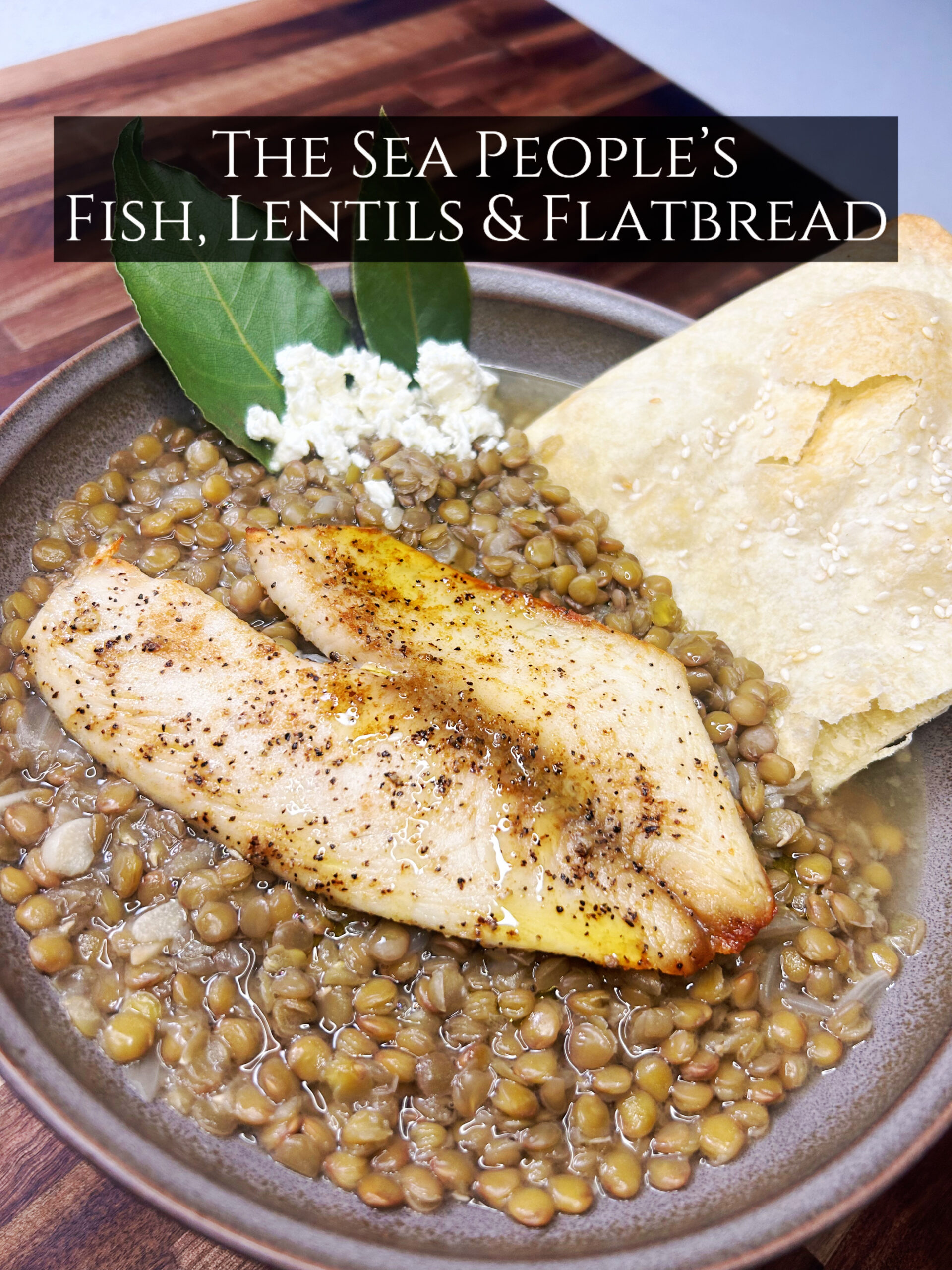
Sea Peoples Fish Stew with Flatbread
Ingredients
Stew & Fish
- 1 fillet firm white fish tilapia or seabass recommended
- 1.5 cups lentils
- 2 tbsp olive oil or animal fat
- ½ onion chopped
- 3 garlic cloves minced
- 1 tsp coriander seed ground
- Salt & cracked black pepper to taste
- ~2 cups water
Ancient Flatbread
- 1 cup barley or all-purpose flour
- ½ tsp salt
- 2 tbsp olive oil or animal fat
- ~¼ cup water more if needed
- Optional: sesame seeds for garnish
Instructions
Prepare the Stew Base
- In a medium clay or heavy-bottomed pot, heat 2 tablespoons olive oil or animal fat over medium heat. Add chopped onion and garlic and sauté for 5–7 minutes until softened and fragrant. Stir in the lentils, ground coriander seed, salt, and pepper. Toast briefly, then add about 2 cups water—just enough to cover the lentils by an inch.
- Simmer uncovered for 20–25 minutes, stirring occasionally, until the lentils are tender and much of the water has reduced.
Bake the Fish
- After seasoning the fish with coriender, salt, and pepper- bake at 350 for 20-25 minutes until golden.
Make the Ancient Flatbread
- While the stew is cooking, combine flour and salt in a bowl. Add olive oil or animal fat and mix until crumbly. Slowly pour in the water, kneading until a soft dough forms. Add more water if the dough feels dry.
- Divide into 2–3 small balls, flatten each into a disk with your hands, and cook on a hot dry skillet or griddle over medium-high heat for 2–3 minutes per side, until blistered and golden. Sprinkle with sesame seeds while warm, if using.
Plate and Serve
- Spoon lentils into a shallow bowl, place the baked fish fillet on top, and serve with a side of hot flatbread. Optionally, garnish with fresh herbs (fennel fronds or wild thyme) for a photogenic touch.
Video
Notes
- Choose the Right Fish: Tilapia or seabass are ideal, as they replicate the firm, white Mediterranean fish likely used in the region during the Bronze Age. Avoid overly oily fish like salmon.
- Barley for Authenticity: If possible, use barley flour instead of all-purpose flour in the flatbread to stay true to what Sea Peoples or Philistines would have had access to. Barley has a coarse, nutty flavor that suits ancient recipes.
- Cookware Tip: Cooking in a clay pot or cast iron gives the stew a smoky, rustic depth—closer to how it would have tasted when simmered over open flame in 1200 BCE.
Sources & Further Reading:
- Ramesses III’s Inscriptions at Medinet Habu
- Translation of Egyptian records detailing the Sea Peoples’ invasion.
- The Epigraphic Survey. Medinet Habu, Volume 1–5. Oriental Institute of the University of Chicago.
- Eric H. Cline – 1177 B.C.: The Year Civilization Collapsed
- A highly recommended read that explores the Late Bronze Age collapse, the Sea Peoples’ invasions, and their effect on ancient Mediterranean powers.
- Nancy K. Sandars – The Sea Peoples: Warriors of the Ancient Mediterranean (1250–1150 BC)
- One of the most comprehensive studies on who the Sea Peoples were, their origins, and archaeological traces.
- Assaf Yasur-Landau – The Philistines and Aegean Migration at the End of the Late Bronze Age
- A deep dive into archaeological finds that connect the Sea Peoples with Aegean and Anatolian cultures.
- Seeden, Helga. “Food and Cooking in Ancient Levant.”
- Discusses common dietary elements of coastal Levantine populations during the Late Bronze Age.