
History has plenty of eccentric eaters, but Kim Jong Il stands in a category of his own. While millions of his people endured hunger during the Arduous March famine of the 1990s, Kim was cultivating one of the most extravagant and unusual diets of any modern leader. He was obsessed with perfection, with excess, and with presentation.
His meals were not just about nourishment but about image, prestige, and power. His dining table became an extension of his rule, a place where the sharpest contrast between his lifestyle and that of his citizens was made clear. Today, we are going to look at how Kim’s quirks defined his palate and then recreate one of his favorite dishes in an ethical way: mock shark fin soup.
If you’re enjoying my recipes, check out Eats History shop, all my e-cookbooks are 40% off!
The Global Grocery List
Kim Jong Il’s grocery bill read like a world tour. In an era when most North Koreans were surviving on wild grasses, tree bark, and meager rations, Kim dispatched buyers across continents to secure the finest delicacies. His personal agents returned with Chinese melons, Uzbek caviar, Czech beer, and Danish pork. He enjoyed tropical fruits from Southeast Asia at a time when refrigeration and transport were luxuries few in the country could dream of.
Next week
I cook these before I write them. Some of it never makes the post.
The failures, the source documents, the version that actually tasted good. That part goes out by email, and next week’s is already on the stove.
 Written and cooked by Donnie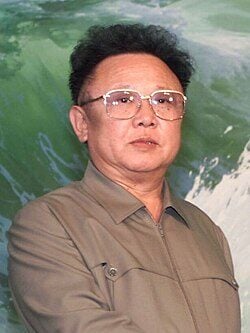
The most striking of these indulgences was his love of sashimi. Kenji Fujimoto, his Japanese sushi chef, recalled Kim’s insistence on live fish being brought to his table so he could savor sashimi prepared moments after the catch. His favorite was toro, the fatty belly of tuna prized in Japanese cuisine, which was nearly impossible to acquire regularly in famine-stricken North Korea. And then there was shark fin soup, a dish once tied to wealth and honor in Chinese banquets. Kim had it served to himself and his son, Kim Jong Un, multiple times a week, as though rare fins were as common as a bowl of rice.
A Cellar to Make the French Blush
Kim’s taste for drink was as elaborate as his meals. Reports claim his wine cellar contained as many as 10,000 bottles of French wines and brandies, and he was said to be one of Hennessy’s biggest customers worldwide. This habit of stocking rare vintages was not merely for pleasure, it was also for signaling prestige. Serving a Bordeaux or a glass of cognac at banquets gave the appearance of refinement, a way to show foreign guests that he could match their sophistication.
The irony is sharp. North Korea’s local alcohol culture is proud and varied. Makgeolli, a cloudy rice beer, and local soju are common among the people, while beer brewed domestically fills the mugs in working-class homes. Yet the man at the top turned his back on local brews in favor of the vineyards of France. His love of imported alcohol demonstrated both his personal indulgence and his distance from the everyday lives of his people.
Fast Food with a Dictator’s Twist
Kim’s palate was not limited to rare fish and French vintages. He also developed a taste for Western fast food. After his sons sampled McDonald’s in Switzerland, he had burgers flown in from Beijing to replicate the experience. This obsession led to the creation of the North Korean “double bread with meat,” essentially a hamburger served in Pyongyang from 2000 onwards. He even ate them in ways that would baffle most of us, dipping burgers into soups like kimchi jig.
Pizza became another fascination. In the 1990s, he imported Italian chefs to train locals in the craft of pizza making. In a country where pizza is still a food for the elite, Kim enjoyed his slices slightly burnt. One Italian chef recalled his surprise when Kim preferred charred crusts, a quirk that only deepened the mythology around his dining table. For ordinary North Koreans, this was unattainable luxury. For Kim, it was Tuesday dinner.
The Institute of Obsessive Eating
If eccentric tastes were not enough, Kim’s obsession with the details of his meals bordered on the surreal. According to Fujimoto and other accounts, he employed a massive team in Pyongyang dedicated solely to managing his diet. Some reports claim as many as 200 people worked in this institute, ensuring that every dish was prepared with the highest possible standards.

His rice was the clearest example of this obsession. Kim reportedly demanded that each grain be uniform in size and color, an impossible standard that required extraordinary effort from his kitchen staff. Banquets, too, were orchestrated with the same intensity. Guests would be treated to days of endless dining, feasting on dishes flown in from every corner of the globe. These events reinforced his image as a leader who lived above ordinary constraints, but they also served as stark reminders of the inequality in his nation.
Shark Fin Soup Disclaimer
Shark fin soup was one of Kim’s most consistent indulgences, but it is also one of the most controversial dishes in the world due to its role in endangering shark populations. Fortunately, the flavors and textures can be recreated without contributing to ecological harm.
Mock shark fin soup uses vermicelli or glass noodles to mimic the silky strands of fin and combines them with a rich, aromatic broth that satisfies just as well.
This dish lets us step into a story of history and power while reclaiming it for a better purpose. It is comforting, delicious, and ethical. Cooking it today gives us a chance to taste a bit of history without repeating its mistakes.
Fake Shark Fin Soup (Imitation Recipe):
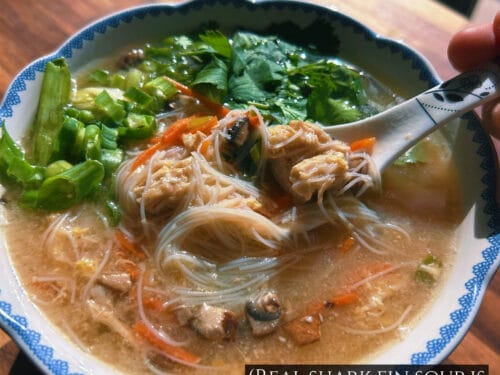
Fake Shark Fin Soup (Imitation Recipe)

Don’t lose this one.
I’ll email it to you so it’s waiting when you’re ready to cook.
Ingredients
Instructions
Notes
- The noodle substitute: Rice vermicelli or glass noodles provide the closest texture to shark fin, softening in the broth and absorbing flavor beautifully.
- Stock matters: A rich homemade chicken or pork stock will elevate the dish. If using store-bought stock, simmer it with ginger and green onions a bit longer for depth.
- Egg ribbon trick: Pour the beaten egg slowly in a thin stream while stirring gently to create delicate, silky ribbons that mimic the luxury feel of the original.