
When exploring the world of medieval cooking, few sources are as fascinating as the Buch von guter Spise—a mid-14th century German cookbook. Inside this manuscript lies a curious recipe known as Heidenisse küchen, or “Heathen Cakes.”
The instructions are simple and almost brusque: make a thin dough, fill it with boiled meat, chopped bacon, apples, pepper, and eggs, bake it, and serve. No frills, no garnish, just fuel for hungry medieval stomachs. It’s the kind of recipe that speaks directly across the centuries, letting us glimpse what a knight, monk, or castle retainer might have eaten after a long day.
The Source
The recipe comes from Ein Buch von guter Spise (“A Book of Good Food”), transcribed by Hans Hajek and translated by Alia Atlas. The manuscript is considered the earliest known German-language cookbook, compiled around the 1340s. The medieval German version reads:
“Diz heizzent heidenisse küchen. Man sol nemen einen teyc. und sol (den) dünne breiten. und nim ein gesoten fleish. und spec gehacket. und epfele. und pfeffer. und eyer dar in. und backe daz. und gibes hin und versirtez niht.”
Next week
I cook these before I write them. Some of it never makes the post.
The failures, the source documents, the version that actually tasted good. That part goes out by email, and next week’s is already on the stove.
 Written and cooked by Donnie
Atlas’s English translation keeps it straightforward:
“These are called heathen cakes. One should take a dough and should spread it thin and take a boiled meat and chopped fatty bacon and apples and pepper and eggs therein and bake that and give out and do not damage.”
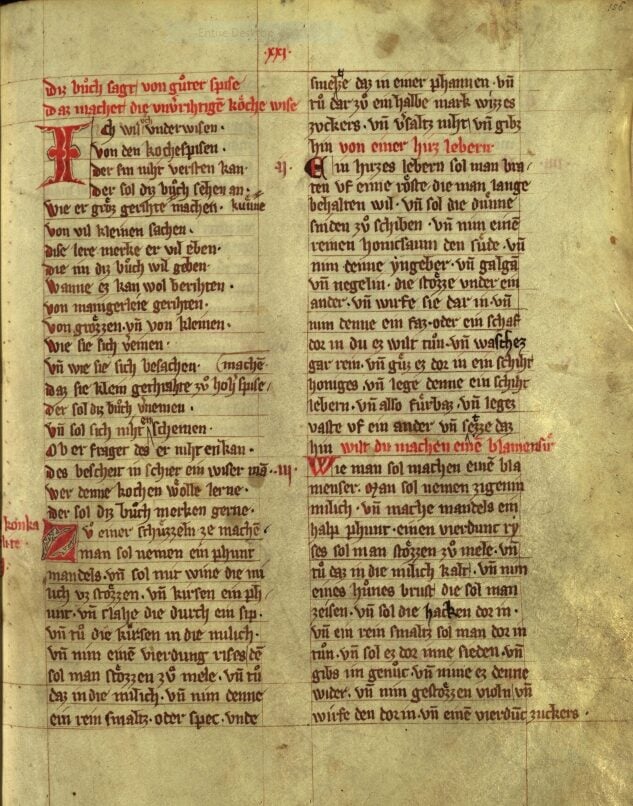
It’s blunt, practical, and exactly what you’d expect from a kitchen text meant for use in noble or monastic settings.
Who Were the Teutonic Knights?
The Teutonic Knights—formally the Order of Brothers of the German House of Saint Mary in Jerusalem—were one of the most formidable military orders of the Middle Ages. Founded during the Crusades, they quickly grew from a hospital brotherhood into a powerful martial order sworn to chastity, poverty, obedience, and the defense of Christendom.

By the 13th century, the Knights had shifted their focus to the Baltic frontier, where they launched campaigns against the pagan Prussians, Lithuanians, and other groups. They weren’t just warriors—they were state builders. The Order constructed enormous fortresses like Malbork Castle, still standing today as the largest brick castle in the world. Within these stone walls, knights lived like warrior-monks: eating in silence, praying, and drilling endlessly for war.
Daily Life in the Order
The life of a Teutonic Knight was one of contrasts. On the battlefield, they were armored shock troops who struck fear into their enemies. But inside their castles, their daily routine was closer to that of monks than soldiers.
They prayed several times a day, ate in silence while scripture was read aloud, and followed a strict code of conduct. Luxuries were forbidden: no gambling, no bright clothing, and meals were to be plain and functional. Yet, because they were a wealthy order with lands stretching from Germany to the Baltic, they could afford fine ingredients. Spices, imported sugar, and even rice reached their kitchens, showing how far trade networks extended in the Middle Ages.
Food as Fuel and Symbol
Food in the Order was not just sustenance but a reminder of discipline and devotion. Meat was allowed on certain days, but on fast days—which were frequent—fish took center stage. Records from Prussian castles show stockpiles of salted herring, freshwater pike, and eels, alongside barrels of beer and stores of rye bread.
A dish like Heathen Cakes would have served well on a feast day, when meat and eggs were permitted, providing warmth and nourishment after long hours of military drill or travel across the harsh Baltic frontier. Their name, tying directly to the “heathens” they fought, is a reminder of how food itself could carry symbolic meaning in the context of holy war.
The Frontier of Faith and War
The Teutonic Knights carved out what was essentially a monastic state in Prussia. Their castles were not only fortresses but administrative centers, monasteries, and supply depots. From here, the Order launched campaigns against pagan Lithuanians and Samogitians, often in brutal winter conditions.
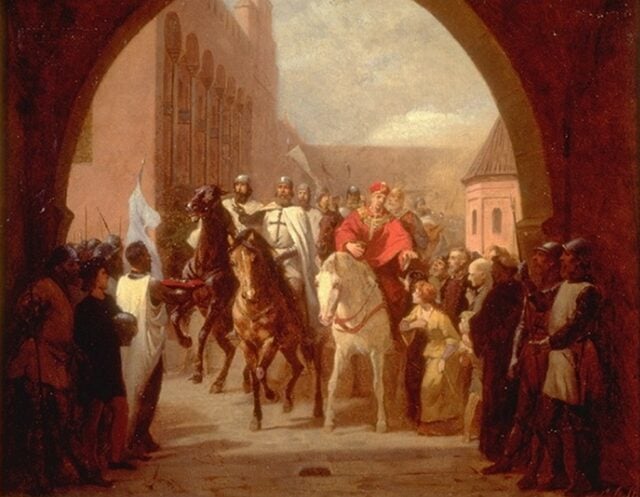
Chroniclers describe raids conducted across frozen rivers and snowbound forests, with knights clad in heavy mail and surcoats emblazoned with their black cross. These campaigns could last weeks, and sustaining the army required organized kitchens, provisions, and simple but hearty foods. Dishes like Heathen Cakes fit this practical need perfectly.
Heathen Cakes in Context
So where do Heathen Cakes fit into this story? The recipe itself is humble: dough, meat, bacon, apple, egg, pepper. But its name—“heathen”—reflects the cultural battleground the Knights lived in. To the German imagination, the Baltic frontier was the land of the heathen. Naming a hearty pastry after them might have been a sly jab, or simply a rustic dish connected to frontier life.
To the modern eater, Heathen Cakes taste like a medieval hybrid between a frittata and a meat pie, with that classic sweet-savory balance that medieval Europeans adored. The apple lightens the richness of the bacon and beef, while pepper brings a touch of spice. It’s filling, efficient, and something you can picture being baked in castle kitchens and passed around to hungry brothers after patrol.
My rating: a strong 8.7 out of 10.

Heathen Cakes

Don’t lose this one.
I’ll email it to you so it’s waiting when you’re ready to cook.
Ingredients
Instructions
Notes
- Pastry Choice – Puff pastry makes a quick, flaky version, but for more authenticity, try a simple lard- or butter-based shortcrust.
- Meat Prep – The recipe calls for “boiled meat,” which in the medieval context often meant using leftover roast or boiled cuts. Don’t over-salt during boiling since the bacon adds saltiness.
- Apple Flavor – Tart apples (like Granny Smith or Braeburn) balance the fat and pepper best, giving a more medieval flavor than sweeter modern varieties.