I came across this recipe while researching ancient Persian food culture and initially thought it was a pleasant curiosity. A simple syrup of honey, water and vinegar, infused with fresh mint, poured over shaved ice in a copper cup. Sounds interesting.
Then I started following the etymology. The Persian word sharbat gave us the Turkish şerbet, which gave us the English sherbet, which became sorbet in French and Italian. The Arabic root shariba, meaning to drink, gave us the word shrub, as in the drinking vinegar cocktail base that became fashionable in American bars about ten years ago. The same root gave us the word julep. Every one of those things, the frozen dessert you ate as a child, the sorbet course at a fine dining restaurant, the craft cocktail shrub, all trace a direct etymological and culinary line back to a Persian honey and vinegar syrup documented in the 11th century.
I made it. It is a 9.1 out of 10 and it is one of the most genuinely surprising things I have cooked for this channel. Here is the full story.
The Evidence: How We Know This Drink Existed
The historical documentation for sekanjabin is unusually solid for a recipe of this age, which is one of the things that makes it such a compelling choice for this channel. We are not working from speculation or reconstruction. We have named authors, titled works, and specific documented dates.
Next week
I cook these before I write them. Some of it never makes the post.
The failures, the source documents, the version that actually tasted good. That part goes out by email, and next week’s is already on the stove.
 Written and cooked by Donnie
The earliest written source is Ibn Sina, known in the Western world as Avicenna, a Persian polymath born in 980 AD who is considered one of the most important figures in the history of medicine. His encyclopaedic work the Canon of Medicine, completed around 1025 AD, is one of the most influential medical texts ever written and remained a standard reference in both Islamic and European medical schools for over six centuries. Within it Avicenna documents sekanjabin as a medicinal preparation, specifically a syrup of honey and vinegar used to treat digestive complaints, fevers, and various conditions of bodily imbalance as understood within the humoral medical framework of the time.

The second primary source is Ismail Gorgani, a Persian royal physician who wrote the encyclopaedia Zakhireye Khwarazmshahi in the 12th century, one of the most comprehensive medical encyclopaedias of the medieval Islamic world. Gorgani describes multiple varieties of sharbat available in Iran at the time, listing sekanjabin among them alongside pomegranate and sour grape versions. His documentation confirms that by the 12th century sekanjabin was not merely a medical preparation but an established category of drink with multiple recognised varieties. It had moved from the physician’s pharmacy into the broader culture of Persian refreshment.
The name itself is documentation. Sekanjabin is an Arabised version of the original Persian term serkangabin, combining the Persian words serkeh, meaning vinegar, and angebin, meaning honey or sweetness. The name literally means honeyed vinegar and it tells you everything you need to know about the drink’s composition and origins. This is a word that was old enough by the 12th century to have already passed through the process of Arabisation, which means the drink itself is almost certainly considerably older than its earliest written documentation.
How They Made It: Snow Runners, Copper Pots, and the Persian Art of Refreshment
Understanding how sekanjabin was actually produced and served in its historical context requires understanding something about the infrastructure of the Persian court and the extraordinary lengths to which it went to provide cold drinks in a hot climate.
The syrup itself was straightforward. Honey and water were combined in a copper or bronze pot and heated gently over a low flame, the foam skimmed continuously as it rose to produce a clear, refined liquid. The skimming of foam from honey-based preparations is documented specifically in multiple medieval Persian and Arabic culinary sources and was considered an essential step in producing a refined rather than a rustic product. Once the honey was fully dissolved and the foam removed, vinegar made from fermented grapes was added and the mixture was simmered further until the sharp edge of the vinegar had cooked off and the flavours had unified. Mint, where used, was added in the final stages so the heat could open the herb without cooking it into bitterness.
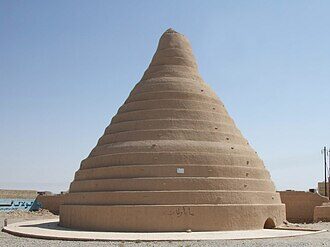
The cold was the more remarkable logistical achievement. Persia is hot. The Persian court’s ability to serve cold drinks was not a casual convenience but a serious organisational undertaking involving the Alborz mountain range to the north and a network of runners, pack animals and underground storage structures called yakhchāl. A yakhchāl, which translates literally as ice pit, was an ancient Persian refrigeration structure, a domed above-ground building connected to a deep underground chamber insulated by thick walls and designed to maintain sub-zero temperatures year-round even in the intense summer heat of the Iranian plateau. Archaeologists have documented yakhchāl structures dating back to at least 400 BC. Ice and snow brought down from the Alborz peaks would be stored in these structures through the summer and retrieved as needed for the preparation of chilled drinks and desserts for the court.
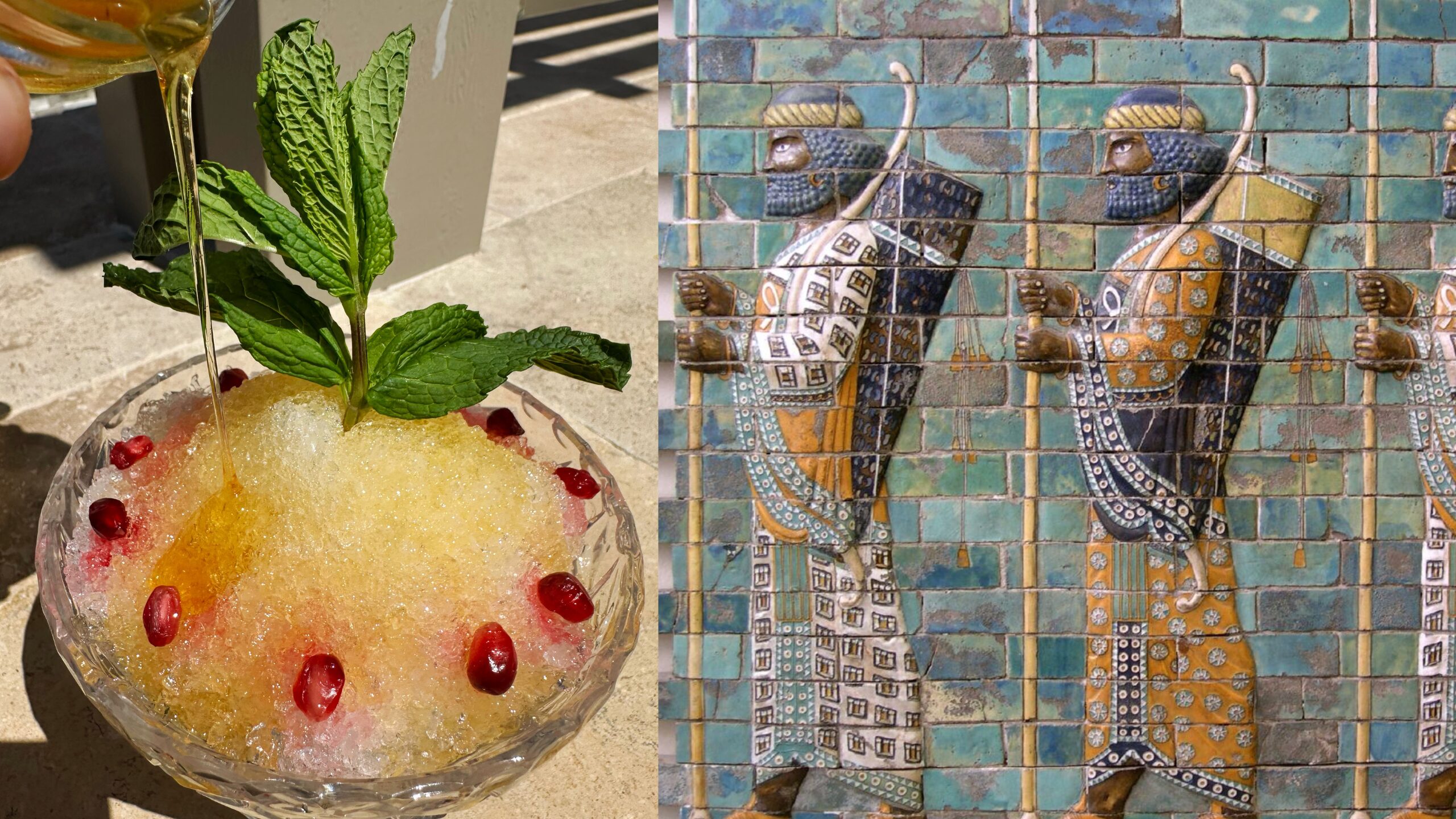
The service of sharbat over crushed or shaved ice in a metal cup, ideally silver or copper, was not a casual choice. Metal conducts cold efficiently and keeps a drink colder for longer than ceramic or glass. The visual of a pale amber syrup running slowly through white crushed ice in a cold metal cup with condensation forming on the outside was the intended aesthetic and it remains genuinely beautiful. Persian miniature paintings from the medieval period depict sharbat being served in exactly this way at court gatherings, the cups held with both hands, the ice visible above the rim.
For those outside the court, sharbat was consumed without ice, diluted with cold water instead, and served at room temperature. The iced version was a marker of wealth and access. The drink itself, however, crossed every social boundary. Sharbat appears in accounts of Persian street vendors, marketplace stalls, and domestic kitchens across the medieval period, always in the form of a concentrated syrup diluted to order with water.
From Medicine to Pleasure: How Sekanjabin Conquered the World
One of the most interesting things about sekanjabin’s history is the way it sits precisely on the boundary between medicine and pleasure that characterised so much of Persian and medieval Islamic food culture. Avicenna documented it as a medicinal preparation. But the drink was clearly being consumed for pleasure long before and alongside its medical use, and the two categories were never cleanly separated in the medieval mind in the way we tend to separate medicine and food today.
The drink travelled west with the expansion of Islamic culture through the Arab world, into North Africa, and eventually into medieval Europe through Sicily and the Crusader contact between Western and Islamic civilisations. The Romans had their own version, called oxymel, a mixture of honey and vinegar in water used both medically and as a general refreshment, which predated the Persian documentation but may share a common origin in the ancient Near Eastern culinary tradition. The Europeans who encountered sekanjabin through contact with the Islamic world brought the concept home and the drinking vinegar tradition, still alive today in the form of shrubs and drinking vinegars, is its direct descendant.
The word sharbat itself made the journey west through Turkish şerbet into Italian sorbetto and French sorbet, acquiring dairy along the way in some versions and losing it in others, freezing solid in some traditions and remaining liquid in others, but always retaining the core identity of a sweetened, flavoured, chilled preparation. The English sherbet powder, that fizzy sweet dust sold in British sweet shops, is separated from the Persian original by a thousand years and is virtually unrecognisable as a descendant, but the etymology is unbroken.
Today sekanjabin is still made across Iran, Afghanistan, and much of the broader Persian cultural sphere. It is a summer staple in Iranian households, made from both honey and sugar depending on the family tradition, infused with mint or sometimes with other aromatics, and served over ice or alongside a bowl of fresh lettuce leaves as a dipping sauce, which is one of the stranger and more wonderful things in food history and which works better than it has any right to. The variation across the region is enormous. In Pakistan and northern India a version called shikanji is made with lemon juice rather than vinegar, with salt and pepper added. In Turkey the syrup base appears in dozens of forms flavoured with rose, pomegranate, tamarind and fruit. In the Arab world sharbat continues as a category of sweetened drink served at celebrations and during Ramadan.
My Rating and Honest Assessment
I went into this recipe with modest expectations and came out genuinely astonished. The combination of honey and white wine vinegar sounds like it should produce something sharp and difficult, and when I smelled the vinegar going into the pot my immediate instinct was that this was going to be a challenging drink. I was wrong.
What happens during the cooking process is remarkable. The sharp, aggressive edge of the raw vinegar cooks off completely during the 25 to 30 minutes of gentle simmering after it is added to the honey syrup. What is left behind is not vinegar in any sense you would recognise from the bottle. It is a clean, bright acidity that reads almost exactly like lemon or citrus. The raw honey brings a floral quality that no sugar-based syrup can replicate.
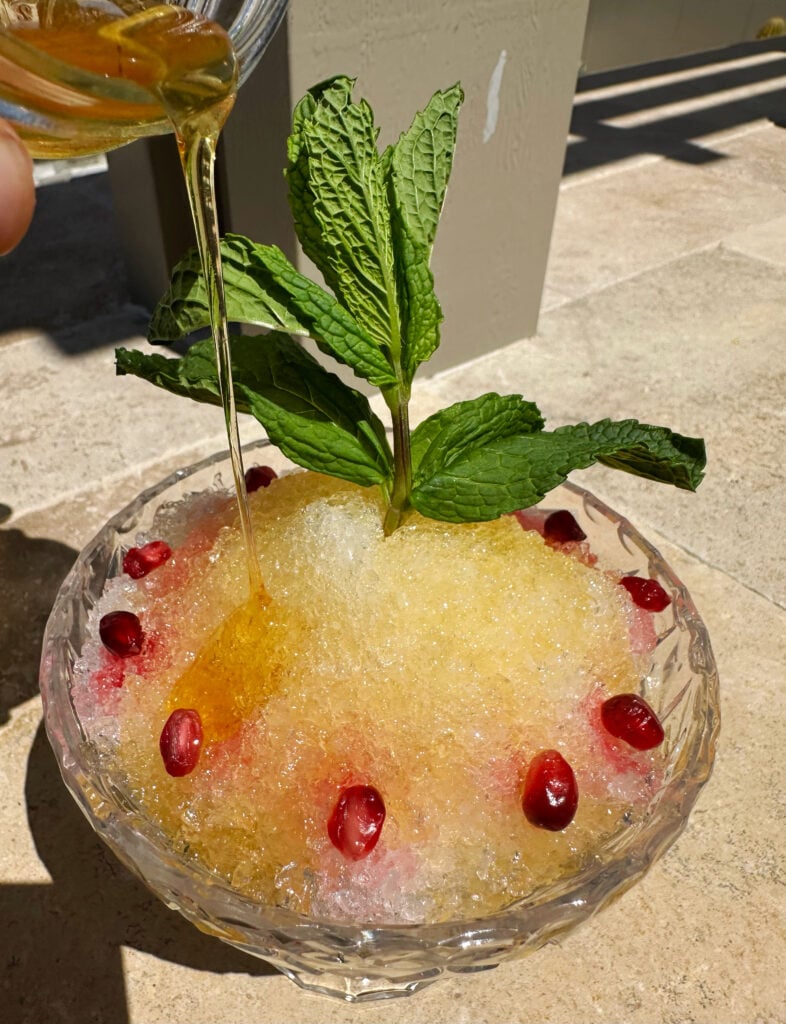
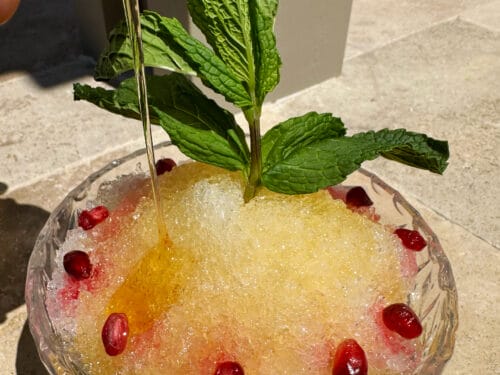
Poured over shaved ice, the syrup moves slowly through the white ice, the amber colour spreading as it settles, the mint sprig standing upright in the centre. It is one of the most visually beautiful things I have made for this channel and it tastes even better than it looks. The acidity that I was worried about at the start turned out to be the entire point. This is a drink that was engineered over a thousand years of refinement to be maximally refreshing in hot weather and it delivers on that completely.
If you are worried about the vinegar, do not be. It does not taste like vinegar. It tastes like a lemon-citrus syrup that happens to be made from honey and has a complexity that lemon could never produce. Make it. You will not regret it.
Rating: 9.1 / 10
The Recipe: Sharbat-e Sekanjabin
Sharbat-e Sekanjabin

Don’t lose this one.
I’ll email it to you so it’s waiting when you’re ready to cook.
Ingredients
Instructions
Notes
- Use the best raw honey you can find. The floral quality of the honey is the backbone of the entire drink and cheap processed honey will produce a noticeably flatter result. Wildflower or orange blossom honey both work beautifully.
- White wine vinegar is the most historically accurate choice as it is closest to the grape-based Persian vinegar of the original. Apple cider vinegar produces a slightly more complex flavour and is also a good choice. Do not use balsamic or distilled white vinegar.
- The syrup is highly concentrated. Start with 3 tablespoons over ice and adjust from there. A little goes a long way and the drink should have a clear balance of sweet and sour rather than being overwhelmingly sweet.