Taoism stretches back more than two thousand years, with roots often traced to the 4th–3rd century BCE, around the time Laozi, the legendary sage, composed the Tao Te Ching. While Taoism is not a religion obsessed with dietary rules, it has always been deeply concerned with how human beings live in harmony with the natural world. Eating has never been separate from this vision. To eat well was to align oneself with the rhythms of the universe, to keep the body light and the spirit clear.
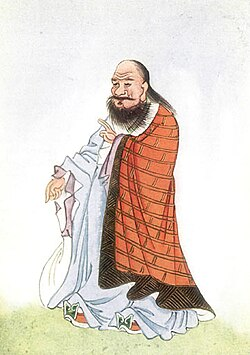
Although the Tao Te Ching itself is not a cookbook, later Taoist practices placed strong emphasis on diet as part of cultivating spiritual clarity and physical longevity. Ancient Taoist practitioners saw food as fuel for Qi, the life force that flows through all things. A body weighed down by heavy or excessive food was a body where Qi could not move freely. To maintain harmony with the Tao, one had to eat foods that were fresh, simple, and close to their natural state.
Bigu and the Avoidance of Grains
One of the most distinctive Taoist dietary practices was known as bigu, which literally means “avoiding grains.” This practice emerged in the early centuries of Taoism and was rooted in the belief that grains generated impurities that tied the body too strongly to the earth and prevented transcendence. While not all Taoists strictly avoided grains, many monks and ascetics experimented with grain-free diets to lighten their bodies and sharpen their spirits. Instead, vegetables, herbs, and roots became the staples of their daily meals.
This perspective helps explain why a simple broth of vegetables and herbs fits so well into the Taoist tradition. It was not about indulgence but about finding nourishment that supported clarity, longevity, and balance.
The Principles of Moderation
Taoist dietary philosophy also emphasized moderation. Overeating was seen as a path to stagnation, just as indulging in luxury foods or rich meats disturbed the balance of Qi. The Taoist approach was to eat only when hungry, to stop before full, and to choose ingredients that nourished without inflaming desire. This restraint created space for clarity of mind and spirit, reminding practitioners that every bite carried consequences for their inner state.
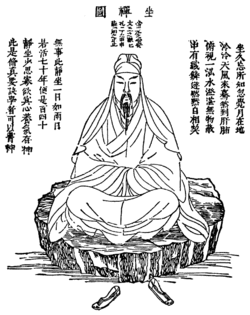
Vegetables such as carrots, daikon radish, mushrooms, and greens were prized not just for their sustenance but also for their symbolism. Root vegetables anchored the body with grounding energy. Mushrooms were linked with vitality and sometimes even immortality. Wild greens like dandelion represented renewal, cleansing, and the return of spring. Each ingredient carried meaning as well as nutrition, feeding not only the body but also the spirit.
Food as Medicine
Herbs and spices such as ginger played an especially important role. Taoist healers saw ginger as a fire-bringing root that kept the body warm, warded off illness, and stimulated Qi. It was a reminder that food was medicine and that the right balance of ingredients could heal imbalances both physical and spiritual. When simmered together in a simple broth, these ingredients created a dish that was light yet restorative, the kind of meal that could support meditation and the long walking practices favored by Taoist seekers.

Avoidance was just as important as inclusion. Taoist communities discouraged intoxicants, such as alcohol, which clouded the mind and weakened self-control. Many reduced or eliminated meat, especially among monks, not just for purity but also for compassion toward living beings. A bowl of vegetable broth with herbs, roots, and wild greens embodied this principle perfectly.
Fasting and Reflection
Fasting was another practice woven into Taoist diet. Periods of abstinence from food were seen as ways to cleanse the body and sharpen the spirit, allowing practitioners to focus entirely on meditation and alignment with the Tao. Yet fasting was not intended as self-punishment but rather as a gentle discipline, a means of quieting the noise of appetite so that the whispers of the Tao could be heard more clearly.
In this way, a Taoist-inspired vegetable soup becomes more than just food. It is a ritual of alignment, a way of grounding oneself in simplicity while opening space for clarity and renewal.
If you’re enjoying my work, check out Eats History shop!
Recipe: Taoist-Inspired Root & Mushroom Broth with Greens
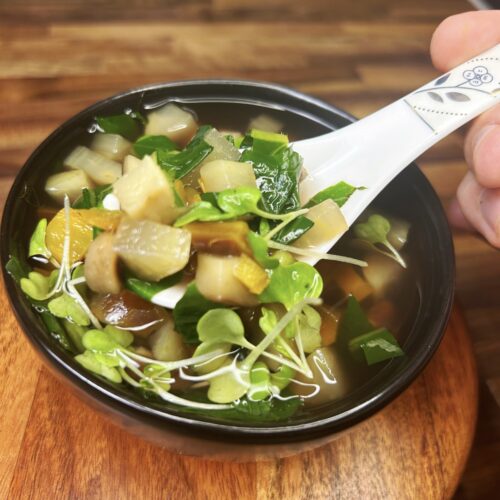
Taoist Soup for the Soul
Ingredients
- 6 –8 shiitake or other mushrooms preferably dried, for depth
- 1 medium carrot sliced
- 1 small daikon or turnip diced (root vegetable in place of grains)
- 2 –3 sprigs of dandelion greens
- 2 slices fresh ginger
- 4 cups water or light vegetable broth
- Optional: handful of fresh herbs like chives or wild herbs
Instructions
- If using dried mushrooms, soak them in warm water for 20 minutes, then slice.
- Bring the water or vegetable broth to a gentle simmer.
- Add the carrot, daikon, mushrooms, and ginger. Cook for 15–20 minutes until vegetables are tender.
- Add the dandelion greens and herbs in the last 5 minutes.
- Season lightly with salt and serve hot.
Notes
- Use dried mushrooms if possible – They bring a deeper, umami-rich flavor that echoes the medicinal use of mushrooms in traditional Taoist diets.
- Adjust the greens seasonally – Taoist practices emphasized harmony with nature, so you can substitute spinach, nettles, or other local greens depending on what is fresh and available.
- Keep the seasoning minimal – The goal of the recipe is not indulgence but clarity, so let the natural flavors of the vegetables shine through rather than masking them with heavy spices.