
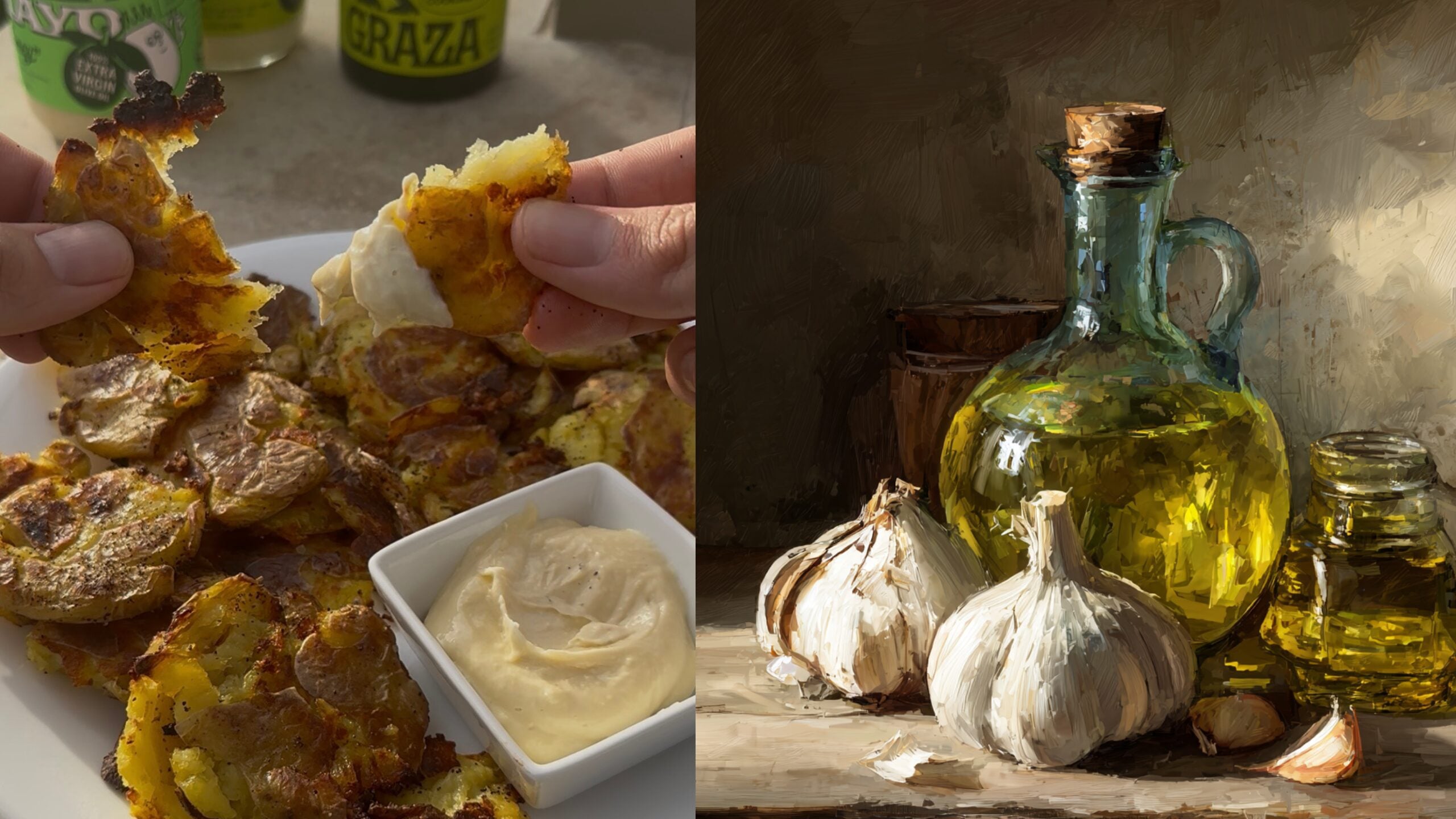
There are certain food combinations that feel so inevitable, so completely right, that it is almost impossible to imagine one existing without the other. Smashed potatoes and aioli is one of those combinations. Shatteringly crisp edges, soft steaming interior, and a pool of rich garlicky sauce that finds every crack and crevice and makes itself at home. It feels ancient. And as it turns out, half of it genuinely is.
Aioli is one of the oldest continuously documented sauces in the Western culinary tradition. The garlic and olive oil emulsion that defines the food culture of the Mediterranean coastline from Catalonia to Provence has been made in essentially the same way for at least two thousand years, predating the food processor, the whisk, and in the case of the classic version, the egg yolk. The smashed potato is a more recent invention but it comes from the same stretch of coastline, cooked in the same olive oil, eaten by the same people. When Graza asked me to build a recipe around their new Garlic Aioli I did not have to think about it for very long.
This is the story of where aioli actually came from, why smashed potatoes belong beside it, and how to make both at home.
The Ancient Origins of Aioli
The word aioli comes from the Catalan and Occitan words for garlic, all or ail, and oil, oli or oli. It means exactly what it is. Garlic and oil. Nothing more in its original form. The sauce predates mayonnaise by centuries and in its purest, most historically accurate version contains no egg yolk whatsoever, just raw garlic crushed to a paste in a mortar and pestle with olive oil worked in drop by drop until an emulsion forms through the natural emulsifying properties of the garlic itself. It is more difficult to make than the egg yolk version and more unstable, but the flavour is cleaner, sharper and more intensely garlic-forward.
Next week
I cook these before I write them. Some of it never makes the post.
The failures, the source documents, the version that actually tasted good. That part goes out by email, and next week’s is already on the stove.
 Written and cooked by Donnie
The Roman writer Virgil described a dish called moretum in a poem of the same name written in the 1st century BC, documenting a garlic and olive oil paste crushed together in a mortar that bears a clear relationship to the aioli tradition. The combination of raw garlic worked with olive oil into a thick emulsified paste appears in cookbooks and medical texts across the Roman and medieval Mediterranean world. By the medieval period aioli was firmly established as the defining condiment of the coastal cooking of Catalonia, Valencia and Provence, documented in 15th century Catalan cookbooks and referenced in the letters and chronicles of the region as a food of both the common people and the nobility.
The Catalan cookbook Llibre de Sent Soví, written in 1324, is one of the earliest European cookbooks and contains preparations in the aioli tradition. By the time Catalan food culture was being documented in any systematic way, aioli was already old enough to be treated as an obvious staple requiring no particular explanation, which is usually the sign of a preparation that has been around long enough to become invisible.
The Mediterranean Coast and the Potato: A Later but Perfect Match
Potatoes arrived in Spain from the Americas in the second half of the 16th century, brought back by Spanish explorers from the Andean highlands of South America where the potato had been cultivated for thousands of years. They were adopted into Spanish cooking faster than almost anywhere else in Europe, partly because of Spain’s direct colonial relationship with the Americas and partly because the Spanish climate and landscape proved well-suited to potato cultivation.
The coastal regions of Catalonia and Valencia, where aioli had been the dominant condiment for centuries, took to potatoes with particular enthusiasm. Patatas bravas, the fried potato dish served with aioli or spicy tomato sauce, became one of the defining dishes of Spanish tapas culture. Potatoes cooked in olive oil and served with garlic sauce are documented in Catalan and Valencian cookbooks by the 18th century. The combination is not a coincidence of geography. It is the natural result of a culture that already had the sauce and the oil and simply found the perfect vehicle for both when the potato arrived from the New World.
The smashed potato, specifically, is a more modern technique than the classic patatas bravas but it belongs to the same culinary logic. Cook the potato through completely, then expose as much surface area as possible to hot oil to maximise crispness. The ragged, lacy edges of a properly smashed potato are not an aesthetic choice. They are the most efficient geometry for producing crunch, and crunch is what makes olive oil and garlic sauce make sense on a potato rather than simply inside one.
Why I Made This With Graza
When Graza approached me about working together the fit was obvious. Graza makes single-origin Spanish olive oil, which puts them directly in the culinary tradition this recipe comes from. Their Sizzle oil, designed specifically for high-heat cooking, is what makes the smashed potato technique work. The oil needs to be genuinely hot before the potato hits the pan, hot enough that the contact is immediate and aggressive and produces the kind of crust that holds its crunch through plating and serving and makes it all the way to your mouth before softening. Cold oil and a cold pan produce a steamed potato. Hot Graza Sizzle and a hot pan produce what you actually want.
Their new Garlic Aioli is the modern version of the sauce, made with olive oil mayo as the base, which gives you the stability and consistency that the traditional no-egg version trades away. The flavour is clean, garlicky and rich without being heavy, and it does exactly what aioli is supposed to do when it meets a hot crispy potato, which is pool into every crack and crevice and make the whole thing taste like the best possible version of itself. This is not the moment for restraint with the aioli. Spoon it generously. Let it find the edges.
My Rating
Smashed potatoes with aioli is one of those recipes where the quality of the individual components does almost all of the work. Get the technique right on the potato, use good olive oil, use good aioli, and the result is close to perfect. The historical context of making this with a Spanish olive oil and a garlic aioli in the tradition of the same Mediterranean coastal culture that invented the sauce two thousand years ago is the kind of food history alignment that this channel exists for. This is a 9.4 out of 10 and I would eat it weekly without complaint.
Rating: 9.4 / 10
The Recipes
Smashed Potatoes with Graza’s Garlic Aioli

Don’t lose this one.
I’ll email it to you so it’s waiting when you’re ready to cook.
Ingredients
Instructions
Notes
- The hot pan step is not optional. A cold pan produces a soft potato. A hot pan produces a crispy one. Give the oil the full 3 to 4 minutes in the oven before the potatoes go in.
- Yukon Gold potatoes are the best choice for this technique because their waxy flesh holds together through boiling and smashing while still producing a creamy interior. Russets are too starchy and will fall apart. Small red potatoes also work well.
- Season more aggressively than you think is necessary. Potatoes need salt. Flaky sea salt added after roasting gives you texture as well as seasoning.

i havent eaten it yet but this is the yummiest scrumiest recipe picture ive ever seen so i already know its gonna be good