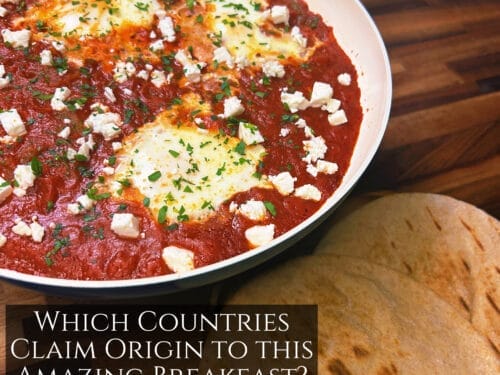
Few breakfast dishes have caused as many heated arguments as shakshuka. Anytime I post about it, the comment section lights up like a battlefield. Tunisians, Egyptians, Israelis, Moroccans, Turks, Libyans — each passionately claims it as their own. It’s amazing how a pan of eggs and tomatoes can stir such fierce debate. But that’s exactly what makes shakshuka so fascinating: it’s more than just food, it’s identity, migration, and history on a plate.
A Dish Born in North Africa
The roots of shakshuka run deep into the soil of North Africa. The first written mentions date back to the late 19th century. In 1894, French records described “chakchouka” as a Tunisian dish. Just two years later, a newspaper listed it among Egyptian foods. By 1899, another European source was calling it Turkish. Even then, people couldn’t agree where it came from, which already tells us something important: shakshuka was never the property of a single people. It was already spread across cultural and political borders.
Food historian Rafram Chaddad attributes it most directly to Tunisia and the Amazigh (Berber) peoples of the Maghreb. He notes that “shakshuka” in Tunisian dialect simply means “a mixture,” which is exactly what this dish is. In Amazigh cooking traditions, stews of seasonal vegetables had been simmered for centuries before the arrival of tomatoes and peppers from the New World. Once those crops entered the Mediterranean through trade with Spain and Portugal in the 16th century, they transformed existing recipes and gave rise to the tomato-based stews we now associate with shakshuka.
The Columbian Exchange and New World Ingredients
It’s impossible to talk about shakshuka without mentioning the Columbian Exchange. Before 1500, there were no tomatoes or peppers in North Africa, the Middle East, or Europe. These crops were indigenous to the Americas, and after Columbus’s voyages they spread rapidly through Spanish and Portuguese trade routes. By the 16th and 17th centuries, tomatoes were already being cultivated in the Mediterranean, where cooks folded them into traditional stews.
Next week
I cook these before I write them. Some of it never makes the post.
The failures, the source documents, the version that actually tasted good. That part goes out by email, and next week’s is already on the stove.
 Written and cooked by Donnie
In North Africa, this meant dishes that had once been built on onions, garlic, and local herbs suddenly had a new depth of flavor. It was almost inevitable that someone would crack eggs into these bubbling pots to create something more filling. That moment of inspiration, whether in Tunisia, Libya, or Morocco, gave us the earliest forms of shakshuka.
The Ottoman Connection
Adding another layer of complexity, the Ottoman Empire ruled much of North Africa and the Middle East from the 16th century onward. In Ottoman Turkish there was a dish called “şakşuka,” which referred to vegetables (sometimes with minced meat) cooked in a spicy tomato sauce. The similarities are obvious, though the Ottoman version did not typically include eggs. It’s possible that the egg-poaching element was introduced later in the Maghreb, then carried back eastward through migration and trade, blending with Ottoman influences along the way.
This kind of back-and-forth cultural borrowing was normal in the region. Recipes moved with soldiers, sailors, and traders, changing slightly with each border they crossed. Shakshuka is a perfect example of how food resists neat labels of national ownership.
Cousins Around the World
One of the best ways to understand shakshuka is to look at its cousins. In Spain, there’s pisto manchego — a stew of tomatoes, peppers, and eggplant, often topped with an egg. In Italy, there’s uova in purgatorio (eggs in purgatory), where eggs simmer in a spicy tomato sauce. In Mexico, huevos rancheros pairs fried eggs with a tomato-chili base. All of these dishes reflect the same simple logic: tomatoes, onions, and peppers make a hearty stew, and eggs transform it into a complete meal.
This shows us that shakshuka is not an isolated invention, but part of a wider Mediterranean and trans-Atlantic story. Its spread was made possible by trade, migration, and the universal appeal of comfort food.
Why the Debate Matters
So why does the debate get so heated? Because food is more than just nourishment. It’s memory, identity, and belonging. Shakshuka is woven into the stories of Tunisian families, Egyptian breakfasts, Israeli cafés, and Ottoman kitchens. When people argue about who “owns” it, they’re really arguing about history and culture.
The truth is shakshuka belongs to all of these traditions. It’s a North African dish with Mediterranean cousins, Ottoman connections, and modern global fame. And like all great recipes, it thrives precisely because it cannot be pinned down to a single origin.
If you’re enjoying my posts, check out Eats History Shop for my e-cookbooks!
Traditional Shakshuka Recipe
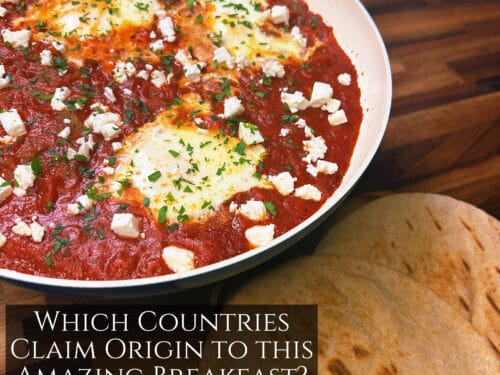
Traditional Shakshuka

Don’t lose this one.
I’ll email it to you so it’s waiting when you’re ready to cook.
Ingredients
Instructions
Notes
- Control the Heat: Adjust the spice level by adding or removing chilies and cayenne. A mild version still tastes fantastic, while a spicier version feels more traditional to North African kitchens.
- Egg Timing Matters: For soft, runny yolks, cover the pan and cook for 5–6 minutes. For firmer yolks, go up to 8–10 minutes.
- Bread is Essential: Crusty bread or pita is not just a side but part of the experience. It soaks up the sauce and yolk, turning shakshuka into a full, filling meal.