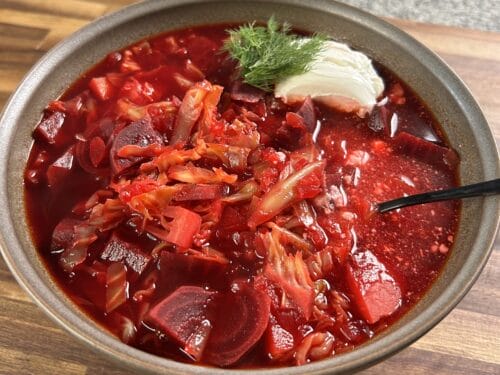
Before you even taste the sweetness of the beets or the tang of vinegar, there’s a deeper story simmering in this pot. This is not just a soup; it’s a reflection of human endurance during one of the darkest and most censored chapters of the 20th century. The dish is simple, humble, and rooted in history, born out of a time when flavor gave way to function, and food became a matter of life and death.
In recreating this recipe, I wanted to capture more than just the ingredients, I wanted to capture the context. To stand in a kitchen, peel a beet, and know that someone, ninety years ago, was doing the same under the threat of famine and political terror. Food, in this case, becomes a quiet but powerful testimony. And borscht, with its deep red hue and layers of flavor, tells a story that textbooks often overlook.
The Source: A Cookbook From the Edge of Survival
This version of Ukrainian borscht is based on a meatless recipe from Практична кухня (Practical Kitchen), a landmark cookbook published in 1929 by Olha Franko. Franko, a pioneer of Ukrainian culinary writing, compiled everyday recipes from the Galician region, focusing on home cooking that blended practical necessity with cultural preservation. Her cookbook was not only about what to cook but how to uphold identity through food, especially during times of scarcity.
Published just before the full weight of Stalin’s policies crashed down on Ukraine, Practical Kitchen offers a rare glimpse into what Ukrainian households were cooking before collectivization gutted the countryside. The recipes—often modest, efficient, and vegetarian—show how food traditions survived even as everything else was stripped away. Borscht, in particular, was and still is a symbol of the Ukrainian table, adaptable and tied deeply to the land.
Next week
I cook these before I write them. Some of it never makes the post.
The failures, the source documents, the version that actually tasted good. That part goes out by email, and next week’s is already on the stove.
 Written and cooked by Donnie
The Holodomor: Famine as a Weapon
In the early 1930s, Soviet dictator Joseph Stalin launched a campaign of forced collectivization in Ukraine. Land was seized, grain quotas were raised to impossible levels, and farmers were forbidden from keeping even the smallest share of their own harvest. Resistance was met with brutal repression. Stalin saw Ukrainian nationalism—and its deeply rooted farming culture—as a threat to his centralized control. And so, he aimed to break it.
The famine, known as the Holodomor, wasn’t an accident. It was deliberate. Soviet officials enforced grain seizures with military precision. Entire villages were surrounded, food confiscated, and any attempts to forage were criminalized. Families watched their stores vanish overnight. Livestock was slaughtered, not for food, but because ownership itself was now considered anti-Soviet. In just one year, millions would die not because of drought or war, but because of bureaucracy and cruelty.
What Ukrainians Had to Eat
During this famine, Ukrainians made do with whatever they could find: wild grasses, tree bark, husks, weeds. Some accounts describe villagers boiling leather belts or chewing on acorns. Parents gave their last morsels to their children, and many starved in silence. In some cases, desperation led to horrifying extremes, which the Soviet regime worked hard to erase from record. The food that did exist was rationed or stolen by the state.
Against this backdrop, a bowl of meatless borscht—made with cabbage, beets, potatoes, and onion—would have been a rare blessing. It represents not luxury, but resilience. These vegetables, if obtained, were stretched into soups to feed as many mouths as possible. Recipes like these were passed down orally or scribbled in margins, preserved not in books but in memory. When I make this dish today, I taste its weight.
Why the Holodomor Was Forgotten
And yet, ask most people today, and they’ve never heard of the Holodomor. Why? Because the Soviets buried it. Foreign journalists sympathetic to communism downplayed it. Some, like the New York Times’ Walter Duranty, outright denied it. And then came World War II, when the USSR became a necessary ally against Hitler. The atrocities of the 1930s were pushed aside in the name of global politics and forgotten in the West’s postwar narrative.
Even after Stalin’s death, the Soviet Union maintained a strict policy of censorship. Mentioning the Holodomor could result in imprisonment. Survivors were silenced. It wasn’t until the fall of the USSR that Ukrainian historians and diasporic communities began to speak out more freely. Today, over 20 countries officially recognize the Holodomor as genocide—but its recognition remains a politically fraught issue, especially in light of renewed Russian aggression.
This Dish as a Form of Remembrance
This is where food becomes a strange kind of witness. Today’s version of this 1930s borscht tastes earthy, sour, and deeply humble. The beets bring a sweetness that contrasts with the sharpness of vinegar and the hearty starch of potatoes. It’s not flashy. It’s not rich. But it fills a bowl, and for millions, that was all that mattered.
Cooking this isn’t just about reenactment. It’s about remembrance. It’s about honoring those who had no voice, no platform, and no justice.
The Present Echoes the Past
But I’ll be honest with you… learning from history is easier said than done. I study this stuff, I tell these stories, and I still feel like we’re watching history echo. It’s hard not to think of the current war in Ukraine, the cities bombed, the food lines, the displacement, the silence. I see footage of families huddled in subway tunnels, of children clutching bread, and I think: This has happened before.
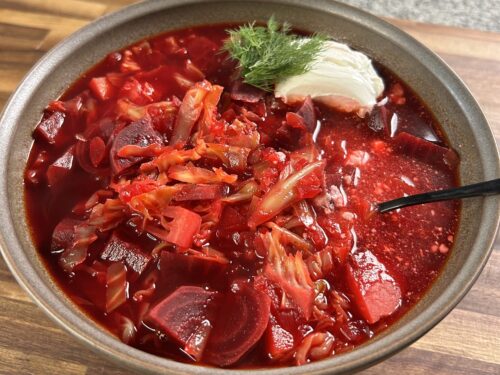
Borscht (Meatless)

Don’t lose this one.
I’ll email it to you so it’s waiting when you’re ready to cook.
Ingredients
Instructions

Notes
- Beet Prep Tip: For a more vibrant color and slightly smoother texture, roast the beets beforehand and then grate or chop them into the soup. This also deepens their natural sweetness.
- Adjusting Acidity: Vinegar was a traditional way to preserve and brighten flavor in the absence of meat stock. If it tastes too sharp, a pinch more sugar or an extra potato can help balance it.
- Traditional Garnishes: Sour cream and fresh dill weren’t always available during famine, but they remain classic toppings that add creaminess and herbaceous lift. Omit or replace based on availability and dietary preference.