To the Vikings, death was not an end but a transformation. A warrior’s life was full of hardship, hunger, and uncertainty, yet also filled with honor, loyalty, and the thrill of battle. Those who died nobly on the battlefield were promised something greater. They would be chosen by the Valkyries, carried away to the great hall of Odin himself, and seated at the endless tables of Valhalla. Here, the rewards were simple yet profound: comradeship, mead that never ran dry, and roasted meat that never diminished.
Food was at the heart of this vision. For people who often lived with scarcity, the idea of eternal abundance was more than just fantasy, it was the perfect picture of reward. To imagine a place where there was always more meat, more drink, and more laughter was to imagine paradise. At its core, Valhalla was not just a hall of warriors but a hall of fellowship, where eating and drinking became eternal acts of celebration.
That is what drew me to recreate this meal. When you picture a Viking feast, you think of long wooden tables, firelight flickering off steel helmets, and the smell of roasted pork filling the air. You think of the legendary boar Sæhrímnir, cooked each night and restored each morning, and the immortal cook Andhrímnir stirring the great cauldron Eldhrímnir. I wanted to bring that image into the kitchen, to cook something hearty, rustic, and worthy of Odin’s table.
If you’re enjoying my recipes, check out Eats History shop for my latest e-cookbooks!
Valhalla: Odin’s Hall of the Slain
The Norse sources describe Valhalla as both magnificent and intimidating. The Poetic Edda paints the hall as a fortress-sized building with 540 doors, each wide enough to let hundreds of warriors march through at once. Shields lined the roof like shingles, and the rafters were spears instead of beams. It was a place that embodied the values of Viking society, where strength, loyalty, and courage defined your worth.

But Valhalla was not only a place of preparation for Ragnarök, the end of the world. It was also a place of joy. The Einherjar, the chosen warriors, would spend their days training for the final battle, but their evenings were spent at Odin’s feast. The rhythm of war and feasting created the perfect image of Viking life. Even in death, they did what they loved most: fighting and celebrating.
To the Vikings, who knew hunger all too well, this vision was powerful. In the long winters, when food ran short and survival meant rationing, the dream of a hall with unlimited meat and drink was irresistible. It was not just about abundance but also about recognition. To sit at Odin’s table was to know that your sacrifices had been seen, and that your bravery had earned you a seat among the greatest of all time.
Sæhrímnir: The Endless Boar
Sæhrímnir, the boar of Valhalla, is one of the most fascinating details in the mythology. Each day it was slaughtered, each night it was eaten, and each morning it returned whole again. For the Einherjar, this meant that hunger was never a concern and that the feast could never end. Unlike mortal life, where each animal slaughtered was one fewer for the herd, Sæhrímnir was eternal. It was the ultimate antidote to scarcity.
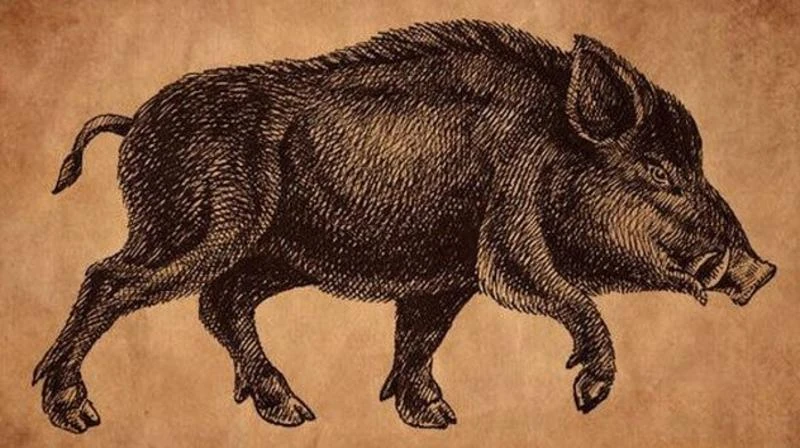
The symbolism here is rich. A boar was a prized animal in Viking culture, associated with fertility, strength, and abundance. To have one that never diminished was a sign of divine favor. The image of warriors endlessly carving into its meat captures the heart of what Valhalla promised: a cycle without loss, a feast without end.
The detail may be brief in the Poetic Edda, but it resonated deeply with Norse culture. It encapsulated both the physical desire for food and the spiritual longing for continuity. In a world where death was certain and resources limited, the idea of eternal meat was nothing less than divine mercy.
Andhrímnir and the Cauldron Eldhrímnir
Andhrímnir, the cook of Valhalla, is an overlooked but vital figure in the myth. Without him, there is no feast. His cauldron, Eldhrímnir, was the vessel in which Sæhrímnir was prepared each night. Though he is mentioned only briefly, his presence says something important: in Viking culture, even the cook was sacred when it came to feeding warriors.
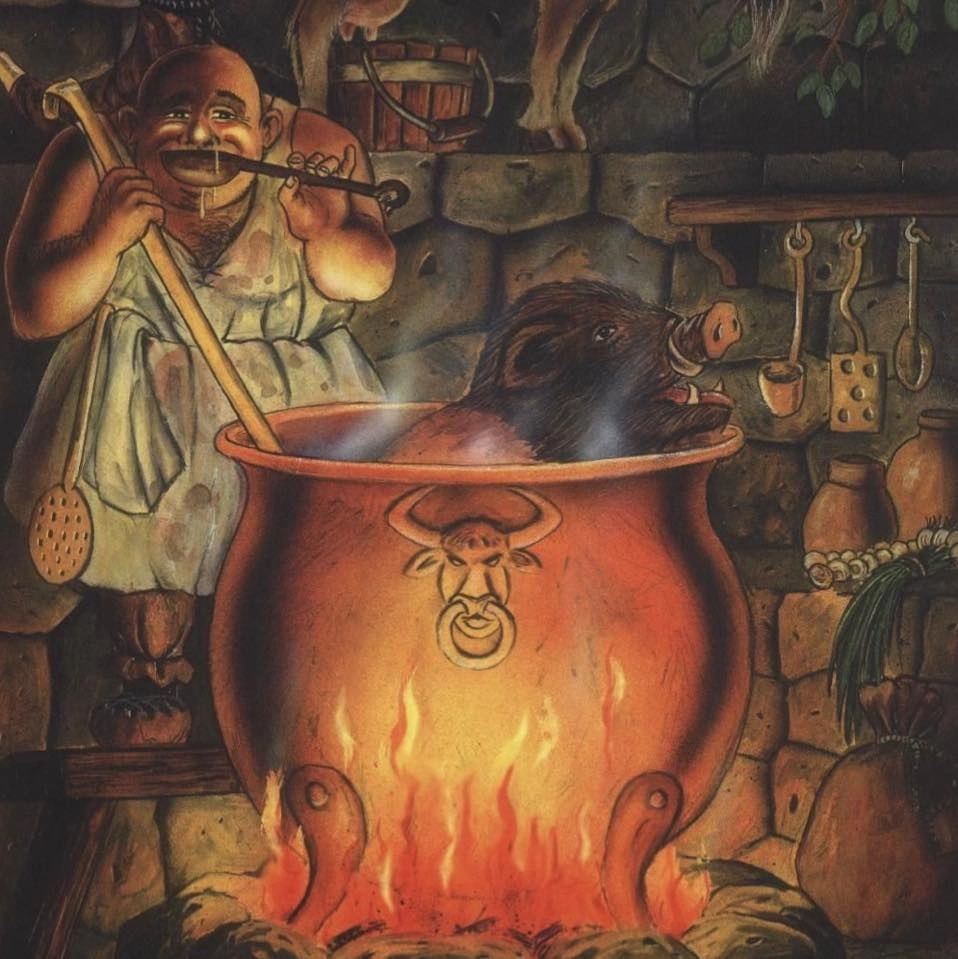
Cooking was not just a chore, it was an act of community and survival. For warriors, a feast after battle was as important as the fight itself. Food restored strength, healed wounds, and reminded them of what they fought for. By making Andhrímnir the eternal cook, the mythology elevated the act of preparing food into a divine duty.
It is a reminder that food is never just food. It is a bond between people, a sign of care, and a ritual that sustains life as much as any sword or shield. In the Viking imagination, Andhrímnir was as essential to Valhalla as Odin himself, for without his hand, there would be no feast to enjoy.
Sources in the Poetic Edda
Our knowledge of Valhalla’s feast comes from Grímnismál, part of the Poetic Edda compiled in the 13th century. Odin, disguised and speaking to a young prince, describes the details of the hall. In his words, we find the first mentions of Sæhrímnir, Andhrímnir, and Eldhrímnir. The lines are brief, almost casual, but they give us a vivid image: the boar, the cook, and the cauldron that sustain the warriors forever.
The brevity of these references has not stopped them from being influential. Later sagas and scholars expanded on the details, painting Valhalla as a place of roaring fires, endless meat, and rivers of mead flowing from the goat Heiðrún. What mattered most was not the exact recipe but the image of abundance and joy.
To modern readers, these lines are both strange and familiar. Strange, because they speak of a boar that regenerates endlessly. Familiar, because they mirror our own desires for celebration, community, and comfort food. Valhalla is not so different from the way we imagine heaven: a place where the things we love most are never taken away.
My Recreation of a Viking Feast
To honor this legend, I recreated the eternal feast of Valhalla with a dish that felt both rustic and celebratory. Pork was my natural stand-in for Sæhrímnir. A pork tenderloin, seared in a cast iron skillet until golden brown, carried the rich flavor that would have filled a Viking hall. Root vegetables like onions, turnips, and garlic surrounded it, absorbing the meat’s juices as they roasted. This combination would have been familiar to the Vikings, who relied heavily on what the land and season provided.
Ale was the natural choice for basting. Vikings brewed and drank ale constantly, and it would have been present at every feast. By adding it to the skillet, I introduced both moisture and flavor, letting it mingle with the pork and vegetables. Covering the skillet with foil created a steaming environment that kept everything tender, and the final broil crisped the top beautifully.
The finishing touch was the lingonberry ale sauce. Lingonberries grow wild in Scandinavia and have been part of Nordic diets for centuries. Their tartness balances the richness of meat, and when combined with ale and honey, they create a sauce that is both sharp and sweet. Reducing it until thick gives it the texture of something you could ladle over a platter of pork, and the color makes it look like a jewel on the plate.
The end result was a dish that brought the myth into my kitchen. It tasted hearty, rustic, and full of character. Eating it, I could almost imagine sitting in Valhalla, surrounded by warriors with horns of mead raised high. On taste alone, I gave it a 9.2 out of 10, but as an experience, it was priceless.
Recipe: Pork Loin with Lingonberry Ale Sauce
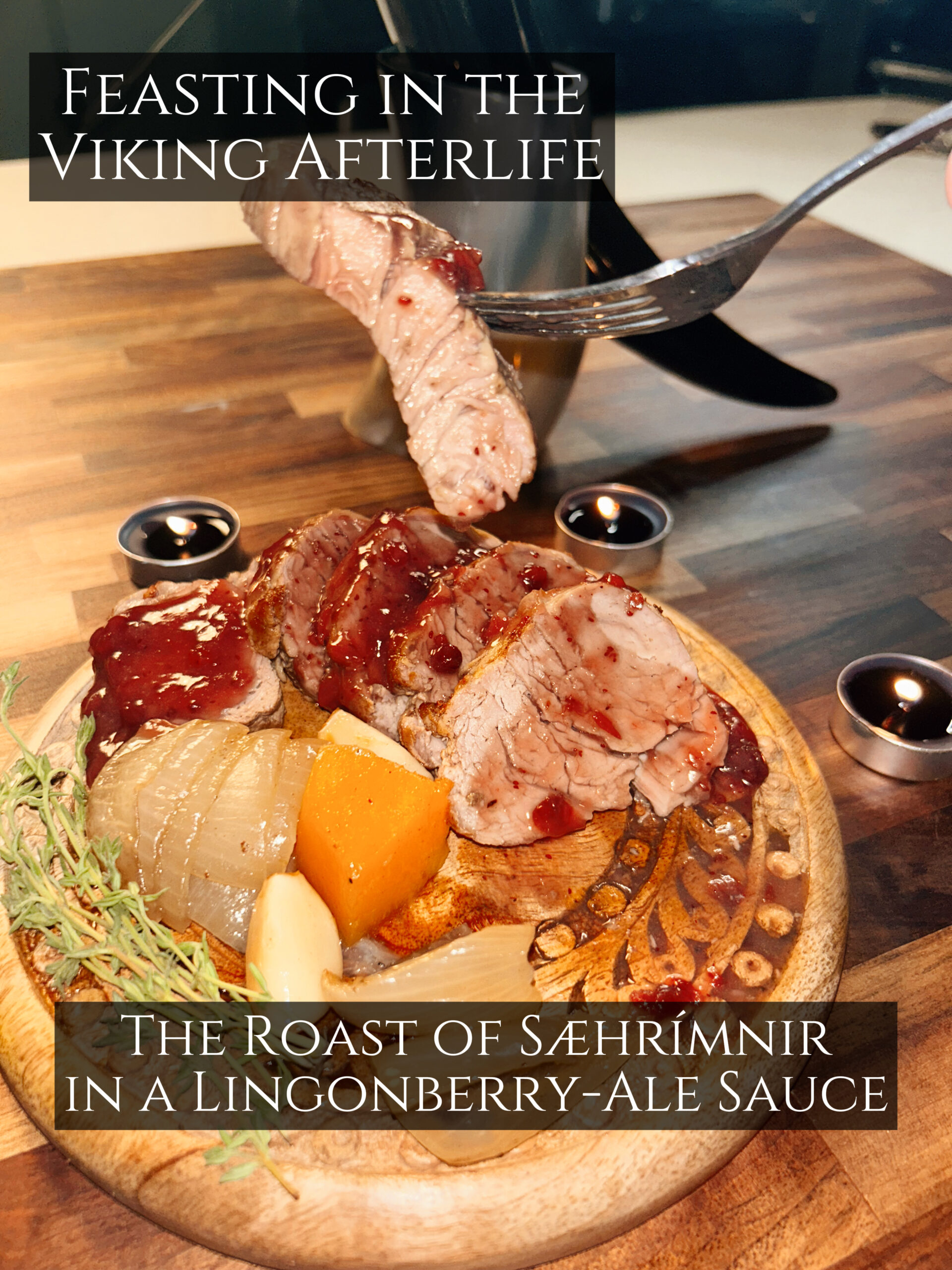
Viking Pork Loin with Lingonberry Ale Sauce
Ingredients
- 1 boneless pork tender loin
- 2 medium onions quartered
- 2 turnips peeled and chopped
- 6 –8 whole garlic cloves
- 1 cup ale divided between roasting and sauce
- 3 tablespoons lingonberry jam
- 2 tablespoons honey
- 1 teaspoon cornstarch optional, for slurry
- Salt and pepper to taste
- Oil or butter for searing
Instructions
- Preheat oven to 375°F (190°C).
- Season the pork tenderloin with salt and pepper. Heat oil in a cast iron skillet over medium-high heat. Sear the pork on all sides until golden brown. Remove and let rest briefly.
- In the same skillet, arrange the onions, turnips, and garlic. Place the pork tenderloin back on top of the vegetables. Pour half the ale over the mixture to baste.
- Cover the skillet tightly with foil and place in the oven. Roast for 45–60 minutes, depending on thickness, until the pork reaches an internal temperature of 145°F (63°C).
- Remove foil and broil for 3–5 minutes to crisp the top. Let the pork rest for 10 minutes before slicing.
- While the pork rests, make the sauce. In a saucepan, combine lingonberry jam, the remaining ale, and honey. Simmer until thickened. If the sauce is too thin, whisk in a cornstarch slurry (1 teaspoon cornstarch mixed with 2 teaspoons water).
- Slice the pork, serve over roasted vegetables, and drizzle generously with lingonberry ale sauce.
Video
Notes
- Rest the pork before slicing. Letting it sit for 10 minutes after roasting ensures the juices redistribute, keeping every slice tender and moist.
- Use a heavy skillet. Cast iron holds heat well for the sear, giving the pork a golden crust and helping the vegetables roast evenly.
- Adjust the sauce. If you prefer a sweeter finish, add a touch more honey. If you want it sharper, increase the lingonberry jam. The cornstarch slurry is optional, but it gives you control over thickness.