In the ancient world, recipes were rarely written down as we know them today. Greek cuisine was passed through poetry, oral traditions, and the dramas of philosophers and playwrights. What we know about what the ancients ate comes not from cookbooks but from scattered references in literature, medicine, and satire.
Among the simplest yet most enduring of their culinary traditions is the lentil soup attributed to Zeno of Citium, the founder of Stoicism. This humble dish reflects the philosophical ideals that shaped an entire school of thought, emphasizing simplicity, self-restraint, and clarity of purpose. Today, this recipe has been adapted from Eugenia Ricotti’s Meals and Recipes from Ancient Greece, drawing on references from ancient texts such as Athenaeus’s Deipnosophistae, which blends gastronomy with the lives of philosophers.
Zeno of Citium: Philosopher of the Portico
Zeno was born around 334 BCE in the city of Citium on the island of Cyprus. His journey to philosophy began in a rather unorthodox way. According to legend, Zeno was shipwrecked and lost all his possessions. While in Athens, he wandered into a bookstore and came across Xenophon’s Memorabilia of Socrates. Captivated by the dialogue, he sought out philosophers and eventually became the founder of his own school, Stoicism, which took its name from the Stoa Poikile, the painted colonnade in the Athenian Agora where he taught.
Stoicism emphasized living in accordance with nature, guided by reason and virtue. Zeno’s ascetic lifestyle reflected his belief that external comforts were not necessary for happiness. Food, therefore, was a means of sustaining the body, not a source of indulgence. His followers, like Musonius Rufus, carried forward these ideas, treating diet as a form of moral and philosophical training. For Zeno, meals were not about gourmet experiences but about aligning the body with the principles of moderation and resilience.
Stoic Philosophy and Food
Food played an unexpectedly central role in Stoic philosophy. Musonius Rufus, a Roman Stoic heavily influenced by Zeno’s ideas, argued that food was not a trivial concern. Instead, he believed that how one ate reflected one’s character. He taught that nourishment should be plain, inexpensive, and derived from what is easiest to obtain. Foods that required little to no preparation, such as fruits, vegetables, and legumes, were considered ideal. The consumption of meat was discouraged, not out of asceticism for its own sake, but because the effort and expense involved often distracted from a life of virtue.
Gluttony, rapid eating, and a desire for luxurious meals were seen as moral failings. The Stoic diner was advised to eat slowly, mindfully, and with gratitude. Even sharing meals equitably among companions was a sign of ethical living. Musonius taught that if one could master their appetite, they were on the first step toward mastering their emotions and impulses. The ideal Stoic meal, therefore, was one that nourished the body while training the soul, such as Zeno’s lentil soup.
Source of the Recipe
The lentil soup recipe featured here is based on an interpretation found in Eugenia Salza Prina Ricotti’s Meals and Recipes from Ancient Greece. Ricotti’s work is a rare and thoughtful exploration of ancient Greek foodways, translating scattered literary, medical, and comedic references into practical modern recipes.

Since the Greeks did not use cookbooks in the way we do today, most of our understanding of their meals comes from texts such as Athenaeus’s Deipnosophistae, where philosophers would recount dishes as part of their intellectual discussions. Ricotti carefully reconstructs these meals using scholarly analysis and archaeological insights, making her book one of the most trusted sources for modern recreations of ancient Greek cuisine. Zeno’s lentil soup stands out among the recipes for its alignment with Stoic values and its use of humble, nourishing ingredients.
Culinary History: Lentils in the Ancient World
Lentils have been a staple in the Mediterranean diet since prehistoric times. Archaeological evidence shows that they were among the first domesticated crops in the Near East and were widely cultivated across ancient Greece and Rome. In Alexandria, Athenaeus mocked the locals for their overreliance on lentils, calling them the “lentil-eaters.” Despite the jest, the dish remained beloved, especially among those who valued health, thrift, and sustenance over spectacle.
The recipe we associate with Zeno is one of the most approachable from the ancient world. Unlike the elaborate feasts described in some elite Roman banquets, this soup uses simple ingredients: lentils, broth, basic vegetables, and a few seasonings. It does not involve complex preparation or rare imports, which aligns with Stoic ideals. A touch of vinegar and honey balance the earthy flavor, and the coriander seeds, counted precisely, offer a burst of aroma that underscores the value of intentionality in cooking.
If you’re enjoying my content, check out my Eats History shop for my e-cookbooks and subscription!
The Recipe: Zeno’s Lentil Soup
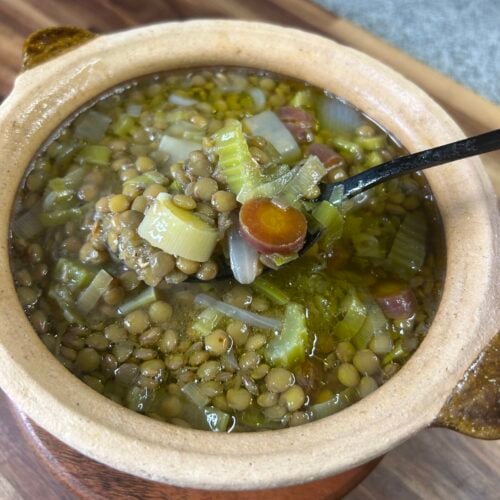
Zeno’s Lentil Soup
Ingredients
- 1 lb. lentils
- 8 cups broth vegetable or light meat broth
- 1 large leek minced
- 1 carrot sliced
- 1 stalk celery sliced
- 1 small onion sliced
- 2 tbsp vinegar wine vinegar preferred
- 1 tsp honey
- 2 tbsp olive oil per serving
- Salt and pepper to taste
- 12 coriander seeds
Instructions
- Rinse the lentils thoroughly, then place them in a pot with the broth. Bring to a boil.
- Reduce the heat and simmer for one hour.
- Skim off any foam from the top, then add the leek, carrot, celery, and onion. Simmer until vegetables are soft, about 30 minutes.
- If the soup appears too watery, mash a portion of the lentils or pass them through a sieve to thicken.
- Add the vinegar and honey, then stir to combine.
- Serve hot with a generous drizzle of olive oil and exactly 12 coriander seeds per bowl.
Video
@eatshistory Zeno’s Stoic Lentil Soup (330s BCE) Zeno of Citium, founder of Stoicism, believed food should be simple, nourishing, and aligned with reason. He avoided gourmet meals and trained his students to eat for strength, not pleasure. This lentil soup is a reflection of that mindset: humble, hearty, and quietly powerful. Based on a reconstruction from Meals and Recipes from Ancient Greece, this dish skips fancy prep and focuses on clean, elemental flavors. No sautéing. No indulgence. Just slow-simmered nourishment, sharpened with vinegar and softened with a touch of honey. Ingredients 1 lb lentils 8 cups broth 1 large minced leek 1 carrot, sliced 1 celery stalk, sliced 1 small onion, sliced 2 tbsp vinegar 1 tsp honey 2 tbsp olive oil per serving 12 coriander seeds Salt and pepper to taste #history #greece #stoic #stoicism #marcusaurelius #dailystoic #historical #recipe #soup #stew #vegan #lentils #vegtables #fyp
♬ Ancient Greek Echoes – World Philharmonic Orchestra
Notes
- Choose your broth wisely: A light homemade vegetable or meat broth works best. Avoid overly salted or strongly flavored broths that may overpower the subtle vinegar and coriander balance.
- Coriander seed count matters: While it may seem unusual, adding exactly 12 coriander seeds per serving brings a fragrant, balanced punch and was specified in the original adaptation of the recipe.
- Meal prep friendly: This soup stores well in the fridge for up to 5 days and can be frozen in individual portions. The flavor deepens over time, making it ideal for batch cooking and reflective meals throughout the week.
Taste and Reflection
This soup may surprise the modern eater with its rich, warming depth. The combination of leek, onion, and coriander produces a full flavor without the need for sautéing or fat-based emulsification. The olive oil, poured raw into the bowl, offers both texture and body, reminiscent of a finishing drizzle in Mediterranean cuisine today. The vinegar and honey add a subtle contrast that awakens the palate without overwhelming the simplicity of the base.
Eating this soup is a small act of time travel and philosophical practice. It invites the eater to reflect on the virtues of restraint and appreciation. Each bite is an opportunity to reconnect with the values of Zeno: to eat for life, not for pleasure alone, and to live each moment in harmony with reason and nature. In a world of fast food and flashy flavors, Zeno’s lentil soup offers an ancient path toward mindful nourishment.