When we imagine Renaissance cuisine, it is easy to picture excess, spectacle, and indulgence. Yet the true mark of Renaissance food was not sheer luxury, but control, refinement, and learned taste. Dishes were designed to demonstrate knowledge as much as wealth. Ingredients were chosen not only for flavor, but for symbolism, balance, and medical theory. Pasta filled with spiced meat and bone marrow was not peasant comfort food. It was culinary rhetoric.
If you’re enjoying my recipes, check out my e-cookbooks at Eats History Shop!

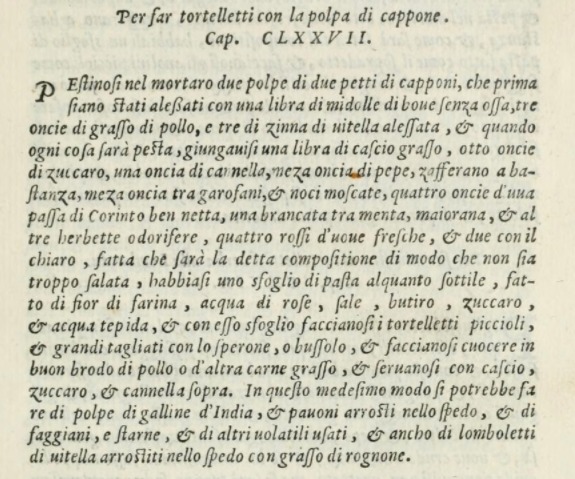
This dish comes from the kitchen of Bartolomeo Scappi, whose monumental cookbook Opera dell’arte del cucinare was published in 1570. Scappi was not cooking for merchants or minor nobles. He served popes, cardinals, and the highest clerical elite of Rome. His recipes represent the pinnacle of Renaissance court cuisine, where food was a display of learning, power, and cosmopolitan reach.
Chicken and capon meat enriched with bone marrow, perfumed with sugar, spice, herbs, and saffron, and wrapped in delicate pasta tells us everything about the era that produced it. This was a cuisine that believed refinement was achieved through balance rather than restraint, and sophistication through careful layering rather than simplicity.
Bartolomeo Scappi and the Papal Kitchen
Bartolomeo Scappi served as the personal cook to Pope Pius V and worked within the kitchens of the Vatican during the height of the Italian Renaissance. His Opera is not simply a recipe collection. It is a technical manual, an inventory of courtly life, and a declaration of culinary authority. In its pages, Scappi records not only dishes but also tools, banquets, seasonal menus, and instructions for feeding hundreds of guests during major religious events.

Scappi’s audience was the educated elite. His recipes assume access to skilled labor, rare ingredients, and refined taste. Rosewater, saffron, imported spices, and bone marrow were not casual inclusions. They were markers of status and global connection. To cook from Scappi was to participate in a shared elite language of food.
This particular stuffed pasta appears in a section dedicated to refined dishes suitable for important tables. It reflects the Renaissance belief that cuisine should harmonize pleasure, nourishment, and learned tradition. Nothing here is accidental. Even sweetness in a savory dish was understood as proper balance, not indulgence.
Why This Dish Defines Renaissance Sophistication
This pasta embodies several core values of Renaissance cuisine. First is luxury through technique, not quantity. The meat is finely chopped, the marrow carefully prepared, and the dough rolled thin. Excess is hidden inside precision.
Second is the continued influence of medieval taste. Sweet and savory are not separated. Sugar, cinnamon, cloves, and nutmeg appear naturally alongside meat and cheese. To the Renaissance palate, these combinations were not confusing. They were refined.
Finally, the dish reflects Renaissance medical thinking. Bone marrow was considered deeply nourishing. Spices were warming and digestively beneficial. Herbs like mint and marjoram were believed to aid balance in the body. Food was still medicine, but now framed within elegance.
This is not rustic Italian cooking. It is intellectual cooking, meant to be discussed as much as eaten.
Torelletti, Tortellini, and the Shape of the Past
One common mistake when recreating Renaissance pasta is assuming modern shapes apply directly. The “torelletti” described by Scappi are not the small ring shaped tortellini familiar today from Bologna. Those tightly wrapped, uniform shapes are a later regional standardization.
In Scappi’s time, stuffed pasta was often closer to what we would now call ravioli or square filled pasta. The emphasis was on thin dough, generous filling, and clean sealing, not ornamental folding. Shapes varied by cook, region, and occasion.
This matters because shape affects texture and experience. Larger, ravioli-like pieces allowed the aromatic filling to dominate. The pasta was a vessel, not the star. Understanding this helps avoid anachronism and brings us closer to how this dish would have actually appeared on a Renaissance table.
What This Dish Would Cost in Today’s Money
Measured by Renaissance standards, the cost of this dish was substantial. Taken together, the ingredients would have represented roughly seven to twelve days of wages forutherford of a skilled artisan in 16th-century Italy. Saffron alone, harvested by hand and imported at great expense, could account for several days of labor. Spices like cloves, cinnamon, nutmeg, and pepper were similarly costly, while sugar was still treated as a spice rather than a daily sweetener. Even the choice of capon over common chicken marked the dish as elite.
Converted responsibly into modern terms, this places the economic weight of the dish somewhere in the range of $1,500 to $3,000 today. Not because the ingredients were rare in quantity, but because they were rare in access. This was not a meal meant to be eaten casually. It was a culinary display intended for important tables, served to guests who understood exactly what they were being offered.
For the papal household and Rome’s highest clergy, this level of expense was not wasteful. It was deliberate. Serving a dish like this declared refinement, stability, and cultural authority. In that sense, Scappi’s pasta was not simply food. It was Renaissance diplomacy, expressed through dough, spice, and bone marrow.
Cooking and Serving in the Renaissance Context
This pasta was traditionally served either lightly bathed in broth or drained and dressed simply. The garnish of cinnamon sugar and Parmesan may surprise modern diners, but it aligns perfectly with Renaissance taste. Cheese, spice, and sweetness were meant to coexist harmoniously.
The broth itself was an essential component. It provided warmth, nourishment, and an aromatic backdrop without overwhelming the filling. The dish was meant to be elegant and digestible, not heavy.
When served, this pasta would have been one course among many, part of a carefully orchestrated progression. It was not the climax, but a demonstration of refinement midway through the meal.
Recipe: Luxury Renaissance Pasta
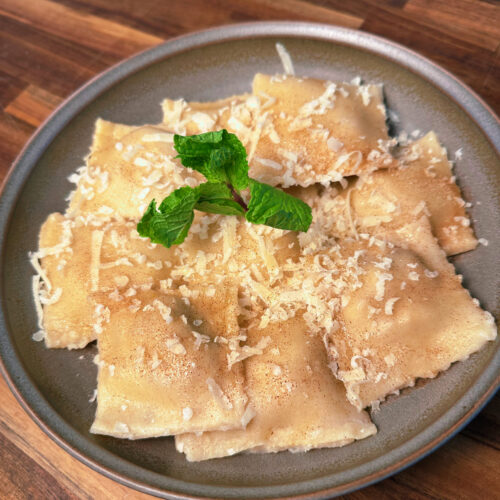
Torelletti with Capon Meat (Serves 4)
Ingredients
Dough
- 2 cups all-purpose flour
- 1 tablespoons unsalted butter softened
- 2½ teaspoons sugar
- ¾ teaspoon salt
- 3 tablespoons rosewater
- 3 tablespoons warm water
Filling
- 3/4 cup cooked capon or chicken breast finely chopped
- 1/2 cup beef bone marrow baked and removed from bone (about 2 bones total)
- 1 cup fresh ricotta
- 1 egg
- 1½ tablespoons sugar
- 1 teaspoon ground cinnamon
- ½ teaspoon freshly ground black pepper
- ¼ teaspoon ground cloves
- ¼ teaspoon ground nutmeg
- Small pinch saffron crushed
- ½ teaspoon finely chopped fresh mint
- ½ teaspoon finely chopped fresh marjoram optional
- Optional parsley chopped
- 2 tablespoons finely chopped currants or raisins
- ¾ teaspoon salt
For Cooking
- 2 quarts meat broth about 8 cups
Garnish
- Cinnamon sugar sprinkled
- Freshly grated Parmesan cheese
Instructions
Make the Dough
- In a mixing bowl, combine the flour, sugar, and salt.
- Rub the softened butter into the flour mixture until it resembles coarse crumbs.
- Add the rosewater and warm water gradually, mixing until a soft dough forms.
- Knead on a lightly floured surface for 8–10 minutes until smooth and elastic.
- Wrap tightly and let rest at room temperature for 30–45 minutes.
Prepare the Filling
- Finely chop the cooked capon or chicken breast and place in a bowl.
- Mash the baked bone marrow until smooth and add it to the meat.
- Stir in the ricotta until fully combined.
- Add the egg, mixing until cohesive.
- Add sugar, cinnamon, pepper, cloves, nutmeg, saffron, mint, marjoram, currants, and salt.
- Mix thoroughly until smooth and fragrant.
- Cover and refrigerate for 30 minutes to firm slightly.
Roll and Shape the Pasta
- Divide the rested dough into two portions, keeping one covered.
- Roll the dough very thin until nearly translucent.
- Cut into 2-inch squares.
- Place about ½ teaspoon filling in the center of each square.
- Cover with another sheet of dough, remove air bubbles, and cut again into sealed squares.
Cook the Pasta
- Bring the meat broth to a gentle boil in a wide pot.
- Add the pasta in batches, avoiding overcrowding.
- Cook for 3–4 minutes until tender and floating.
- Remove with a slotted spoon.
Serve
- Serve hot, lightly bathed in broth or drained.
- Finish with cinnamon sugar and freshly grated Parmesan.
- Serve immediately.
Video
Notes
- Bone marrow texture matters: The marrow should be baked just until soft and set, not fully melted. If it renders into liquid fat, the filling will lose structure and become greasy. Aim for a custardy consistency that can be mashed smoothly and folded into the meat. If the marrow is slightly warm when mixing, allow the filling to chill briefly before shaping.
- Roll the dough thinner than you think: Renaissance pasta dough was rolled extremely thin. Thicker dough will overpower the delicate, spiced filling and make the dish feel heavy. You should be able to see your fingers faintly through the dough before cutting. This also shortens cooking time and gives the pasta a more historically accurate texture.
- Do not skip the sweetness or spice balance: The sugar, cinnamon, cloves, and nutmeg are not optional embellishments. They are essential to the dish’s historical flavor profile. Modern palates often want to reduce sweetness in savory dishes, but doing so flattens the character of the filling. Keep the quantities as written and adjust only after tasting the finished dish, not before.