In the spring of 1843, roughly a thousand people loaded everything they owned into canvas-covered wagons and pointed them west. This became known as the Great Emigration, where 1,000 people in 120 wagons alongside 5,000 cattle, setting out on a 2,170-mile journey that would take between four and six months to complete.
They were not soldiers, not explorers, and not particularly well-funded. Most were middle-class settlers from Ohio, Indiana, Illinois, and Missouri, setting out from Independence, Missouri, the last major outpost on the western frontier. They were farmers, families, and people who had decided that whatever waited at the end of the trail was worth the risk of the trail itself.
If you’re enjoying my content, check out my e-cookbooks at the Eats History Shop!
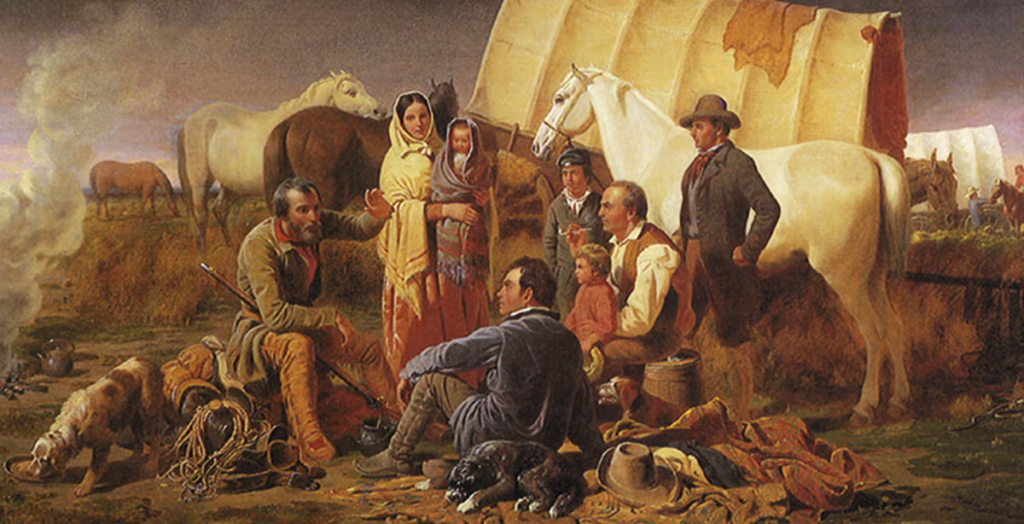
Pioneer families carried all of their possessions in wagons only about ten feet long and four feet wide, called prairie schooners because the canvas cover looked like a ship’s sail. Most were pulled by oxen, which were dependable and inexpensive. The journey was brutal in ways that the romanticized version of westward expansion tends to skip over. Illness and accidents were more serious threats than any attack, about 20,000 people died on the California Trail alone between 1841 and 1859, an average of ten graves for every mile. Disease, broken wheels, river crossings, and the simple grinding arithmetic of walking fifteen miles a day for five months straight claimed more lives than almost anything else.
Daily life on the trail followed a predictable rhythm. Travelers rose before dawn, prepared breakfast, gathered livestock, and were on the move by sunrise. The wagon train would cover fifteen to twenty miles on a good day before setting up camp in the late afternoon. Evenings were for cooking, repairs, and the rare luxury of sitting still. Then it started again at 4am the next morning, and the morning after that, for the better part of half a year.
The Book That Made This Video Possible
Every episode of Eats History is based on a primary source, and for this one there is no better document in existence than Captain Randolph B. Marcy’s The Prairie Traveler: A Hand-book for Overland Expeditions, published in 1859 by the U.S. War Department. Marcy was an army officer who spent decades on the western frontier and was commissioned by the government to write the definitive guide for emigrants making the overland journey. It is meticulous, practical, and reads like the manual of someone who had personally watched people make catastrophic decisions about what to pack and what to eat.
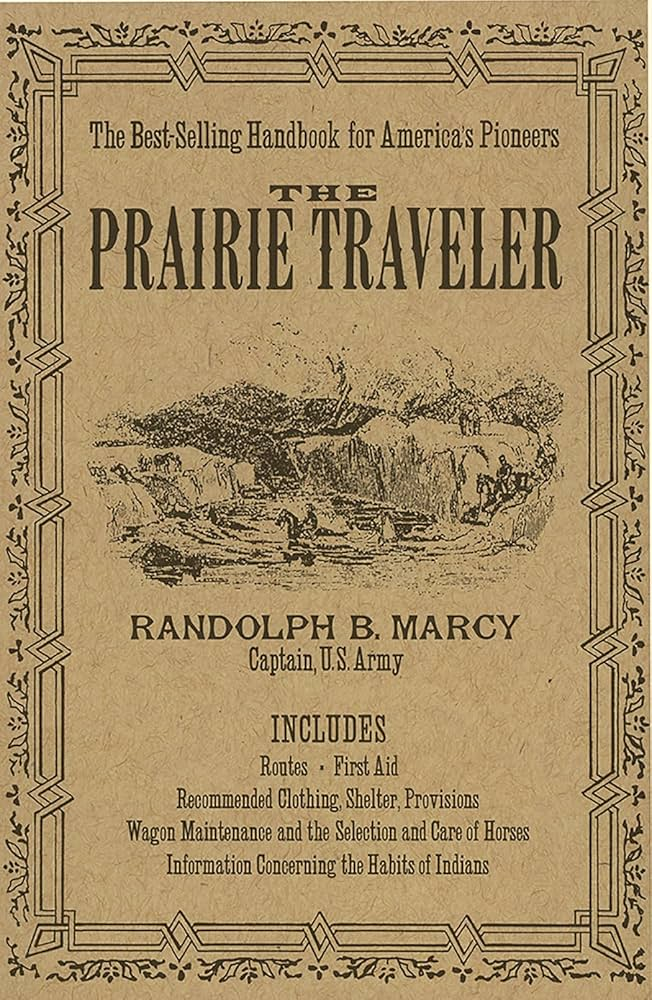
On the subject of provisions, Marcy does not speculate. He specifies. For each grown person to make the journey from the Missouri River to California or Oregon (provisioned for 110 days) the following was deemed requisite: 150 lbs of flour or its equivalent in hard bread, 25 lbs of bacon or pork plus enough fresh beef driven on the hoof, 15 lbs of coffee, and 25 lbs of sugar, along with saleratus or yeast powders for making bread, salt and pepper. That is the entire daily provision list for a working adult walking fifteen miles a day in all weather for nearly four months. It is not a lot. It was designed to keep someone alive and functional, not comfortable.
The Prairie Traveler is freely available through Project Gutenberg and is genuinely worth reading in its entirety, not just for the food history but for how matter-of-fact Marcy is about everything, the river crossings, snake bites, the relative merits of oxen versus mules, how to signal distress with smoke. It is a document from a world where the details genuinely meant the difference between arriving in Oregon or not arriving at all. As a primary source for recreating pioneer food, it is as good as it gets.
Cooking on the Trail: One Skillet, No Mercy
The first days of cooking on the trail were an eye-opening and challenging new experience. Some pioneer women brought their iron ovens from home, but these were heavy and required a lot of wood so they were often abandoned along the trail. A Dutch oven and a cast iron skillet were the practical tools that actually survived the journey.
Everything I made for this video came out of a single cast iron skillet, because that is what they had. One pan. No temperature control beyond moving it closer to or further from the fire. Good fuel was critical, and once the great plains were reached, trees were few. Overlanders resorted to collecting dry buffalo dung to use as fuel. I used my apartment electric burner, which is admittedly a significant upgrade from dried buffalo dung, but the food itself is as documented as I can make it. Cornmeal for breakfast, beans with bacon and biscuits for supper, coffee throughout the day, roasted in the skillet and boiled directly in water. This was the diet. This was every day, for five months.
Around 4am the wagon leader sounded a trumpet or fired a rifle to wake everyone up. By 5am breakfast was prepared while the animals were rounded up after a night of grazing. By 6am the men and boys hitched the wagons while everyone else ate breakfast. At 7am the bugle sounded and the emigrants started off for the day. Pioneers walking fifteen miles a day carrying nothing were still burning somewhere between 3,500 and 4,500 calories. The daily ration provided maybe 2,600 on a good day. The math was always slightly against them.
The Recreation: What I Actually Made and Ate
Breakfast — Cornmeal Mush with Bacon and Coffee
I will be direct: cornmeal mush is not good. It is not terrible, and I understand entirely why it existed — cornmeal was cheap, light, shelf-stable for months, and could be cooked in under twenty minutes with nothing but a pot and water. As a delivery mechanism for calories before a fifteen-mile walk, it is efficient. As something you want to eat, it is another matter entirely.
I made it the documented way, a half a cup of cornmeal stirred slowly into boiling salted water, cooked down to a thick porridge, sweetened with a spoonful of molasses. The molasses helps. It adds a dark, slightly bitter sweetness that cuts through the starchy blandness and gives it something. The bacon fried alongside in the same skillet is genuinely good (crispy, smoky, the rendered fat going slightly amber in the pan) and dipping a piece of bacon into the mush is the best version of the combination. But on its own, as the primary event of your morning, cornmeal mush earns its place in the historical record as something people ate because they had to rather than because they wanted to. The coffee, made by roasting green beans in the dry skillet, grinding them, and boiling them directly in water, was excellent. The coffee was always the highlight.
Supper — Pinto Beans with Bacon, Molasses, and Biscuits
This is where the day completely turned around. The beans had been soaking overnight and simmering all day in their pot, and by evening they were soft, creamy, and had absorbed everything the salt pork had to give over eight hours of low cooking. Then the cast iron skillet came back out: more bacon, fried until the fat had rendered and the edges were starting to crisp, and then the beans went in with a generous splash of molasses and a hit of salt. The molasses caramelizes slightly against the hot metal and coats the beans in something that is sweet and smoky and deeply savoury all at the same time. Biscuits baked alongside in the same pan, golden on the bottom from the bacon fat still in the skillet, used to scoop and soak up the bean broth.
This dish is as good in 2026 as it was in the 1840s. Possibly better now that I am eating it sitting down rather than after walking fifteen miles. The sweetness of the molasses against the smokiness of the bacon fat against the earthiness of the beans is a combination that works on every level, and the biscuits are so simple and so satisfying that you understand immediately why they appeared at every meal for five months. This is genuinely good food. Humble, honest, and completely delicious.
The Verdict: 7.9 out of 10
The day as a whole gets a 7.9 out of 10, which is higher than I expected going in.
The breakfast drags the score down. Cornmeal mush is a food I respect historically but do not want to eat again voluntarily, and doing it without the context of genuine hunger after a cold 4am start is not doing it any favours. I also roasted my own coffee beans in a dry skillet from green, which is a process that smells extraordinary and produces a cup that is legitimately excellent — strong, slightly earthy, none of the bitterness of an over-roasted commercial bean — and that experience alone is worth the whole exercise.
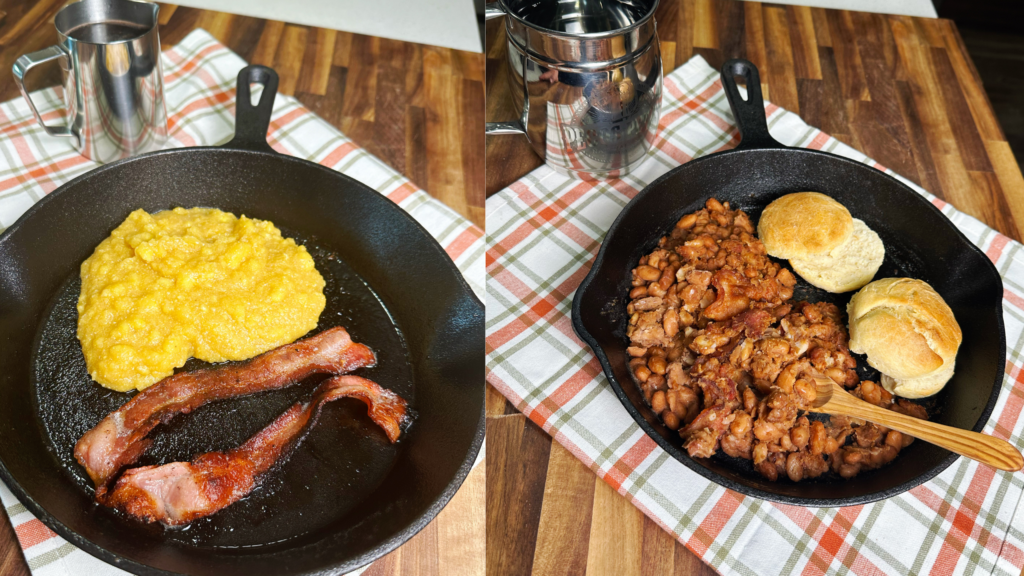
The supper is what saves this. Smoky, slightly sweet pinto beans with bacon fat and molasses over biscuits is one of the better things I have cooked for this channel, and I say that without any historical charity factored in. If you gave me that bowl of beans on a cold evening without telling me it was a historical recreation, I would be happy. The pioneers who ate this every night for five months had something to look forward to at the end of a very hard day, and that matters more than it sounds.
Primary source: Captain Randolph B. Marcy, The Prairie Traveler: A Hand-book for Overland Expeditions (1859), U.S. War Department. Free on Project Gutenberg.
The Oregon Trail Recipes:
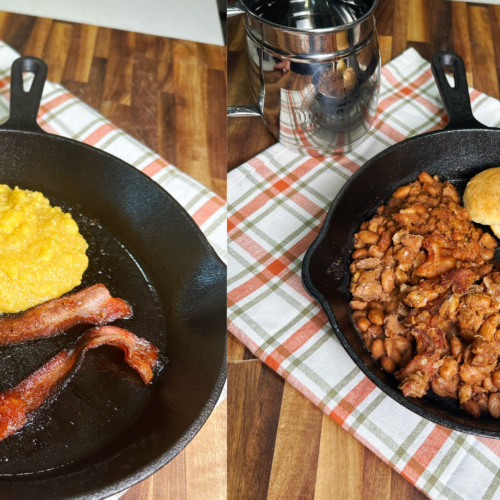
Oregon Trail Full Day — Breakfast and Supper
Ingredients
Breakfast
- ½ cup coarse ground cornmeal
- 2 cups water
- ½ tsp salt
- 1 tbsp molasses
- 2 3 strips thick-cut bacon
- 2 tbsp whole coffee beans
- 1½ cups water coffee
- 1 tsp sugar or molasses coffee
Supper
- 1 cup dried pinto beans soaked overnight
- 5 cups water
- 4 oz thick-cut bacon or salt pork cut into chunks
- 1 tbsp molasses
- 1 tsp salt
- ½ tsp black pepper
Biscuits
- 2 cups all-purpose flour
- 1 tsp baking powder
- ½ tsp salt
- 3 tbsp lard bacon fat, or butter
- ¾ cup milk or water
Instructions
THE NIGHT BEFORE
- Rinse 1 cup dried pinto beans and cover with cold water in a heavy pot. Leave to soak overnight.
BREAKFAST
- Drain the soaked beans and put them on to cook first — cover with 5 cups fresh water, add the salt pork chunks, bring to a boil, then reduce to the lowest possible simmer. They cook all day. Check occasionally and add water if needed. Season with salt and pepper in the final hour.
- For the coffee: place 2 tbsp whole beans in the dry cast iron skillet over medium heat. Stir constantly for 10 to 12 minutes until deep brown and fragrant. Remove from the skillet, grind coarsely, and set aside. Bring 1½ cups water to a full boil in a small pot, add the grounds directly, stir once, remove from heat and let stand 4 minutes for the grounds to settle. Pour carefully into a cup leaving the last bit of grounds in the pot. Add sugar or molasses. This is the first coffee.
- For the cornmeal mush: bring 2 cups water to a rolling boil in the cast iron skillet. Add ½ tsp salt. Pour the cornmeal in a slow, steady stream while stirring constantly — do not stop or it will clump. Reduce to low and keep stirring for 15 to 20 minutes until it thickens to a heavy porridge that holds its shape. Add 1 tbsp molasses. Transfer to a bowl.
- In the same skillet, fry the bacon strips until crisp. Eat the mush with the coffee and bacon alongside.
SUPPER
- By now the beans have been cooking 8 to 10 hours. They should be completely soft, the broth thick and dark from the pork fat.
- In the cast iron skillet, fry 2 to 3 more strips of bacon until the fat has rendered and the edges are crisping. Pour in the beans along with enough of their broth to fill the skillet about halfway. Add 1 tbsp molasses, stir to combine, and let everything cook together over medium heat for 5 to 8 minutes until the molasses has caramelized slightly into the beans and the broth has thickened. Taste and adjust salt.
- For the biscuits: combine flour, baking powder, and salt in a bowl. Add the fat and work it into the flour with your fingers until it resembles coarse crumbs. Add liquid gradually and stir until a soft dough just comes together. Do not overwork. Pat to ¾ inch thick on a floured surface, cut into rounds. Place directly into the skillet alongside the beans if it is large enough, or in a separate greased pan. Bake at 425°F for 12 to 15 minutes until golden. The bacon fat in the skillet will fry the underside of the biscuits slightly, which is correct and good.
- Serve the beans in a deep bowl with the biscuits to soak up the broth. Make the final round of coffee using the same method as breakfast.
- This is supper. This was always supper. It is very good.
Video
Notes
- The Beans Are the Whole Day: Do not skip the overnight soak and do not rush the simmer. Eight to ten hours of low, slow cooking is what turns dried beans and a chunk of bacon into something that tastes genuinely cared for. The fat from the pork slowly works into every bean over the course of the day, and the broth that results is the base for everything that happens in the skillet at supper. Start them the night before for a midday meal, or first thing in the morning for an evening supper. Low heat and patience are the only technique required.
- One Skillet, In Order: The cast iron skillet is doing multiple jobs across the day and the order matters. Coffee beans first in the dry pan, then cornmeal mush, then breakfast bacon, then beans and molasses at supper, then biscuits last. Each use seasons the skillet a little more and the residual bacon fat from both cooks goes into the biscuit bottoms. Do not wash the skillet between uses. Wipe it if necessary but keep the fat in the pan. This is the entire point of cast iron cooking and the pioneers knew it.
- The Molasses Is Not Optional: Molasses is doing real work in both dishes. In the mush it is the only thing that makes breakfast worth eating, cutting the starchy blandness with a dark, slightly bitter depth that plain sugar cannot replicate. In the beans it caramelizes against the hot skillet and creates a sweet-smoky glaze that ties together the bacon fat, the broth, and the spice. Blackstrap is the most period-accurate and most flavorful choice. Do not substitute maple syrup as it is too thin, too sweet, and will not behave the same way in a hot pan.