Go Back

Oregon Trail Full Day — Breakfast and Supper

Print Recipe
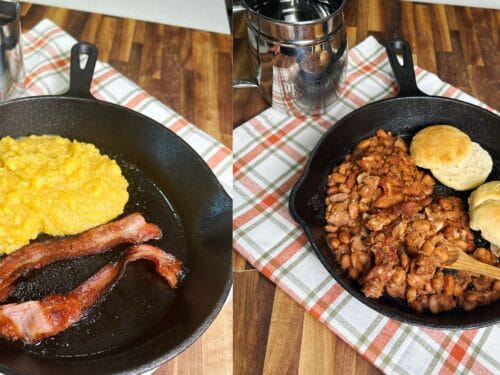
This is a full day of eating reconstructed from Captain Randolph B. Marcy's The Prairie Traveler (1859), the U.S. government-issued handbook that every Oregon Trail emigrant carried west. Breakfast is cornmeal mush sweetened with molasses and eaten alongside fried bacon and black camp coffee roasted in the same skillet — functional, calorie-dense, and fine in the way that all food eaten before a fifteen-mile walk is fine. Supper is where the day earns its score: pinto beans simmered all day with salt pork until the broth is thick and smoky, then finished in the cast iron with a hit of molasses that caramelizes into something genuinely extraordinary, served with biscuits baked in the same bacon-fat pan. The combination of slightly sweet beans, smoky rendered fat, and hot biscuits to soak up the broth is as good in 2026 as it was in the 1840s — a 7.9 out of 10, with the cornmeal mush dragging the morning down and the supper pulling everything back up.
Prep Time 20 minutes
Cook Time 40 minutes
Beans Simmering 8 hours

Ingredients

Breakfast

  • ½ cup coarse ground cornmeal
  • 2 cups water
  • ½ tsp salt
  • 1 tbsp molasses
  • 2 3 strips thick-cut bacon
  • 2 tbsp whole coffee beans
  • cups water coffee
  • 1 tsp sugar or molasses coffee

Supper

  • 1 cup dried pinto beans soaked overnight
  • 5 cups water
  • 4 oz thick-cut bacon or salt pork cut into chunks
  • 1 tbsp molasses
  • 1 tsp salt
  • ½ tsp black pepper

Biscuits

  • 2 cups all-purpose flour
  • 1 tsp baking powder
  • ½ tsp salt
  • 3 tbsp lard bacon fat, or butter
  • ¾ cup milk or water

Instructions

THE NIGHT BEFORE

  • Rinse 1 cup dried pinto beans and cover with cold water in a heavy pot. Leave to soak overnight.

BREAKFAST

  • Drain the soaked beans and put them on to cook first — cover with 5 cups fresh water, add the salt pork chunks, bring to a boil, then reduce to the lowest possible simmer. They cook all day. Check occasionally and add water if needed. Season with salt and pepper in the final hour.
  • For the coffee: place 2 tbsp whole beans in the dry cast iron skillet over medium heat. Stir constantly for 10 to 12 minutes until deep brown and fragrant. Remove from the skillet, grind coarsely, and set aside. Bring 1½ cups water to a full boil in a small pot, add the grounds directly, stir once, remove from heat and let stand 4 minutes for the grounds to settle. Pour carefully into a cup leaving the last bit of grounds in the pot. Add sugar or molasses. This is the first coffee.
  • For the cornmeal mush: bring 2 cups water to a rolling boil in the cast iron skillet. Add ½ tsp salt. Pour the cornmeal in a slow, steady stream while stirring constantly — do not stop or it will clump. Reduce to low and keep stirring for 15 to 20 minutes until it thickens to a heavy porridge that holds its shape. Add 1 tbsp molasses. Transfer to a bowl.
  • In the same skillet, fry the bacon strips until crisp. Eat the mush with the coffee and bacon alongside.

SUPPER

  • By now the beans have been cooking 8 to 10 hours. They should be completely soft, the broth thick and dark from the pork fat.
  • In the cast iron skillet, fry 2 to 3 more strips of bacon until the fat has rendered and the edges are crisping. Pour in the beans along with enough of their broth to fill the skillet about halfway. Add 1 tbsp molasses, stir to combine, and let everything cook together over medium heat for 5 to 8 minutes until the molasses has caramelized slightly into the beans and the broth has thickened. Taste and adjust salt.
  • For the biscuits: combine flour, baking powder, and salt in a bowl. Add the fat and work it into the flour with your fingers until it resembles coarse crumbs. Add liquid gradually and stir until a soft dough just comes together. Do not overwork. Pat to ¾ inch thick on a floured surface, cut into rounds. Place directly into the skillet alongside the beans if it is large enough, or in a separate greased pan. Bake at 425°F for 12 to 15 minutes until golden. The bacon fat in the skillet will fry the underside of the biscuits slightly, which is correct and good.
  • Serve the beans in a deep bowl with the biscuits to soak up the broth. Make the final round of coffee using the same method as breakfast.
  • This is supper. This was always supper. It is very good.
Video

Notes

  • The Beans Are the Whole Day: Do not skip the overnight soak and do not rush the simmer. Eight to ten hours of low, slow cooking is what turns dried beans and a chunk of bacon into something that tastes genuinely cared for. The fat from the pork slowly works into every bean over the course of the day, and the broth that results is the base for everything that happens in the skillet at supper. Start them the night before for a midday meal, or first thing in the morning for an evening supper. Low heat and patience are the only technique required.
 
  • One Skillet, In Order: The cast iron skillet is doing multiple jobs across the day and the order matters. Coffee beans first in the dry pan, then cornmeal mush, then breakfast bacon, then beans and molasses at supper, then biscuits last. Each use seasons the skillet a little more and the residual bacon fat from both cooks goes into the biscuit bottoms. Do not wash the skillet between uses. Wipe it if necessary but keep the fat in the pan. This is the entire point of cast iron cooking and the pioneers knew it.
 
  • The Molasses Is Not Optional: Molasses is doing real work in both dishes. In the mush it is the only thing that makes breakfast worth eating, cutting the starchy blandness with a dark, slightly bitter depth that plain sugar cannot replicate. In the beans it caramelizes against the hot skillet and creates a sweet-smoky glaze that ties together the bacon fat, the broth, and the spice. Blackstrap is the most period-accurate and most flavorful choice. Do not substitute maple syrup as it is too thin, too sweet, and will not behave the same way in a hot pan.