Every Mongol warrior carried his own food supply, concentrated, lightweight and requiring no cooking fire to consume in the field. Borts, air-dried meat reduced to powder and dissolved in hot water. And suutei tsai, salted milk tea brewed in an iron pot over a small fire, providing warmth, calories, salt and hydration in a single bowl.
I made both. The borts in an oven rather than the Mongolian steppe. The suutei tsai on a modern gas range rather than a camp fire. The result is a spread that makes complete sense for a nomadic warrior covering sixty miles a day and makes considerably less sense for a 21st century city dweller sitting in a kitchen in North America. This is the full story of what the most militarily successful army in human history ate on campaign, and why.
The Sources: What We Actually Know
The oldest and most significant source is the Secret History of the Mongols, the earliest surviving Mongolian literary work, compiled around 1227 AD, the year of Genghis Khan’s death. It is the foundational document of Mongol history and culture and it references dried mutton, known historically as si’usun, as a staple prepared food for travel, military campaigns and family gatherings. It does not provide a recipe in the modern sense but it documents the practice clearly and repeatedly, treating dried meat as an obvious and universal element of Mongol life rather than something requiring explanation.
The most detailed eyewitness accounts come from Western travellers who visited the Mongol empire in the 13th century. Friar William of Rubruck, a Flemish Franciscan monk who travelled to the Mongol court between 1253 and 1255 and left one of the most comprehensive accounts of Mongol life ever written by an outsider, documented both the dried meat and the drinking habits of the Mongols with the fascinated horror of a man encountering a civilisation completely unlike his own. On the subject of water, Rubruck noted that the Mongols were most careful not to drink pure water, a direct reference to the cultural preference for milk, fermented milk drinks, and milk tea over plain water that is still documented in Mongolian culture today.
Marco Polo, writing around 1300 AD based on his travels in the Mongol empire, documented the military ration specifically, noting that a Mongol cavalryman could go ten days without cooking food, sustained by dried meat and fermented mare’s milk. He was not exaggerating for effect. The logistics of Mongol military campaigns confirm that no supply line existed in the Western sense. Every soldier was his own supply chain.
The Yinshan zhengyao, a dietary manual compiled in 1330 AD by Hu Sihui, court dietician to the Yuan dynasty Mongol emperors of China, is the most detailed primary source for the food culture of the Mongol imperial court. It documents milk preparations, meat dishes and tea-based drinks in enough detail to reconstruct them with confidence. Suutei tsai as a preparation is documented in sources from this period and the tradition of salted milk tea as a daily staple is referenced in virtually every Western account of Mongol life from Rubruck onward.
Borts: The Original MRE
Borts is one of the most ingeniously engineered food preservation systems in history and it was developed not in a laboratory but by nomadic herders on the Mongolian steppe through centuries of practical necessity.
The process begins with fresh meat. Horse is the most historically associated with borts and is still used in traditional Mongolian preparation today. Beef, mutton, goat and camel are all documented. The meat is sliced into long, thick strips, two to three centimetres thick and five to seven centimetres wide, cutting against the grain to maximise the surface area exposed to the air. Every trace of fat is removed. This is the most important step and cannot be skimped on. Fat does not dry cleanly in the shade-and-wind method the Mongols used. It turns rancid instead of desiccating, which defeats the entire purpose of the preservation.
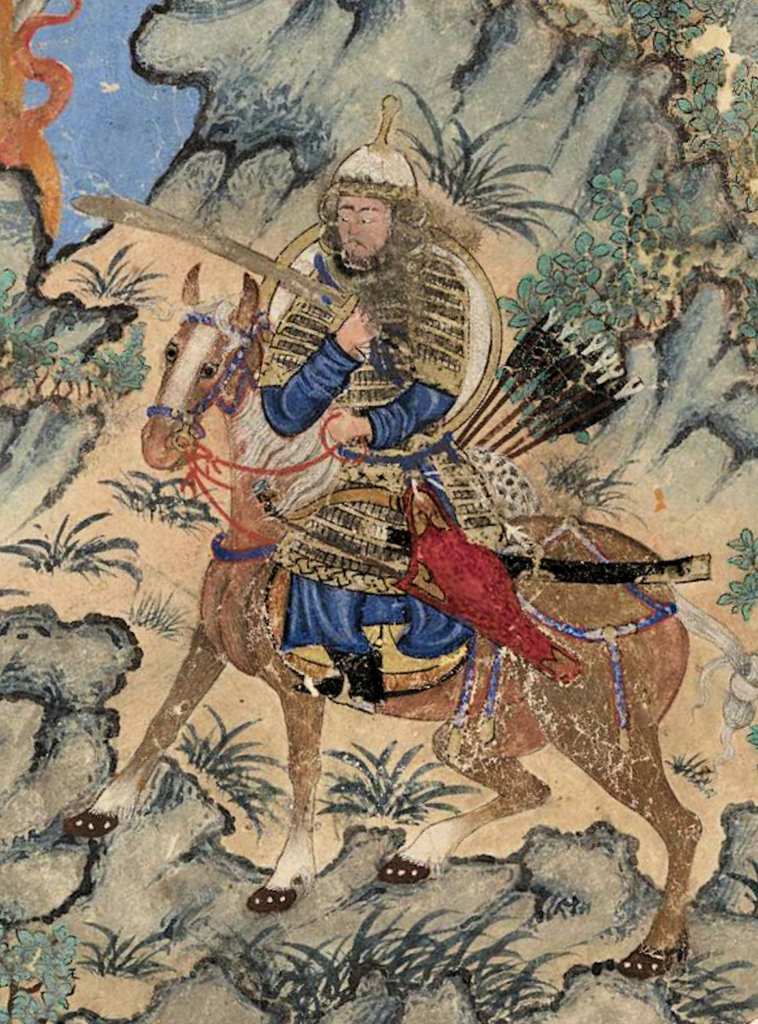
The stripped meat is then hung in the shade, typically under the eave of a yurt or in a cool, constantly ventilated location, and left for approximately one month. The Mongolian climate does most of the work. Cold winters and arid summers create ideal conditions for natural desiccation. The meat dries from the outside in, slowly losing moisture until it becomes rigid, dark brown, and so hard it can be snapped rather than bent. At this point it is broken into smaller pieces and ground coarsely in a mortar or between stones into a rough fibrous powder.
The volume reduction achieved through this process is what made borts so militarily significant. The dried, powdered meat of an entire cow could be stored in that same cow’s stomach used as a bag, a detail documented in multiple historical sources. A soldier carrying a small leather pouch of borts powder was carrying the nutritional equivalent of several kilograms of fresh meat. It required no refrigeration, no cooking, and in the field it could be consumed in two ways. A small handful of powder dissolved in a cup of boiling water produced a thin but intensely flavoured, protein-rich broth that could sustain a rider for hours. Larger pieces soaked overnight and simmered with whatever vegetables or grains were available produced a full reconstituted meat stew. The Mongol army could stop for twenty minutes, heat water over a small fire, dissolve their borts, drink the broth, and be moving again before a European army had finished deciding where to make camp.
Suutei Tsai: The Drink of the Steppes
The name means milk tea in Mongolian. Suutei means milk, tsai means tea, and the drink is exactly that: tea brewed strong in water, combined with an equal volume of whole milk, and seasoned with salt. It is consumed hot, typically from wide, shallow bowls held with both hands, multiple times per day. William of Rubruck’s documentation that Mongols were most careful not to drink pure water is the earliest Western reference to this practice. Mongolian culture traditionally considered plain water unsuitable as a daily drink, partly for practical reasons in a landscape where water sources could be contaminated or unreliable, and partly for cultural reasons tied to the belief that water was sacred and should not be casually consumed. Milk and milk-based drinks, including suutei tsai, airag, the fermented mare’s milk that was the adult beverage of choice on the steppe, and various other dairy preparations, were the liquids of daily Mongolian life.
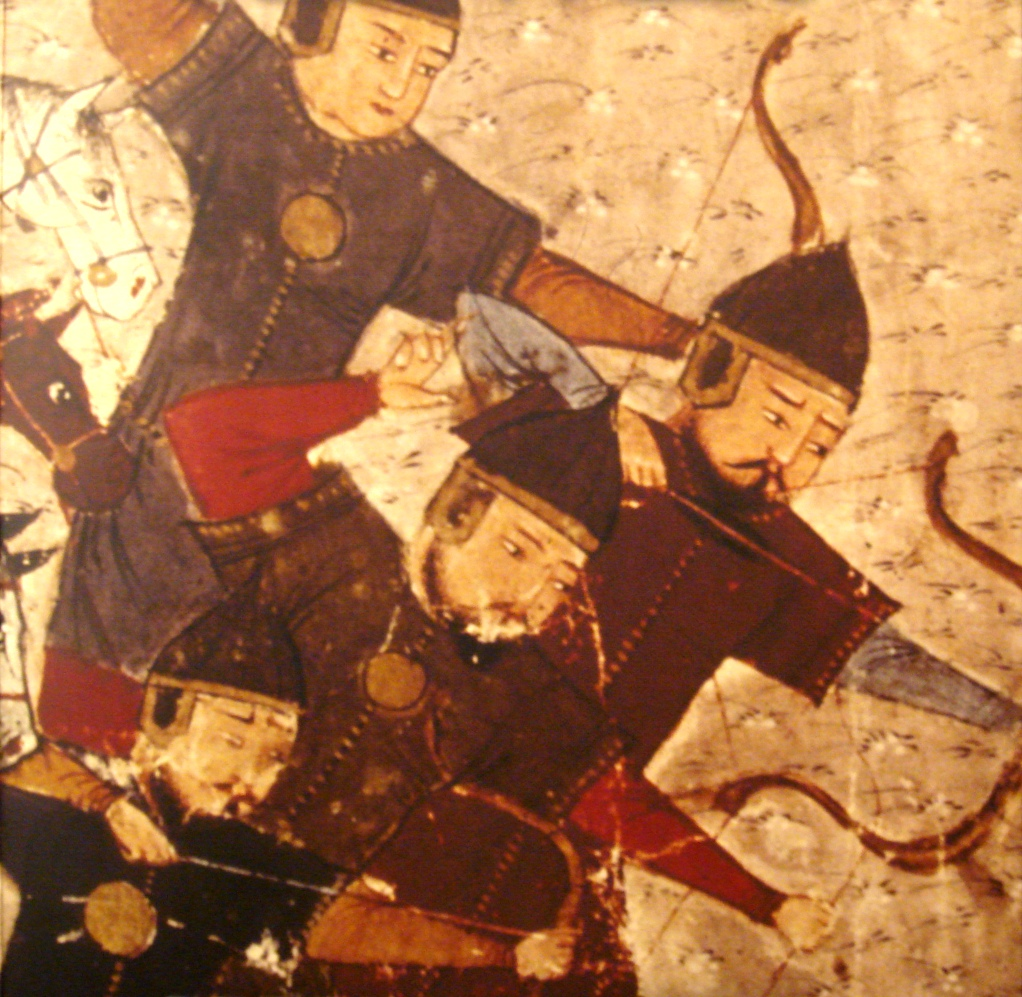
The tea itself came from China, brought into the Mongol empire through trade and tribute. Compressed brick tea, made from low-grade leaves and stems pressed into hard blocks for easy transport and storage, was the standard form. Pieces were chipped off the block and boiled directly in water rather than steeped delicately as in the Chinese or Japanese traditions. The Mongol preparation was robust and functional. You boiled the tea hard for several minutes, added the milk, added the salt, simmered until everything was integrated, and served it. The Yinshan zhengyao documents variations of this preparation in the Yuan dynasty court context and the tradition is continuous in Mongolian culture from the 13th century to the present day.
The toasted millet addition, documented in Mongolian culinary sources as budaatai tsai, the millet version of suutei tsai, added body, calories and a faintly nutty flavour. On a cold morning on the steppe before a day of riding, a bowl of suutei tsai with toasted millet is not a refined drink. It is fuel, warmth and sustenance in a single vessel, which is exactly what it was designed to be.
The Camp: What a Mongol Field Meal Actually Looked Like
Understanding borts and suutei tsai in isolation gives you the ingredients. Understanding how they were used together gives you the full picture of Mongol military logistics.
A Mongol warrior on campaign woke before dawn. He packed his yurt or his felt sleeping blanket, saddled one of his several horses, and prepared to ride. The fire from the night before, if there had been one, was already cold. He heated water in a small iron pot, the universal cooking vessel of the Mongol steppe, over a quickly built fire of dried dung, the standard fuel on the treeless grasslands. He brewed his suutei tsai with the brick tea and milk he carried. He dissolved a handful of borts powder in hot water and drank the broth from a wooden or metal bowl. He ate a small piece of dried borts if he was hungry. He broke camp. He rode.
This process, from waking to moving, took considerably less time than any contemporary army’s equivalent. No bread to bake. No porridge to prepare from scratch. No supply wagon to wait for. The food was already prepared, already concentrated, already portable. The Mongol army’s logistics were not organised around food. The food was organised around the army’s need to move. This is the fundamental inversion that made the Mongol military machine unlike anything that had come before it and unlike anything that would come after it until the development of modern military rations in the 19th and 20th centuries.
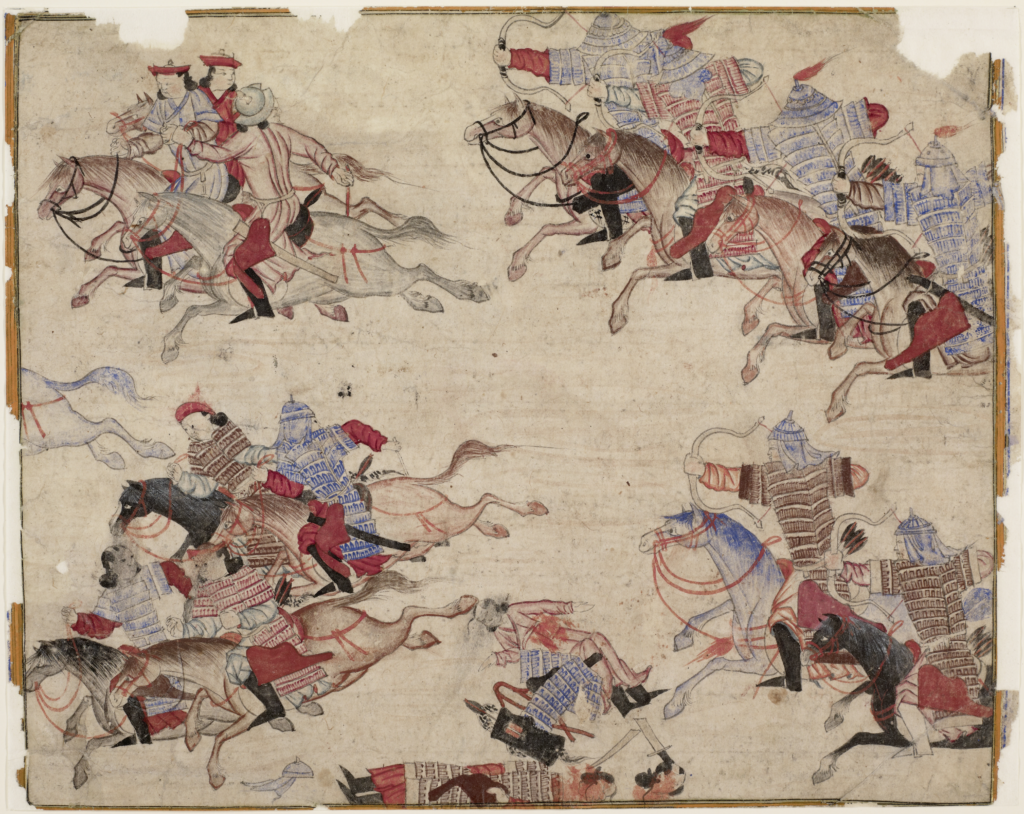
Every soldier carried approximately ten days of borts powder and sufficient brick tea, salt and dried milk curds to make suutei tsai. The herd of horses that accompanied every Mongol unit provided fresh milk when available. When it was not, the dried milk curds dissolved in water. When everything ran out, as Marco Polo documented, a desperate Mongol could open a vein in his horse’s neck, drink a small amount of blood, close the wound, and continue riding. The horse survived. The soldier was sustained. The army kept moving.
My Rating and Honest Assessment
I want to be completely honest about this one. I made the borts in an oven rather than hanging it in the open air for a month, which is the historically accurate method. The oven works as a desiccation method but it does not perfectly replicate the result of cold, moving air over thirty days. The texture was correct, rigid and dense and requiring significant effort to break apart. But the flavour, and this is the critical thing, is almost nonexistent.
No salt. No seasoning. Nothing. The borts dissolved in hot water produces a thin, dark, faintly meaty broth that tastes of very little. As a survival ration it makes complete sense. As something to eat voluntarily in the 21st century it requires a significant adjustment of expectations. I kept thinking about what it would taste like with salt, with dried herbs, with anything. The answer is that it would taste considerably better. The Mongol warrior eating this on the steppe after three days of hard riding was not thinking about flavour. He was thinking about distance. I was thinking about dinner.
The suutei tsai genuinely surprised me. I expected to find the salted milk tea off-putting and I did not. It is savoury and warming and the earthiness of the green tea works with the fat of the whole milk in a way that makes the salt feel natural rather than intrusive. My honest thought on drinking it was that a small amount of honey would make it considerably better. I am aware that this thought marks me clearly as a person of the 21st century rather than a Mongol warrior. The suutei tsai is a genuinely pleasant drink once you adjust your expectations away from sweetness.
As a complete meal for a nomadic warrior covering sixty miles a day in minus twenty degree temperatures: this is exceptional food, precisely engineered for its purpose. As a complete meal for a 21st century city dweller sitting in a kitchen: the thumbs go down.
Rating: 3.5 / 10
The Recipes: Borts and Suutei Tsai
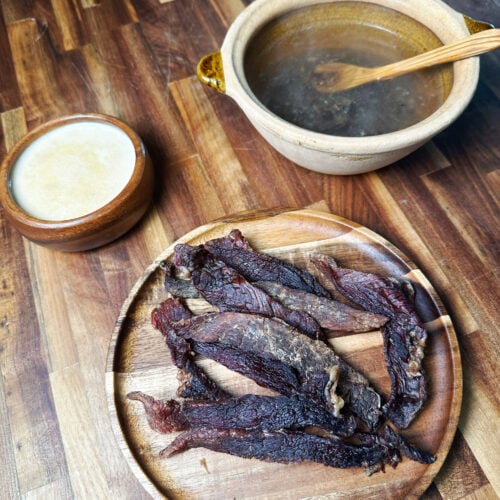
Borts and Suutei Tsai
Ingredients
Ingredients
For the Borts:
- 2 lbs lean beef lamb, or goat — horse is the most historically accurate but beef is the most practical substitute. Use a lean cut: brisket, round or flank. Trim every trace of visible fat and sinew
- No salt. No seasoning. This is the historically documented preparation and the entire point
For the Suutei Tsai:
- 2 cups water
- 2 cups whole milk full fat — the richer the better. A splash of cream added to whole milk is closer to the original milk from Mongolian livestock
- 1 tbsp loose green tea leaves or one block of compressed green tea chipped apart — green tea is more historically accurate for the Mongol period. Black tea became dominant in later centuries
- ½ to 1 tsp coarse salt to taste — start conservatively and add more. The salt should be clearly present but not overwhelming
- 2 tbsp toasted millet optional but recommended — toast dry millet in a pan over medium heat until golden and fragrant, stirring constantly, before adding to the pot
Instructions
Make the Borts
- Slice the meat against the grain into long strips, 2 to 3 cm thick and 5 to 7 cm wide. Uniformity matters for even drying. Remove every trace of fat and sinew. Fat will not dry properly and will cause the meat to spoil rather than preserve. This step is not optional.
- Oven method: Lay the strips on a wire rack set over a baking sheet. Place in the oven at the lowest possible temperature, 170°F or below. Prop the oven door open slightly with a wooden spoon to allow moisture to escape continuously. Dry for 6 to 8 hours until the strips are completely rigid, dark brown, and snap rather than bend when pressure is applied. If they bend at all they are not done.
- Dehydrator method: Lay strips on dehydrator trays with space between each piece. Set to 160°F and run for 6 to 8 hours until completely rigid and hard.
- To store: Break the dried strips into smaller pieces and grind coarsely in a food processor or pound in a mortar until you have a rough, fibrous powder. Store in a cloth or linen bag, not airtight. In dry conditions it will keep for months.
- To eat as broth: Take a small handful of ground borts powder and add to a cup of boiling water. Let it rehydrate for 5 to 10 minutes. Drink the resulting broth directly from the bowl.
- To eat as reconstituted meat: Soak larger pieces of borts in cold water overnight until rehydrated. Add to a pot of boiling water with wild onion, millet or scallions. Simmer for 30 to 45 minutes until completely tender.
Make the Suutei Tsai
- Bring the water to a full boil in a medium saucepan or iron pot. Add the tea leaves and simmer hard for 3 to 4 minutes. The resulting tea base should be strong and dark.
- Add the whole milk and salt. Stir to combine. Return to a gentle simmer, stirring occasionally to prevent the milk from scorching on the bottom. Do not boil hard at this stage. Simmer together for 5 minutes until the tea, milk and salt are fully integrated.
- If using toasted millet, add it now and simmer for a further 5 minutes. The millet will absorb some of the liquid and add a faintly nutty, slightly thickened quality to the drink.
- Strain into wide, shallow bowls rather than cups. Hold the bowl with both hands. Drink it hot alongside the borts broth.
Video
Notes
- Do not add sugar. Suutei tsai is a savoury drink and adding sugar produces a completely different beverage that has no historical relationship to the original. If you find the salt overwhelming on your first attempt, reduce it slightly on your second. The balance takes some adjustment for palates accustomed to sweet drinks.
- The millet version, budaatai tsai, is more filling and more appropriate as a meal accompaniment. The plain version is lighter and closer to the everyday drink consumed throughout the day on the steppe.
- If you want to know what it tastes like with honey: yes, it is better. That information is for you personally and not for the historical record.