Go Back

Borts and Suutei Tsai

Print Recipe
The field rations of the Mongol Empire, 13th century. Borts (dried beef or goat jerkey) and Suutei Tsai (milk tea). Primary sources: The Secret History of the Mongols, c.1227 AD; Friar William of Rubruck, account of his journey to Mongolia, 1253-1255 AD; Marco Polo, Travels, c.1300 AD; Hu Sihui, Yinshan zhengyao, 1330 AD.
Prep Time 5 minutes
Cook Time 1 hour
Dehydration Time 8 hours

Ingredients

Ingredients

For the Borts:

  • 2 lbs lean beef lamb, or goat — horse is the most historically accurate but beef is the most practical substitute. Use a lean cut: brisket, round or flank. Trim every trace of visible fat and sinew
  • No salt. No seasoning. This is the historically documented preparation and the entire point

For the Suutei Tsai:

  • 2 cups water
  • 2 cups whole milk full fat — the richer the better. A splash of cream added to whole milk is closer to the original milk from Mongolian livestock
  • 1 tbsp loose green tea leaves or one block of compressed green tea chipped apart — green tea is more historically accurate for the Mongol period. Black tea became dominant in later centuries
  • ½ to 1 tsp coarse salt to taste — start conservatively and add more. The salt should be clearly present but not overwhelming
  • 2 tbsp toasted millet optional but recommended — toast dry millet in a pan over medium heat until golden and fragrant, stirring constantly, before adding to the pot

Instructions

Make the Borts

  • Slice the meat against the grain into long strips, 2 to 3 cm thick and 5 to 7 cm wide. Uniformity matters for even drying. Remove every trace of fat and sinew. Fat will not dry properly and will cause the meat to spoil rather than preserve. This step is not optional.
  • Oven method: Lay the strips on a wire rack set over a baking sheet. Place in the oven at the lowest possible temperature, 170°F or below. Prop the oven door open slightly with a wooden spoon to allow moisture to escape continuously. Dry for 6 to 8 hours until the strips are completely rigid, dark brown, and snap rather than bend when pressure is applied. If they bend at all they are not done.
  • Dehydrator method: Lay strips on dehydrator trays with space between each piece. Set to 160°F and run for 6 to 8 hours until completely rigid and hard.
  • To store: Break the dried strips into smaller pieces and grind coarsely in a food processor or pound in a mortar until you have a rough, fibrous powder. Store in a cloth or linen bag, not airtight. In dry conditions it will keep for months.
  • To eat as broth: Take a small handful of ground borts powder and add to a cup of boiling water. Let it rehydrate for 5 to 10 minutes. Drink the resulting broth directly from the bowl.
  • To eat as reconstituted meat: Soak larger pieces of borts in cold water overnight until rehydrated. Add to a pot of boiling water with wild onion, millet or scallions. Simmer for 30 to 45 minutes until completely tender.
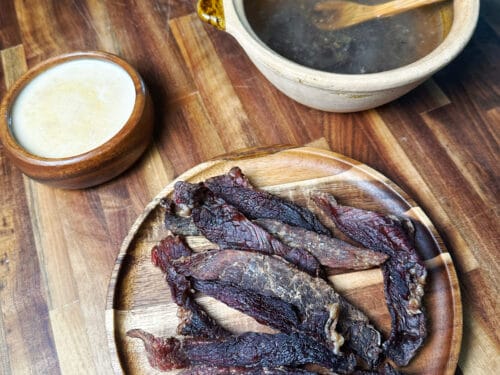
Make the Suutei Tsai

  • Bring the water to a full boil in a medium saucepan or iron pot. Add the tea leaves and simmer hard for 3 to 4 minutes. The resulting tea base should be strong and dark.
  • Add the whole milk and salt. Stir to combine. Return to a gentle simmer, stirring occasionally to prevent the milk from scorching on the bottom. Do not boil hard at this stage. Simmer together for 5 minutes until the tea, milk and salt are fully integrated.
  • If using toasted millet, add it now and simmer for a further 5 minutes. The millet will absorb some of the liquid and add a faintly nutty, slightly thickened quality to the drink.
  • Strain into wide, shallow bowls rather than cups. Hold the bowl with both hands. Drink it hot alongside the borts broth.

Video

Notes

  • Do not add sugar. Suutei tsai is a savoury drink and adding sugar produces a completely different beverage that has no historical relationship to the original. If you find the salt overwhelming on your first attempt, reduce it slightly on your second. The balance takes some adjustment for palates accustomed to sweet drinks.
 
  • The millet version, budaatai tsai, is more filling and more appropriate as a meal accompaniment. The plain version is lighter and closer to the everyday drink consumed throughout the day on the steppe.
 
  • If you want to know what it tastes like with honey: yes, it is better. That information is for you personally and not for the historical record.