The Ancient Greeks did not set a place at the table for their gods. They knew better than that.
The gods ate ambrosia and drank nectar, divine substances that had nothing to do with the barley, cheese, and olive oil that sustained mortal life on the hillsides of Attica and the coasts of the Aegean. To offer a god your food was not to feed them. It was to acknowledge them. To declare, in the language of smoke and honey and grain, that you understood your place in the order of things and you were grateful for it.
If you’re enjoying my content, pick up an e-cookbook at the Eats History Shop! Now 40% Off!

And yet the Greeks baked. Constantly, elaborately, with extraordinary specificity. Different cakes for different gods. Different shapes, different ingredients, different occasions. A cake for Artemis on the full moon. A cake for Demeter made only from wheat grown on a specific sacred plain. A cake for Zeus in the shape of a bull, offered precisely because people once sacrificed actual bulls and someone eventually decided the cake was enough.
The popanon kathemenon, the flat wheat and cheese cake offered specifically to Poseidon, is documented in the Athenian sacred calendar of the 1st century CE, inscribed in stone. Two ingredients: wheat flour and soft cheese. Flat, round, and modest. Offered alongside fresh fish from the sea that was his domain.
We are making it today, alongside a seared tuna steak seasoned with nothing but sea salt. Fish from the sea, cake from the earth, laid on an altar for the god who could shake the ground open with his trident or swallow a fleet whole in a storm. The simplicity of the offering is the point. You do not dazzle Poseidon. You acknowledge him.
Blood, Fire, and Honey Cakes: Greek Sacrificial Practice
How the Greeks Approached Their Gods
Greek religion was not a system of belief so much as a system of transaction. You gave the gods what they were owed, and in return you hoped for their favor, or at minimum their indifference. The word for the primary sacrificial ritual, thysia, referred to a specific sequence of events that any Greek citizen would have recognized immediately: a procession, a prayer, the slaughter of an animal, the burning of its bones and fat on the altar, and the distribution of its meat among the participants.
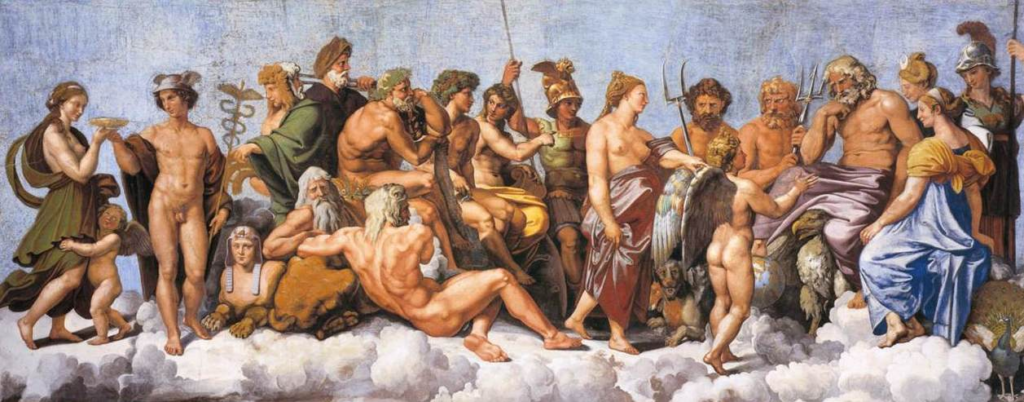
The burning was the key act, as the smoke carried the offering upward, to wherever the gods lived, and the smell of roasting fat was believed to please them. Homer describes the gods on Olympus delighting in the savor of sacrifice rising from the cities below. The meat itself stayed on earth, where it was eaten by the priests and the community in a communal feast that was simultaneously religious rite and social event.
Before any sacrifice, participants underwent purification rituals: washing hands and bodies, offering prayers, ensuring the animal was free from blemish. Only the best was acceptable. Different deities demanded different animals. Sheep and goats for Artemis. Bulls for Zeus. Dark-colored animals for chthonic deities connected to the underworld. White animals for the Olympians of light and sky. Every detail carried meaning, and the Greeks were meticulous about getting it right.
When Animals Were Too Much
Not everyone could afford an ox. Not every occasion called for blood. And not every philosophical tradition was comfortable with animal sacrifice at all.
Plato, writing in The Laws, described an earlier, purer time when people “offered no animals in sacrifice, but rather, cakes and the fruits of the earth soaked in honey, and other such pure sacrifices.” Pythagoras, whose dietary philosophy prohibited the eating of meat entirely, sacrificed “no more than barley bread, cakes and myrrh; least of all, animals, unless perhaps cocks and pigs.” The Orphic tradition, which held that all living creatures shared a divine spark, forbade animal sacrifice outright and maintained what it called pure altars, where only grain and honey cakes were offered.
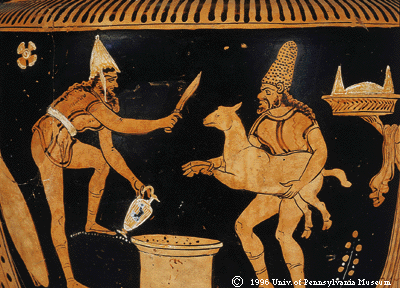
But even for the mainstream Greek worshipper with no philosophical objection to blood sacrifice, cakes served an essential function. They were the preliminary offering brought to the altar before the animal, setting the sacred atmosphere. They were the gift of the poor, who could not afford livestock. They were the daily offering left at a household shrine, the small gesture that kept a person in right relationship with the divine on an ordinary Tuesday morning.
“No offering was too small or plain for the gods. The Delphic Oracle herself chided a rich merchant who asked who was the most pious, and gave him the name of a peasant who gave regularly of what he had.” — Ancient Greek sacred tradition, as recorded in classical sources
The Sacred Cakes of Ancient Greece: A Complete Picture
The Greeks did not bake one sacred cake. They baked dozens, each with its own name, its own shape, its own divine recipient, and its own occasion. The scholarship on these cakes draws from inscriptions carved in stone, vase paintings, comedy plays, and classical writers including Homer, Aristophanes, Pausanias, and Athenaeus.
Pausanias, the 2nd-century CE Greek geographer, attributes the introduction of cakes into sacred rites to Kekrops, the mythical king and founder of Athens. According to Pausanias, Kekrops replaced the ritual bloodshed of animals with the offering of bull-shaped cakes called the pelanoi, which became so fundamental to Athenian worship that the pelanos’s name was later used as a generic term for sacred offerings altogether.
Here is the detail that should stop you completely: Greek sacred cakes may contain the ancient roots of wedding cakes, birthday cakes, and the tradition of putting candles on the top of the latter. The amphiphon, offered to Artemis on the full moon, was a round cheese pie with small candles placed on top. The next time you put candles on a birthday cake, you are completing a ritual gesture that goes back at least 2,500 years to a Greek woman standing in moonlight, offering cheese and fire to the goddess of the hunt.
The documented Greek sacred cakes:
Popanon kathemenon (flat) — Offered to Poseidon, Kronos, Apollo, and Artemis. Wheat flour and soft cheese. The size was regulated by law: a full choinix of flour. No interpretation required.
Popanon polyomphala (knobbed) — The same base cake but with multiple raised knobs on top. Offered to Zeus, the Winds, Heracles, and Demeter. The knobs may have represented the multiple aspects of the deity being honored.
Pelanos — Offered exclusively to Demeter during the Great Mysteries at Eleusis, and made specifically from wheat grown on the sacred plain of Rharus near the sanctuary. The provenance of the grain was as important as the cake itself.
Plakous — A layered honey pastry with goat’s milk cheese offered to Apollo, Dionysus, and Heracles. Athenaeus devotes considerable attention to it in the Deipnosophistae, quoting earlier sources on its precise preparation.
Phthois — A wheat, cheese, and honey cake offered to Hestia, Zeus, Apollo, and Asclepius. The cheese made it sacred to Hestia specifically, as goddess of the hearth where it would have been baked.
Amphiphon — Offered exclusively to Artemis on the full moon. A round cheese pie with candles placed on top. The candles represented the light of the moon. Two and a half thousand years before the birthday cake.
Pelanoi / bull-shaped cakes — Barley flour shaped into bull forms, offered to Zeus as a replacement for actual bull sacrifice. The transition from animal to cake is documented in Athenian sources as a deliberate reform, not an improvisation.
Nastos — A honeyed cake offered to Zeus the Farmer and various deities at agricultural festivals. Connected to the seasonal cycle of planting and harvest.
After the offerings had lain on the altar for the prescribed time, they were collected by the priest, not as theft but as his legal right, written into the sanctuary’s public regulations. The fascinating theological dimension here is that although worshippers knew perfectly well that the priest would eventually take the cakes, they had no difficulty imagining that the gods themselves had partaken of the gifts. The divine consumption was not literal. It was the intention behind the offering that mattered, and the smoke, the fragrance, the gesture of giving.
Why This Meal Belongs to Poseidon
Poseidon was among the most ancient and most feared of the Greek gods, older in some traditions than Olympus itself. He was the brother of Zeus and Hades, and the three divided the cosmos between them: Zeus took the sky, Hades the underworld, Poseidon the sea. He also ruled earthquakes, which the Greeks called ennosigaios, the Earth-shaker, a reminder that his power was not merely oceanic but geological. When Poseidon was displeased, he did not merely raise storms. He moved the ground beneath your feet.
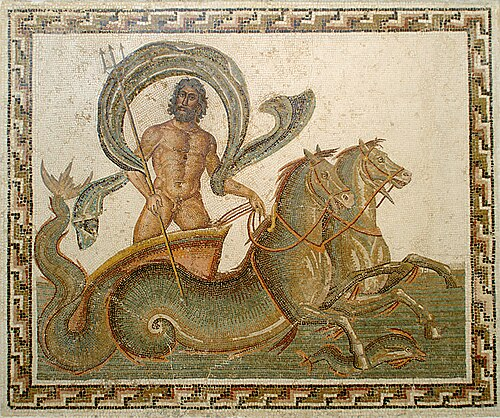
His relationship with Athens was one of the most famous rivalries in Greek mythology. He and Athena competed for the patronage of the city, each offering a gift to its citizens. Poseidon struck his trident into the Acropolis and produced a saltwater spring. Athena produced an olive tree. The Athenians chose the olive tree. Poseidon, furious, flooded the Attic plain. The wound apparently never fully healed: in the Athenian sacred calendar, both Poseidon and Athena received ritual cakes, but the city named itself after the winner.
The tuna connection is not incidental. Bluefin tuna migrate through the Aegean in enormous schools, and the great seasonal tuna runs were a source of both sustenance and awe for coastal Greek cities. The spectacle of thousands of massive fish moving through the straits was understood as a manifestation of Poseidon’s generosity or his mood. The tuna was his fish in the most direct sense: a creature of his domain, subject to his will, arriving and departing on his schedule.
The popanon kathemenon offered to Poseidon was the flat version, not the elaborately knobbed cakes offered to other gods. Flat. Plain. Modest. There is something fitting in this. Poseidon was not a god who wanted elaborate flattery. He was a god who wanted acknowledgment. The flat cake laid beside the fresh fish from his sea is an offering that says: we know who controls this water, and we are grateful for what it gives us, and we are leaving this here so you know we have not forgotten.
For our version, the popanon are baked in the oven and pressed into small rounds stamped with fish and tridents before baking, a shape that would have been entirely recognizable to any Greek priest carrying offerings to a Poseidon temple on the coast. The tuna is seared hot and fast in olive oil with nothing but sea salt, still pink in the center, the way a fish pulled fresh from the Aegean and cooked immediately over a fire would have been. Drizzled with honey and scattered with poppy seeds, the cakes are finished the way the Greeks finished almost every sweet thing: with the two ingredients that most represented abundance and the favor of the gods.
The Verdict
Let me be upfront: tuna is tuna.
A seared tuna steak seasoned with nothing but sea salt and olive oil is an excellent piece of fish. It always has been. The simplicity of the preparation is the point, and the simplicity is correct. The outside sears dark and the inside stays deep pink and the salt does exactly what salt has always done to fish, which is make it taste more completely like itself. There is nothing surprising here, and there does not need to be. Poseidon did not need to be surprised. He needed to be acknowledged. The fish on this plate accomplishes that.
The little spelt honey cakes are a different story entirely. I was not expecting much from two ingredients pressed into small rounds. What I got reminded me of a rustic, slightly dense cookie with a savory interior from the ricotta and a gently wheaty bite from the flour. On their own they are modest. Drizzle them with warm honey and scatter poppy seeds across the top and they become something genuinely lovely. The honey soaks into the surface while the cake is still warm from the oven and the poppy seeds add a faint nuttiness that makes you want another one immediately.
The combination of the two, the austere seared tuna and the sweet honey-drizzled cakes, is not a meal in the modern sense. It is an offering that you also get to eat. Which is exactly what every Greek who participated in a sacred feast experienced: the food given to the god that came back to you, transformed by the act of giving it.
I pressed fish and tridents into mine before baking. The fish stamp held its shape beautifully. The trident was slightly less crisp but entirely recognizable. They looked exactly like what they were: small cakes made for the god of the sea, baked by someone two thousand years too late to leave them at his altar.
7.8 / 10 — Ancient, austere, and quietly extraordinary.
The Recipe: Poseidon’s Offering — Seared Tuna with Spelt Honey Cakes
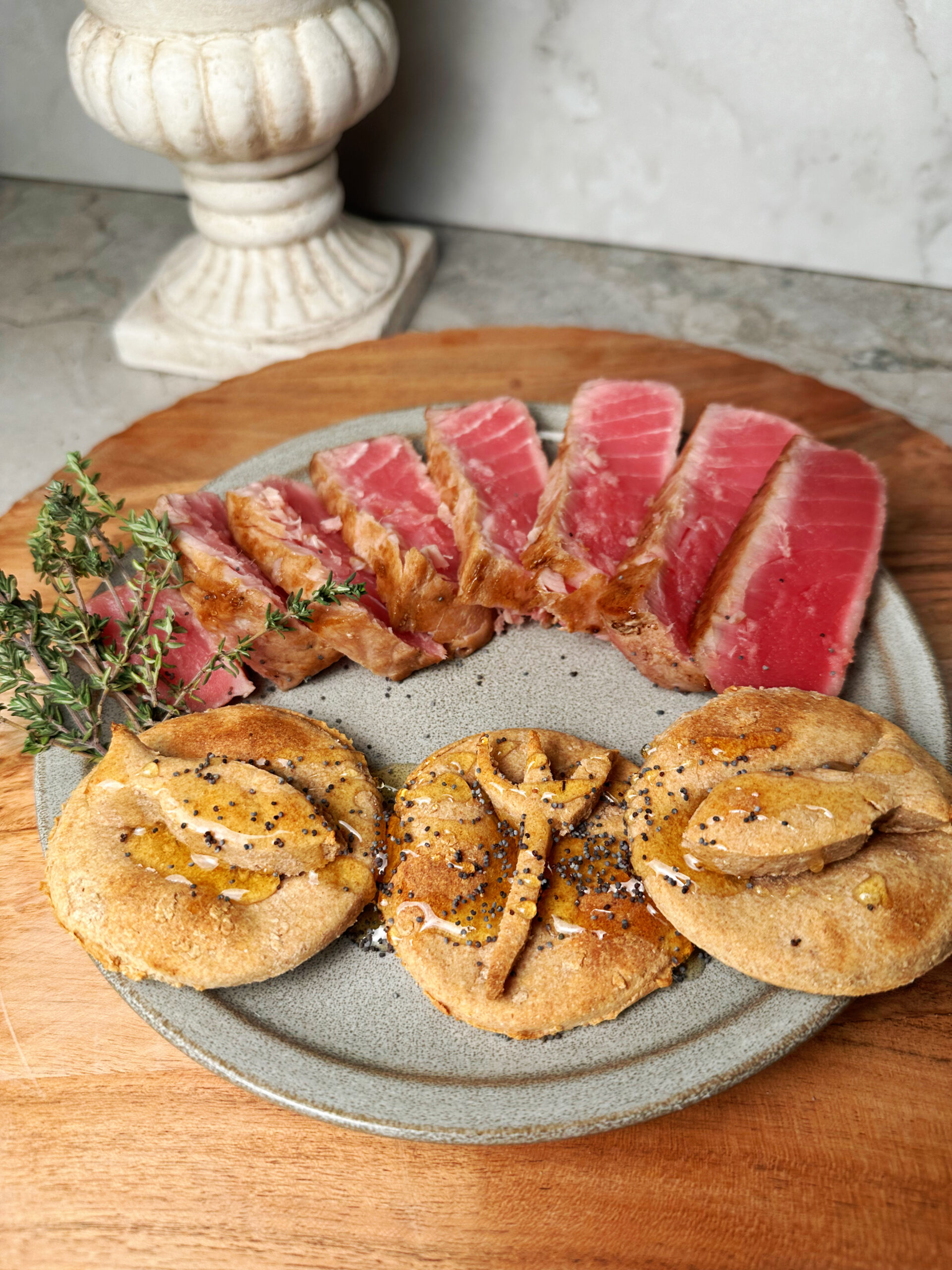
Seared Tuna with Spelt Honey Cakes
Ingredients
For the Popanon Cakes
- 1 cup wheat or spelt flour spelt is the more historically accurate choice and gives a slightly nuttier flavor
- ½ cup fresh ricotta or soft goat cheese — the closest modern equivalent to ancient Greek soft cheese
- 3 tablespoons water added gradually
- ¼ teaspoon sea salt
- 1 tablespoon olive oil for the baking pan
- ½ cup honey gently warmed until fluid, for finishing
- 1 teaspoon poppy seeds for finishing
For the Tuna
- ¾ pound fresh tuna steak 1 inch thick — use the best quality yellowfin or bluefin you can find
- 1 teaspoon coarse sea salt — the only seasoning
- 2 tablespoons olive oil for searing
- 4 fresh wild thyme sprigs for garnish
Instructions
The Popanon Cakes
- Preheat your oven to 375°F. Lightly oil a baking sheet with the olive oil.
- Combine the flour and salt in a bowl. Add the ricotta or goat cheese and work together with your hands until the cheese is fully incorporated and the dough comes together. It will look shaggy at first. Add water one tablespoon at a time until the dough just holds together as a firm, slightly tacky ball. Do not overwork it. It should feel denser than bread dough and slightly rougher than pastry.
- Wrap in a cloth and rest 15 minutes. This step matters — the flour needs to hydrate fully for the cakes to hold their shape.
- Divide the dough into 8 equal portions. Roll each into a ball and press flat into a round disc about 3 inches wide and a quarter inch thick. If you have small cookie stamps, press a fish or trident shape into the surface of each cake before baking. The impression should be about half the depth of the cake. The shape will hold through baking.
- Place on the oiled baking sheet. Bake at 375°F for 15 to 18 minutes until the edges are just golden and the surface is set and dry to the touch. Pull them while they still feel slightly soft in the center; they firm as they cool.
- While still warm from the oven, drizzle generously with the warmed honey and scatter poppy seeds across the surface. The honey must go on warm or it will not absorb into the cake. Set aside.
The Tuna
- Pat the tuna steak completely dry. Press the coarse sea salt firmly into both flat faces with your hand. Let it sit uncovered at room temperature for 10 minutes. The salt draws moisture to the surface, concentrating flavor and building the sear crust.
- Heat the olive oil in the heaviest skillet you own over the highest heat until the oil just begins to smoke. This is not negotiable — the pan must be genuinely hot or the tuna will steam rather than sear and you will lose the entire crust.
- Lay the tuna flat in the pan. Do not touch it. Sear for 90 seconds without moving. Flip once. Sear another 60 to 90 seconds. The outside should be deeply seared and dark at the edges, the interior still deep pink-red when you slice into it. Pull it off the heat immediately and rest 2 minutes on a board.
- Slice the tuna against the grain into thick pieces. Lay on a dark wooden board or stone slate alongside the whole popanon. Place fresh thyme sprigs across the tuna. Pour a thin thread of olive oil over everything.
Video
Notes
- A note on the cakes: the popanon without honey is a savory, slightly dense cheese flatbread. With honey it becomes something else entirely — sweeter, softer, and genuinely addictive. The Greeks drizzled almost everything with honey. In this case they were right.
- A note on the tuna: 90 seconds per side is the absolute maximum. Pull it before you think it is done. It carries over from the residual heat and the interior should stay red. Grey tuna is a sadness that cannot be undone.