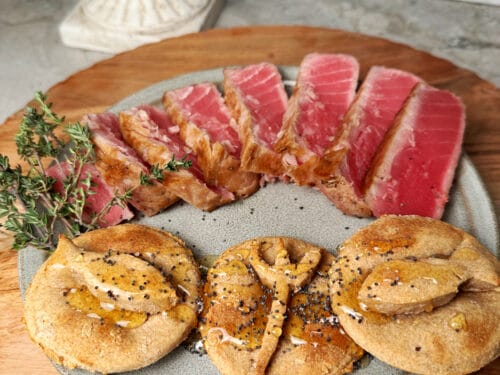
Poseidon's offering is one of the oldest documented meal combinations in Western religious history: a seared tuna steak and small flat wheat and cheese cakes called popanon kathemenon, both sourced directly to the Athenian sacred calendar of the 1st century CE and inscribed in Greek sanctuary law in stone. The tuna is seasoned with nothing but coarse sea salt and seared hard in olive oil, dark on the outside and deep pink through the center, exactly as a fish pulled fresh from the Aegean would have been cooked. The popanon are pressed by hand from spelt flour and fresh ricotta into small flat rounds, stamped with fish and tridents, baked until just golden, and finished warm from the oven with a generous drizzle of honey and a scatter of poppy seeds. Together they are not a meal in any modern sense but an offering you also get to eat: austere and ancient on one side of the plate, rustic and quietly sweet on the other, united by the olive oil and sea salt that underpin every serious thing the Greeks ever cooked.
Prep Time 25 minutesmins
Cook Time 20 minutesmins
Ingredients
For the Popanon Cakes
1cupwheat or spelt flourspelt is the more historically accurate choice and gives a slightly nuttier flavor
½cupfresh ricotta or soft goat cheese — the closest modern equivalent to ancient Greek soft cheese
3tablespoonswateradded gradually
¼teaspoonsea salt
1tablespoonolive oilfor the baking pan
½cuphoneygently warmed until fluid, for finishing
1teaspoonpoppy seedsfor finishing
For the Tuna
¾poundfresh tuna steak1 inch thick — use the best quality yellowfin or bluefin you can find
1teaspooncoarse sea salt — the only seasoning
2tablespoonsolive oilfor searing
4fresh wild thyme sprigsfor garnish
Instructions
The Popanon Cakes
Preheat your oven to 375°F. Lightly oil a baking sheet with the olive oil.
Combine the flour and salt in a bowl. Add the ricotta or goat cheese and work together with your hands until the cheese is fully incorporated and the dough comes together. It will look shaggy at first. Add water one tablespoon at a time until the dough just holds together as a firm, slightly tacky ball. Do not overwork it. It should feel denser than bread dough and slightly rougher than pastry.
Wrap in a cloth and rest 15 minutes. This step matters — the flour needs to hydrate fully for the cakes to hold their shape.
Divide the dough into 8 equal portions. Roll each into a ball and press flat into a round disc about 3 inches wide and a quarter inch thick. If you have small cookie stamps, press a fish or trident shape into the surface of each cake before baking. The impression should be about half the depth of the cake. The shape will hold through baking.
Place on the oiled baking sheet. Bake at 375°F for 15 to 18 minutes until the edges are just golden and the surface is set and dry to the touch. Pull them while they still feel slightly soft in the center; they firm as they cool.
While still warm from the oven, drizzle generously with the warmed honey and scatter poppy seeds across the surface. The honey must go on warm or it will not absorb into the cake. Set aside.
The Tuna
Pat the tuna steak completely dry. Press the coarse sea salt firmly into both flat faces with your hand. Let it sit uncovered at room temperature for 10 minutes. The salt draws moisture to the surface, concentrating flavor and building the sear crust.
Heat the olive oil in the heaviest skillet you own over the highest heat until the oil just begins to smoke. This is not negotiable — the pan must be genuinely hot or the tuna will steam rather than sear and you will lose the entire crust.
Lay the tuna flat in the pan. Do not touch it. Sear for 90 seconds without moving. Flip once. Sear another 60 to 90 seconds. The outside should be deeply seared and dark at the edges, the interior still deep pink-red when you slice into it. Pull it off the heat immediately and rest 2 minutes on a board.
Slice the tuna against the grain into thick pieces. Lay on a dark wooden board or stone slate alongside the whole popanon. Place fresh thyme sprigs across the tuna. Pour a thin thread of olive oil over everything.
Video
Notes
A note on the cakes: the popanon without honey is a savory, slightly dense cheese flatbread. With honey it becomes something else entirely — sweeter, softer, and genuinely addictive. The Greeks drizzled almost everything with honey. In this case they were right.
A note on the tuna: 90 seconds per side is the absolute maximum. Pull it before you think it is done. It carries over from the residual heat and the interior should stay red. Grey tuna is a sadness that cannot be undone.