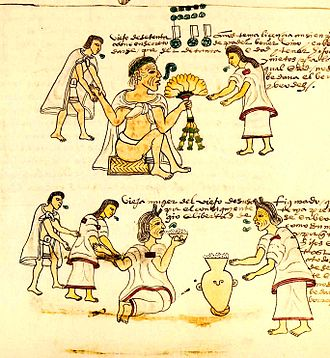
Pozole is one of Mexico’s most beloved dishes today, especially during Christmas, New Year’s, and major family gatherings. It is warming, communal, and celebratory. Yet beneath its comforting surface lies one of the most striking origin stories in food history. The earliest written references to pozole appear in the Florentine Codex, compiled in the 16th century by the Franciscan friar Bernardino de Sahagún. This massive ethnographic work recorded Nahua culture through the testimony of Indigenous elders, including their foods, rituals, and ceremonies.
If you’re enjoying my recipes, all of my e-cookbooks are currently 40% Off at Eats History Shop!

According to these accounts, an early form of pozole was prepared using nixtamalized maize, chili peppers, and meat reserved for religious contexts. In some ceremonial settings tied to human sacrifice, the meat used was human flesh from ritual victims, prepared for elite consumption as part of sacred rites. This was not everyday food. It was deeply symbolic, ritualized, and bound to the Aztec worldview of reciprocity between gods and humans.
It is important to note that these practices were limited to specific ceremonies and social classes, and they existed within a religious framework very different from modern moral systems. Pozole in this context was not simply a meal, but a sacred substance meant to honor the gods and sustain cosmic balance.
Maize, Nixtamalization, and Sacred Food
At the heart of pozole is hominy, large kernels of maize treated through nixtamalization using lime. This process, developed thousands of years earlier in Mesoamerica, transforms corn into a more nutritious and digestible food. For the Aztecs, maize was not just sustenance but the substance of humanity itself. According to creation myths, humans were formed from maize dough, making corn both literal and symbolic life.
Pozole’s name likely derives from the Nahuatl word pozolli, meaning foamy, a reference to the way hominy blooms and opens as it cooks. Even in its earliest forms, the soup emphasized maize above all else. The broth, spices, and meat were secondary to the corn, reinforcing its sacred centrality.
This focus on maize survived every transformation of the dish. Even today, no matter the region or color, pozole is defined by its hominy. Remove the corn, and the dish ceases to be pozole.
The Spanish Conquest and a Radical Transformation
When the Spanish arrived in the early 16th century, they were deeply disturbed by Indigenous religious practices, particularly human sacrifice. Colonial authorities and Catholic clergy moved quickly to suppress these rituals, banning both sacrifice and cannibalism outright. As a result, the ceremonial version of pozole could no longer exist in its original form.
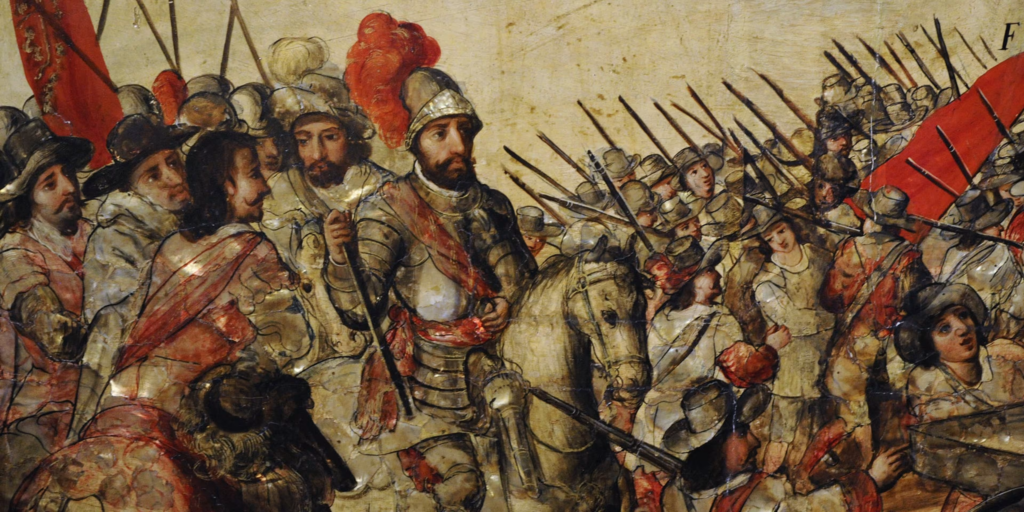
Pork soon became the replacement. Spanish chroniclers noted that pork’s texture was considered similar enough to serve as a substitute, though this claim may reflect colonial rationalization rather than Indigenous preference. Over time, pork became fully integrated into the dish, not as a symbolic replacement but as a practical and flavorful protein well suited to long simmering.
Alongside pork came onions, garlic, bay leaves, and Old World herbs. These ingredients blended with Indigenous staples like chiles and maize, creating one of the earliest and most successful examples of mestizo cuisine.
Regional Variations and Living Tradition
As pozole spread across Mexico, it evolved into dozens of regional expressions. Pozole blanco is the closest to its pre-Hispanic ancestor, featuring a clear broth with hominy and meat, often garnished heavily at the table. Pozole rojo, common in central and western Mexico, uses dried red chiles such as guajillo and ancho to create a deep, brick-colored broth. Pozole verde, especially associated with Guerrero, incorporates tomatillos, green chiles, herbs, and seeds for a brighter profile.
What unites all versions is the ritual of assembly. Pozole is rarely eaten alone. It is served in large pots, ladled generously, and finished with fresh garnishes like radish, lettuce or cabbage, cilantro, onion, and lime. The act of customizing each bowl is part of the experience, echoing the dish’s ceremonial roots.
By the modern era, pozole had become inseparable from celebrations. It is a dish of togetherness, abundance, and memory.
Pozole and the Christmas Table
Today, pozole is a centerpiece of Mexican holiday cooking, especially around Christmas and New Year’s. Families prepare it in enormous batches, often letting it simmer for hours or even days. Like many festive dishes, it improves with time, deepening in flavor as the broth absorbs chile, corn, and meat.
Serving pozole during Christmas carries an unspoken symbolism. After a year of labor, hardship, and scarcity, the table fills with something rich and generous. The soup’s history, once bound to ritual sacrifice, has been transformed into a celebration of life, family, and continuity.
It is one of the clearest examples of how a dish can carry trauma, adaptation, and survival, yet still remain joyful.
Taste, Texture, and Why It Endures
Pozole rojo is rich without being heavy. The broth is savory and earthy, with mild sweetness from guajillo chiles and depth from slow-cooked pork. Hominy provides a chewy, almost floral corn flavor that anchors the dish. Fresh garnishes add crunch, acidity, and brightness, preventing the soup from feeling monotonous.
Every spoonful feels layered. No single ingredient dominates. Instead, the flavors mesh into something comforting and deeply satisfying. It is easy to understand why this dish survived conquest, prohibition, and centuries of change.
For me, pozole is one of those rare historical foods that feels timeless. It tastes ancient and modern at the same time. I gave it a 9.4 out of 10. If you are looking for a new soup to make this holiday season, it is hard to recommend anything more meaningful.
Follow along for more historical cooking!
Pozole Rojo Recipe:
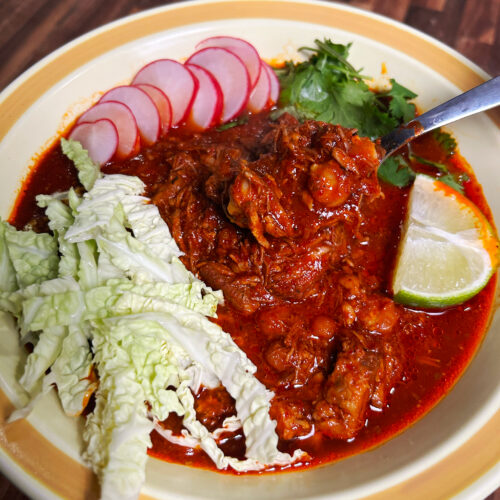
Pozole Rojo
Ingredients
- 2 pounds pork shoulder cut into large cubes
- 1½ yellow onions divided
- 10 cloves garlic divided
- 4 dried guajillo chiles stemmed and seeded
- 2 dried ancho chiles stemmed and seeded
- Optional: 1–2 dried arbol chiles for heat
- 2 bay leaves
- 1½ teaspoons Mexican dried oregano
- Salt to taste
- 1 can cooked hominy rinsed
Instructions
Prep the basics
- Pork: Cut pork shoulder into 1½ to 2-inch cubes. Bigger chunks stay juicy during the simmer.
- Onion + garlic:
- Set aside ½ onion for the broth (roughly chopped is fine).
- Keep the remaining 1 onion for roasting/toasting with the chiles.
- Use 10 garlic cloves total, split between broth and sauce (you can do 4–5 in broth, 5–6 for sauce).
- Start the pork broth (the foundation)
Add to a large pot:
- Cubed pork
- ½ onion
- A handful of the garlic cloves
- Enough water to cover the pork by 1–2 inches
- Bring to a gentle boil, then immediately reduce to a steady simmer.
- Skim impurities for the first 15–20 minutes (gray foam). This keeps the broth cleaner and the flavor less “muddy.”
- Add:
- Bay leaves
- Mexican oregano
- Salt (start lighter than you think, you’ll adjust later)
- Simmer 1 to 1½ hours, until the pork is tender and starting to shred if you press it.
Toast the dried chiles (wake up the flavor)
- While the pork simmers, prep your chiles:
- Remove stems and shake out most seeds.
- Heat a dry skillet over medium.
- Toast the guajillo + ancho chiles 10–20 seconds per side, just until fragrant and slightly darkened.
- If they smell acrid or look scorched, they’ll make the soup bitter, so keep this quick.
- Optional: toast árbol chiles very briefly too (they burn fast).
- Toast the remaining onion + garlic (adds depth)
- In the same skillet (still dry or with the tiniest slick of fat), add:
- The remaining onion (rough chunks)
- Remaining garlic cloves (you can leave them whole)
- Char/toast until:
- Onion has browned edges
- Garlic has a few dark spots
- This step makes the chile sauce taste “slow-cooked” even before it hits the pot.
- Blend the red chile sauce (smooth and powerful)
- Ladle 2–3 cups of hot pork broth into a blender (start with 2 cups, add more as needed).
- Add:
- Toasted chiles
- Toasted onion + garlic
- Mexican oregano
- A good pinch of salt
- Blend until very smooth (1–2 minutes).
- For the smoothest, most restaurant-style texture:
- Strain through a fine mesh sieve into a bowl, pressing the liquid through with a spoon.
- This removes tough skins and makes the broth silky.
- Add hominy, then add the sauce
- Once pork is tender, add rinsed hominy to the pot.
- Pour in the red chile sauce.
- Bring back to a simmer and cook 30 minutes to 1 hour so the hominy and broth become one unified flavor.
- Shred the pork (for the perfect texture)
- Remove pork chunks to a bowl.
- Shred with two forks (or chop roughly if you like chunkier pozole).
- Return the pork to the pot.
- Simmer another 30 minutes if you can. The longer it sits, the more it becomes “one soup” instead of separate parts.
Final seasoning + serve
- Taste and adjust:
- Salt (almost always needs a final bump)
- Oregano (a little more if it needs “lift”)
Serve hot with toppings:
- Lime wedges
- Sliced radish
- Chopped cilantro
- Shredded cabbage or lettuce
- Optional but great: diced onion, crushed oregano, or a little chile oil.
Video
Notes
- Do not burn the chiles. A 10–20 second toast per side is enough. If they blacken, the whole pot can taste bitter.
- Straining the sauce is the upgrade. It’s the difference between “homemade stew” and “holy crap this tastes like a restaurant.”
- Hominy and salt need time. Hominy dulls seasoning at first, so salt in stages and always do a final adjustment after the soup has simmered with the chile sauce for a bit.