Go Back

Pozole Rojo

Print Recipe
Pozole rojo is one of those soups that tastes like it took all day even when it didn’t. You get a deep, red-chile broth that’s earthy and slightly sweet from guajillo, richer and darker from ancho, and built on a clean pork base with garlic, onion, bay, and oregano. The hominy is the secret weapon, it brings a soft chew and a gentle corn sweetness that rounds everything out, and once you hit it with lime, crunchy radish, and cabbage, the bowl turns into the perfect balance of rich, bright, and fresh.
Prep Time 25 minutes
Cook Time 3 hours

Ingredients

  • 2 pounds pork shoulder cut into large cubes
  • yellow onions divided
  • 10 cloves garlic divided
  • 4 dried guajillo chiles stemmed and seeded
  • 2 dried ancho chiles stemmed and seeded
  • Optional: 1–2 dried arbol chiles for heat
  • 2 bay leaves
  • teaspoons Mexican dried oregano
  • Salt to taste
  • 1 can cooked hominy rinsed

Instructions

Prep the basics

  • Pork: Cut pork shoulder into 1½ to 2-inch cubes. Bigger chunks stay juicy during the simmer.
  • Onion + garlic:
  • Set aside ½ onion for the broth (roughly chopped is fine).
  • Keep the remaining 1 onion for roasting/toasting with the chiles.
  • Use 10 garlic cloves total, split between broth and sauce (you can do 4–5 in broth, 5–6 for sauce).
  • Start the pork broth (the foundation)

Add to a large pot:

  • Cubed pork
  • ½ onion
  • A handful of the garlic cloves
  • Enough water to cover the pork by 1–2 inches
  • Bring to a gentle boil, then immediately reduce to a steady simmer.
  • Skim impurities for the first 15–20 minutes (gray foam). This keeps the broth cleaner and the flavor less “muddy.”
  • Add:
  • Bay leaves
  • Mexican oregano
  • Salt (start lighter than you think, you’ll adjust later)
  • Simmer 1 to 1½ hours, until the pork is tender and starting to shred if you press it.

Toast the dried chiles (wake up the flavor)

  • While the pork simmers, prep your chiles:
  • Remove stems and shake out most seeds.
  • Heat a dry skillet over medium.
  • Toast the guajillo + ancho chiles 10–20 seconds per side, just until fragrant and slightly darkened.
  • If they smell acrid or look scorched, they’ll make the soup bitter, so keep this quick.
  • Optional: toast árbol chiles very briefly too (they burn fast).
  • Toast the remaining onion + garlic (adds depth)
  • In the same skillet (still dry or with the tiniest slick of fat), add:
  • The remaining onion (rough chunks)
  • Remaining garlic cloves (you can leave them whole)
  • Char/toast until:
  • Onion has browned edges
  • Garlic has a few dark spots
  • This step makes the chile sauce taste “slow-cooked” even before it hits the pot.
  • Blend the red chile sauce (smooth and powerful)
  • Ladle 2–3 cups of hot pork broth into a blender (start with 2 cups, add more as needed).
  • Add:
  • Toasted chiles
  • Toasted onion + garlic
  • Mexican oregano
  • A good pinch of salt
  • Blend until very smooth (1–2 minutes).
  • For the smoothest, most restaurant-style texture:
  • Strain through a fine mesh sieve into a bowl, pressing the liquid through with a spoon.
  • This removes tough skins and makes the broth silky.
  • Add hominy, then add the sauce
  • Once pork is tender, add rinsed hominy to the pot.
  • Pour in the red chile sauce.
  • Bring back to a simmer and cook 30 minutes to 1 hour so the hominy and broth become one unified flavor.
  • Shred the pork (for the perfect texture)
  • Remove pork chunks to a bowl.
  • Shred with two forks (or chop roughly if you like chunkier pozole).
  • Return the pork to the pot.
  • Simmer another 30 minutes if you can. The longer it sits, the more it becomes “one soup” instead of separate parts.
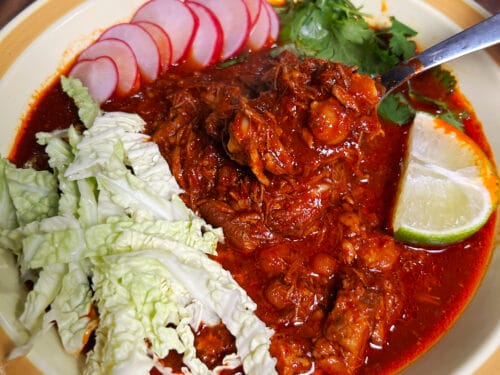
Final seasoning + serve

  • Taste and adjust:
  • Salt (almost always needs a final bump)
  • Oregano (a little more if it needs “lift”)

Serve hot with toppings:

  • Lime wedges
  • Sliced radish
  • Chopped cilantro
  • Shredded cabbage or lettuce
  • Optional but great: diced onion, crushed oregano, or a little chile oil.

Video

Notes

  • Do not burn the chiles. A 10–20 second toast per side is enough. If they blacken, the whole pot can taste bitter.
 
  • Straining the sauce is the upgrade. It’s the difference between “homemade stew” and “holy crap this tastes like a restaurant.”
 
  • Hominy and salt need time. Hominy dulls seasoning at first, so salt in stages and always do a final adjustment after the soup has simmered with the chile sauce for a bit.