Ludwig van Beethoven was born in Bonn in 1770, moved to Vienna at 21, and spent the next 35 years changing Western music forever. He composed nine symphonies, 32 piano sonatas, 16 string quartets, and enough concertos and overtures to fill a concert hall for a week. He did much of this while going deaf. By his late forties he could hear almost nothing at all, and yet the Ninth Symphony, arguably the most joyful piece of music ever written, came entirely from a mind working in near silence.
What we know less about is what he ate while doing all of this. Beethoven was not a food person. He regarded elaborate dining roughly the way most of us regard traffic, as a necessary obstacle between him and somewhere more interesting. He once walked into a restaurant, saw the succession of dishes being brought to a neighboring table, and reportedly said: “Man is certainly very little higher than the other animals if his chief delights are those of the table.” He then presumably went back to scribbling notes on whatever napkin was nearby.
But food history is about the gaps as much as the feasts. What a person eats when they are not paying attention to eating is often more revealing than any formal meal. And Beethoven, for all his indifference to food, had a few things he cared about deeply. One of them was pasta with cheese. The other was coffee. And the coffee ritual was something genuinely remarkable.
A Portrait of Chaos: Beethoven’s Daily Habits
Before we get to the food, it helps to understand the man in full, because the eating habits only make sense inside the larger picture of spectacular, creative dysfunction.
Next week
I cook these before I write them. Some of it never makes the post.
The failures, the source documents, the version that actually tasted good. That part goes out by email, and next week’s is already on the stove.
 Written and cooked by Donnie
Beethoven moved residences between 70 and 80 times during his 35 years in Vienna. His rooms were described by multiple contemporaries as containing a “frightful confusion” of manuscripts, old clothes, dust, and minimal furniture. He had a habit, while composing, of pouring large pitchers of cold water over his hands and head, bellowing up and down the musical scale while the water ran across the floor and through the floorboards. This was so regular that it was one of the main reasons landlords kept evicting him.
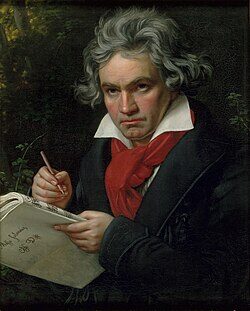
He was quick-tempered, suspicious of staff, and genuinely terrible at running a household. His cook turnover was extraordinary. Going through his notebooks, his biographer Anton Schindler found at least twenty entries between 1819 and 1820 alone recording staff warnings, hirings, firings, and walkouts, all written in Beethoven’s own hand. He referred to one housekeeper as “a beast in spite of her pretty face.” He once attempted to host a dinner party for friends and spent an hour and a half at the stove producing what his guests described as soup resembling “charitable leavings distributed to beggars in taverns” and beef that was “but half done and calculated to gratify only an ostrich.” He ate it with apparent satisfaction.
His deafness, which began creeping in around age 28 and was severe by his mid-forties, profoundly shaped everything including how he ate. As the world went quiet around him, routine became increasingly important. He slept from around 10pm and rose at dawn. He composed intensely from about 6:30am until early afternoon, took a long vigorous walk in which he always carried pencil and paper for musical ideas, ate a midday dinner, and retired early. The rhythm of the day was fixed, and within it, breakfast was the anchor.
What Beethoven Actually Ate: The Documented Picture
Here it is worth being honest about the source problem. Most of what we know about Beethoven’s eating habits comes from Anton Schindler, the violinist who became Beethoven’s unpaid secretary and later wrote the first biography of the composer, Beethoven as I Knew Him, published in 1840. Schindler is a complicated witness. It was later demonstrated by musicologists that he forged entries in Beethoven’s conversation books after the composer’s death, exaggerated the closeness of their relationship, and may have destroyed hundreds of original documents. The Beethoven Compendium puts it bluntly: virtually nothing Schindler wrote can be taken entirely at face value without supporting evidence.
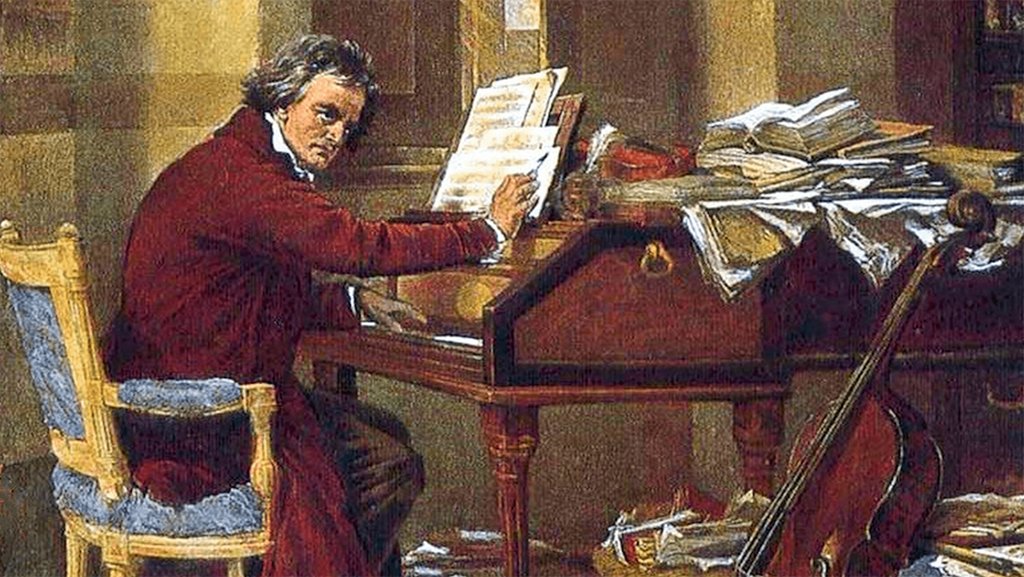
That said, the food accounts are supported by multiple independent sources, and Schindler’s detailed domestic observations are generally considered more reliable than his musical claims. His fellow contemporary Ignaz von Seyfried, a former student of Mozart who knew Beethoven independently, corroborated many of the same eating habits. So what do the sources agree on? Beethoven had a small number of foods he actually liked, and he was indifferent to almost everything else.
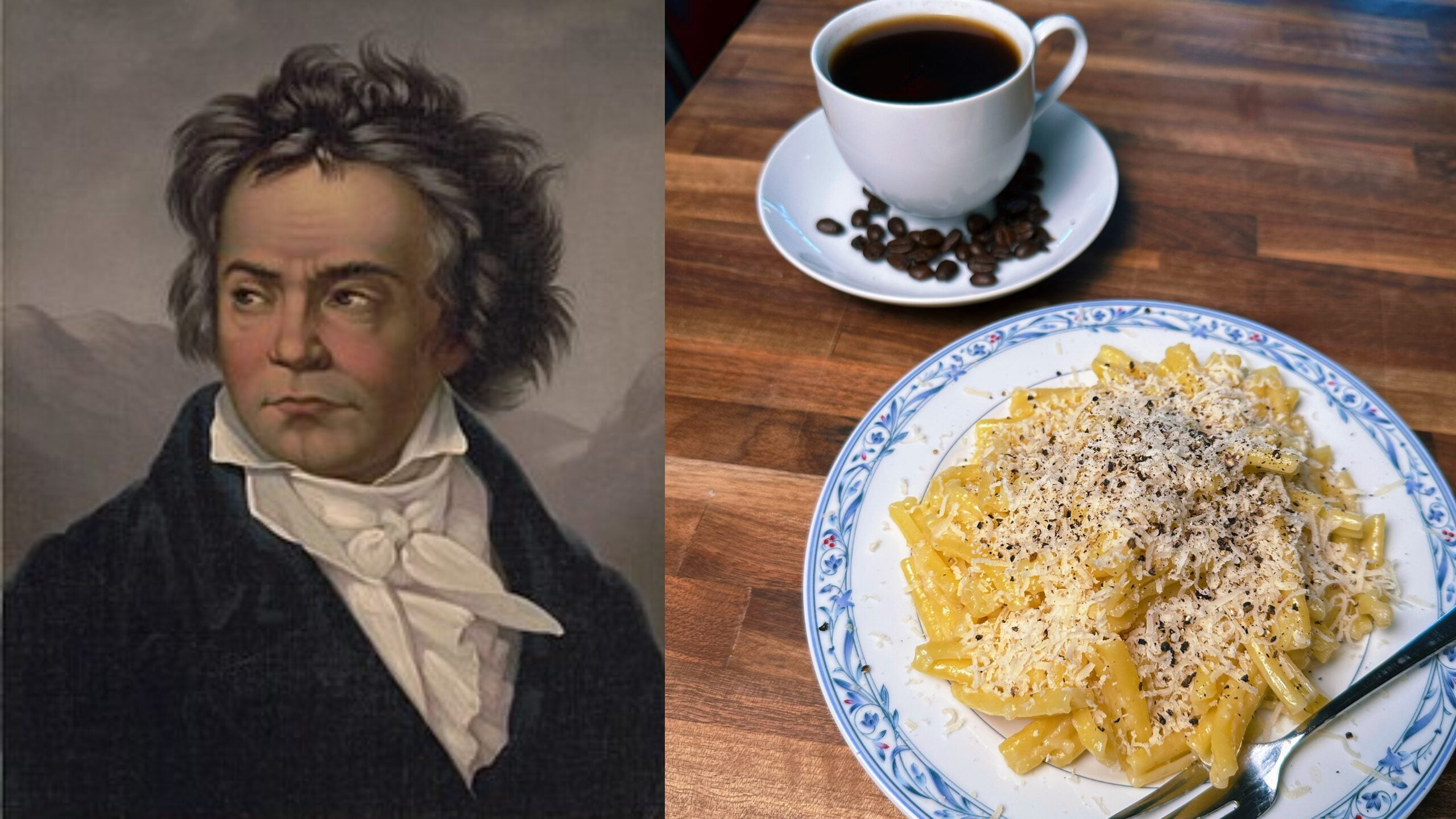
Schindler wrote that when Beethoven first arrived in Vienna, “he cared little about good food, his favorite dish being a mess of macaroni with plenty of cheese on top.” The macaroni was paired with expensive imported Italian Parmigiano-Reggiano, which was triple the price of rice in Vienna at the time. For a man who was often financially precarious, this was an extravagant preference that he maintained consistently throughout his life. Seyfried documented that Beethoven also kept stracchino cheese from Lombardy and Verona salami in his room so that, as Seyfried put it, “he so often forgot about mealtime that he must have taken a bite when he got hungry.” He preferred fish to meat, flat water to sparkling, and light Austrian white wine to red. Every Thursday, he ate a specific bread soup made to the consistency of mush, which he apparently looked forward to with genuine enthusiasm. And every single morning, he made his coffee.
The 60-Bean Ritual: Coffee as Composition
Schindler’s account of the coffee is the most precise and the most famous. He wrote in the 1840 biography: “For his breakfast he usually took coffee, which he frequently prepared himself; for in this beverage he had an oriental fastidiousness of taste. He allowed sixty beans for each cup, and lest his measure should mislead him to the amount of a bean or two, he made it a rule to count over the sixty for each cup, especially when he had visitors.”
Schindler elsewhere summarized it more simply: “Coffee seems to have been the one indispensable item in his diet.”
Sixty beans works out to approximately 8 grams of coffee, which is almost exactly the dose in a modern Nespresso pod. Whether this was instinct, obsession, or genuine precision is impossible to say. What multiple sources agree on is that Beethoven brewed the coffee himself using what is described as a glass brewing apparatus, probably something similar to a siphon or early glass press, and that he insisted on doing this personally even when staff were present to do it for him.
The coffee ritual has to be understood in the context of his deafness. When you can no longer hear the world around you, the sensory experiences that remain become heightened and more precious. Beethoven’s sense of taste reportedly sharpened significantly as his hearing deteriorated. The morning coffee was one of the few things he could still calibrate to his exact specification, control completely, and rely on to be precisely what he expected. In a life of increasing chaos and isolation, 60 beans was something solid to hold onto. He counted them out in front of guests to show them how it was done. He would not let anyone else do it.
The Recreation: Making Beethoven’s Breakfast
I made both dishes that Schindler documents as Beethoven’s constants: the 60-bean coffee and the macaroni mit Parmesan-Käse. Here is exactly what I did and what I found.
The Coffee
I used a French press, which is not the glass contraption Schindler describes but is probably the closest modern equivalent in terms of method: ground coffee steeped in hot water then pressed. I counted out 60 beans one at a time onto the counter. This takes longer than you think. Around bean 30 you start to understand something about Beethoven. There is a meditative quality to it that only becomes clear when you are actually doing it. Each bean is a deliberate choice. The act itself says: this matters, and I am paying attention.
The 60 beans ground to roughly 8 grams of coarse ground coffee. I brewed it with 150ml of water just off the boil, steeped for four minutes, and pressed slowly. The result is a small, strong, dark cup. No milk. No sugar. This is how Beethoven took it. I drank it black.
Here is my honest rating: 6.6 out of 10. The coffee itself is just black coffee. 60 beans at a standard roast makes a decent but not remarkable cup. It is on the lighter side for modern tastes, probably because Beethoven’s cups were smaller than ours and the beans of his era were darker roasted. The ritual is the point, not the result. If you count the beans yourself, the cup tastes different than if you just scoop. That is not mystical, it is psychological, but it is real.
The Macaroni
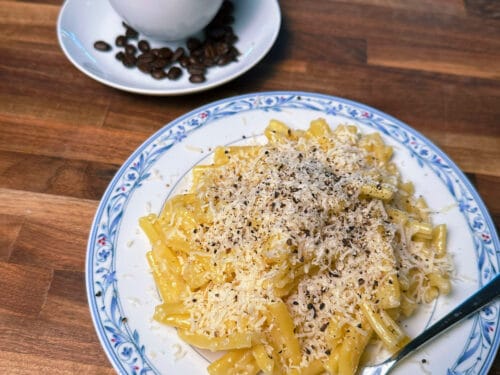
For the pasta I used casarecce, a twisted short pasta shape with good surface area for catching sauce, more period-appropriate than modern elbow macaroni and closer to what would have been available in 19th century Vienna. I boiled it until tender, not al dente, because Beethoven’s food consistently trended soft across every account. I melted butter in the warm pot, added the drained pasta, reserved a little starchy cooking water, and tossed it with most of the Parmigiano-Reggiano until it formed a glossy, clingy coating rather than a pooled sauce. Finished with a generous grind of black pepper and the remaining Parmesan piled on top.
Rating: 6.6 out of 10. It is simple, it is honest, and it is exactly what it looks like: buttered pasta with good cheese. There is nothing wrong with it but there is nothing surprising about it either. The quality of the Parmesan carries the entire dish. Schindler noted Beethoven liked it “with plenty of cheese on top,” and he was right to. Without imported Parmigiano-Reggiano this is just pasta. With it, it earns its place on the plate.
What Food Meant to a Man Who Didn’t Care About It
There is something worth sitting with in all of this. Beethoven, by every account, regarded food as fuel. He forgot to eat. He skipped meals. He produced inedible food when he tried to cook. He fired housekeepers for substandard eggs. He ate mush soup with enthusiasm every Thursday. He was in no way a gourmand.
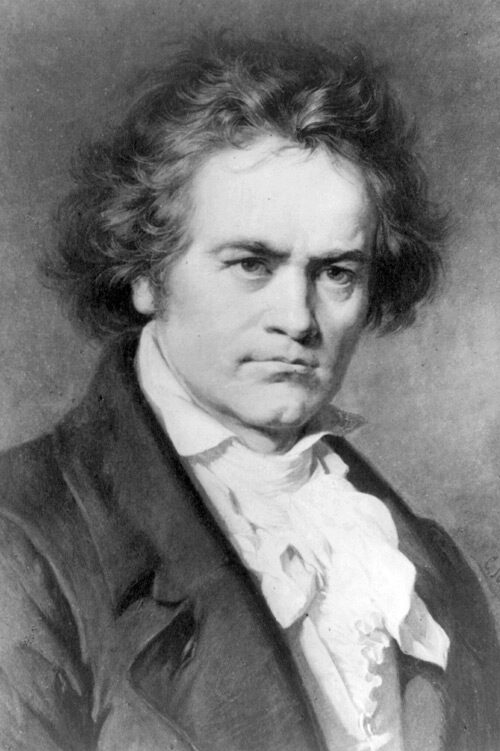
And yet the two things he ate consistently, the coffee and the pasta, were both characterized by a demand for quality ingredients and a refusal to compromise. The coffee had to be exactly 60 beans and he had to make it himself. The cheese had to be real Parmigiano-Reggiano imported from Italy, expensive and inconvenient. There is a version of Beethoven here that runs against the chaos of the rest of his domestic life: a man who, on the specific things that mattered to him, would accept no substitution.
The counting of the beans is the clearest expression of this. Beethoven composed by obsessive revision, scratching out and rewriting notes hundreds of times until every bar was exactly as he heard it in his head. He counted 60 beans for the same reason. Not because he thought more beans or fewer beans would be catastrophically different, but because the act of counting was an expression of the standard he held himself to. Precision in the small things. Everything measured. Everything intentional.
He went deaf and kept composing. He counted his beans and kept going. There is a whole philosophy of creative life in that morning routine, if you are looking for one.
The Recipes
Beethoven’s Breakfast: 60-Bean Coffee and Macaroni mit Parmesan-Käse

Don’t lose this one.
I’ll email it to you so it’s waiting when you’re ready to cook.
Ingredients
Instructions
Notes
- On the pasta shape I went with casarecce instead of standard elbow macaroni. In Beethoven’s Vienna, macaroni was a catch-all term for dried pasta rather than the specific elbow shape we know today, and the twisted surface of casarecce catches the butter and cheese far better than a smooth tube would. Rigatoni or fusilli work just as well. Whatever you choose, cook it soft. Every account of Beethoven’s food describes it trending toward the tender side, and this dish is no different.
- Do not skip on the cheese- This dish lives or dies on the Parmigiano-Reggiano. I bought a block and grated it myself right before cooking. Pre-grated cheese from a bag will not melt into the pasta the same way, it clumps rather than coats, and the whole point of the sauce is that glossy, clingy texture. Beethoven paid a premium for imported Italian Parmesan in 19th century Vienna and it cost him more than triple the price of rice. That context makes the dish taste better. Use the good stuff.
- The rating I gave both a 6.6 out of 10. The coffee is just black coffee. No number of carefully counted beans changes what it is, and 60 beans at a coarse grind makes a decent but not extraordinary cup by modern standards. The macaroni is genuinely good but completely simple. What makes both worth making is not the result but the process. Count the beans yourself. Do not rush it. That two minutes of counting is the whole point of the exercise.