Go Back

Beethoven's Breakfast: 60-Bean Coffee and Macaroni mit Parmesan-Käse

Print Recipe
Beethoven's two documented daily constants, pulled from Anton Schindler's 1840 biography. The coffee was the only thing Schindler called truly indispensable to his diet. The macaroni was his favorite dish from the moment he arrived in Vienna. I made both. Neither will change your life. Both will make you think.
Prep Time 5 minutes
Cook Time 15 minutes

Ingredients

  • 60 pieces whole coffee beans counted individually
  • 0.6 cups water just off the boil
  • 2 cups casarecce or short pasta
  • 3 tablespoons butter
  • 1 cups Parmigiano-Reggiano freshly grated
  • 0.3 cups pasta cooking water reserved
  • 1 teaspoons black pepper freshly cracked
  • 1 tablespoons salt for pasta water

Instructions

  • Count the beans: Count out exactly 60 pieces whole coffee beans, counted individually one at a time onto the counter. I counted mine out loud. It takes about two minutes and feels slightly ridiculous, and then it starts to feel like something else entirely. Beethoven recounted them in front of visitors. Do not skip this step.
  • Grind and set up the press: Grind the 60 beans coarsely. Add to a French press. Pour 0.6 cups water, just off the boil over the grounds and stir once gently. Place the lid on but do not press yet.
  • Steep the coffee: Let the coffee steep for 4 minutes
  • while you start the pasta water. The cup will be small and strong.
  • Press and pour: Press slowly. Pour into a small cup, not a mug. Drink it black with nothing added. Set it aside and work on the pasta.
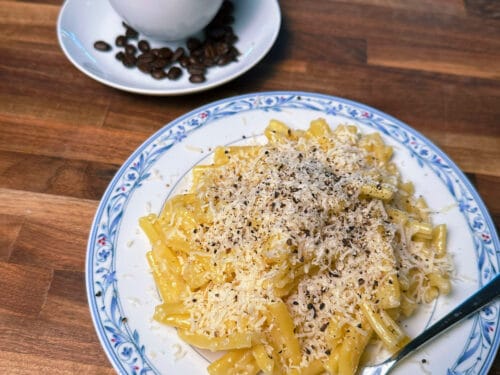
  • Cook the pasta: Bring a large pot of water to a rolling boil. Add 1 tablespoons salt, for pasta water. Cook 2 cups casarecce or short pasta until properly soft, not al dente. Before draining, scoop out 0.3 cups pasta cooking water, reserved and set it aside.
  • Build the sauce: Return the empty pot to low heat and melt 3 tablespoons butter. Add the drained pasta and toss. Pour in the reserved cooking water and most of 1 cups Parmigiano-Reggiano, freshly grated. Toss vigorously for about 1m until the cheese melts into a coating that clings to the pasta rather than sitting at the bottom of the bowl.
  • Finish and serve: Crack 1 teaspoons black pepper, freshly cracked generously over the top. Heap onto a plate and pile on the remaining Parmesan. Eat it immediately with whatever is left of the coffee alongside it. This is the meal Beethoven ate while going deaf and writing the Ninth Symphony. Make of that what you will.
Video

Notes

  • On the pasta shape I went with casarecce instead of standard elbow macaroni. In Beethoven's Vienna, macaroni was a catch-all term for dried pasta rather than the specific elbow shape we know today, and the twisted surface of casarecce catches the butter and cheese far better than a smooth tube would. Rigatoni or fusilli work just as well. Whatever you choose, cook it soft. Every account of Beethoven's food describes it trending toward the tender side, and this dish is no different.
 
  • Do not skip on the cheese- This dish lives or dies on the Parmigiano-Reggiano. I bought a block and grated it myself right before cooking. Pre-grated cheese from a bag will not melt into the pasta the same way, it clumps rather than coats, and the whole point of the sauce is that glossy, clingy texture. Beethoven paid a premium for imported Italian Parmesan in 19th century Vienna and it cost him more than triple the price of rice. That context makes the dish taste better. Use the good stuff.
 
  • The rating I gave both a 6.6 out of 10. The coffee is just black coffee. No number of carefully counted beans changes what it is, and 60 beans at a coarse grind makes a decent but not extraordinary cup by modern standards. The macaroni is genuinely good but completely simple. What makes both worth making is not the result but the process. Count the beans yourself. Do not rush it. That two minutes of counting is the whole point of the exercise.