
Asparagus may seem like a humble side dish today, but in the Roman world it was prized for much more than its flavor. It was admired for its medicinal qualities, its rarity, and—most notably—its reputation as a powerful aphrodisiac. For Julius Caesar, who conquered Gaul, defied the Senate, and redefined the Roman Republic, asparagus held a place not just on the table but in Roman lore. It was the kind of dish that spoke to refinement, luxury, and virility—all qualities Caesar liked to be associated with.
The Roman biographer Plutarch gives us a glimpse into Caesar’s attitude toward food in his Life of Caesar, including this anecdote:
“He was once entertained without ceremony by a provincial and partook heartily of asparagus, which was served with oil instead of liquamen. When his companions showed disgust, Caesar corrected them, saying that to be nice about food is for women in full health.”
Plutarch paints Caesar not as a man overly concerned with luxury, but also not one to turn down a good Roman delicacy. Asparagus, in this case, was accepted by Caesar even without the more flavorful fish sauce traditionally paired with it, reinforcing both its natural appeal and Caesar’s appetite.
Apicius and the Roman Method
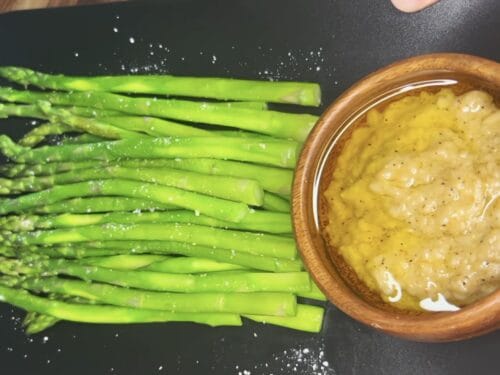
We find a Roman recipe for asparagus in De Re Coquinaria, a cookbook attributed to Apicius, the most well-known name in ancient Roman culinary history. While the text does not dwell on vegetables as much as meats or elaborate sauces, it does include a preparation for asparagus that is instructive in its technique and pairings. Rather than boiling from raw in a large volume of water, the Romans often blanched the stalks lightly and cooked them from the bottom up, standing in shallow water, so that the stalks were softened while the heads remained firm and intact. This reverse steaming or “head-out boiling” helped preserve the prized texture of the tips.
Next week
I cook these before I write them. Some of it never makes the post.
The failures, the source documents, the version that actually tasted good. That part goes out by email, and next week’s is already on the stove.
 Written and cooked by Donnie
The dish was often paired with a nutty, sweet, and tangy sauce, composed of ingredients commonly used by Roman cooks: pine nuts, olive oil, wine vinegar, honey, salt, and pepper. This combination added flavor and richness to a simple vegetable, enhancing its aphrodisiac reputation. Romans believed asparagus could stir the blood and invigorate the body, with Pliny the Elder and Galen both remarking on its stimulating effects. That reputation continued into the Renaissance, and even today asparagus appears in traditional herbal texts as a food of vitality and desire.
Asparagus in Roman Society
Asparagus was not a vegetable for the poor in Roman times. Though it was grown locally, it was also transported over long distances to meet the demands of the elite. The Romans even developed special techniques to preserve asparagus for off-season use, including drying and pickling, which allowed it to be served at banquets year-round. The imperial appetite for asparagus was so well known that the phrase “faster than you can cook asparagus” became a Roman expression to refer to anything done quickly. This shows not only how common the vegetable was but also how deeply it was woven into cultural references.
Emperors such as Augustus are recorded as having asparagus fleets, small military units tasked with retrieving and preserving it. Writers like Pliny the Elder took note of how prized and refined the best asparagus was, especially that which came from the region near Ravenna. While we might think of asparagus today as a side dish or salad ingredient, for the Romans it was a seasonal treasure with spiritual, physical, and even erotic connotations.
The Aphrodisiac Mythos
The ancient world often associated certain foods with sexual vitality, and asparagus was no exception. Writers from Hippocrates to Galen commented on its ability to stimulate the body and quicken the humors. The spear-like shape of asparagus was believed to symbolize virility, and its effect on the body was thought to be warming and invigorating. These qualities made it a favorite at feasts that celebrated fertility, marriage, or military victories.
Asparagus found its place among a class of foods considered to awaken desire and fortify the male constitution. Combined with honey, wine, and vinegar, these were all seen as potent ingredients in their own right. The dish was thought to arouse not only the appetite but also the passions. While modern science may take a different view, there is no question that the symbolism of the dish aligned perfectly with Caesar’s own persona as a man of appetite and action.
Caesar’s Taste and Table
Julius Caesar’s table was not just a place for eating. It was a stage for diplomacy, loyalty, and identity. Though he is often portrayed as austere, Caesar understood the role food played in Roman politics. Lavish feasts helped solidify alliances, reward soldiers, and display Rome’s dominance over conquered lands. He did not need to eat extravagantly to impress others, but the ability to enjoy refined ingredients with restraint only added to his cultivated image.
Despite his political power, Caesar’s personal habits around food were seen as modest. Plutarch’s story about his casual enjoyment of simply dressed asparagus reinforces this image. He could appreciate the luxury of the ingredient without insisting on the most expensive or fashionable preparation. That balance between pleasure and practicality mirrored Stoic ideals, even if Caesar himself was no Stoic. His relationship to food was, like much else in his life, carefully calculated and deeply symbolic.
Julius Caesar’s Asparagus

Don’t lose this one.
I’ll email it to you so it’s waiting when you’re ready to cook.
Ingredients
Instructions

Notes
- Use fresh, firm asparagus for best texture. Thin stalks are ideal for upright steaming, but you can also trim thicker stalks and peel the lower ends slightly to keep the dish tender throughout.
- Roman sauces often balance sweet, sour, and savory. Adjust the honey and vinegar in your sauce depending on how bold or subtle you want the flavor. The goal is not sweetness but harmony.
- A mortar and pestle gives the most authentic texture. If you have one, grind the pine nuts by hand with the other sauce ingredients. If not, a small food processor will work fine, just avoid over-pureeing to maintain some rustic texture.