Before tacos were tacos, before the taqueria, before the tortilla press and the salsa bar, someone in the American Southwest was pressing corn flat between their palms, laying it on a hot stone, and folding it around spiced meat. Not as a taco. Not with a name we would recognize. Just as food. Practical, nourishing, built from what the land gave them.
If you’re enjoying these recipes, check out my e-cookbook at Eats History Shop, now 40% Off!
This recipe is a reconstruction. A reasonable, historically grounded attempt to recreate a meal that the Ancestral Puebloan people of the Four Corners region, present-day Arizona, Colorado, New Mexico, and Utah, might have assembled from the three things they reliably had: blue corn ground into meal, venison from the deer they hunted, and dried chiles that had grown in the Southwest for thousands of years before any European set foot on this continent.
We know they had these ingredients. We know they cooked meat in ceramic pots. We know blue corn was not just food but sacred. What we are doing here is filling in the reasonable gaps with honest imagination, and saying so clearly. The result is one of the most ancient meals I have ever cooked, and one of the most unexpectedly delicious.
A Brief History of the Ancestral Puebloans
Who They Were
The people we now call the Ancestral Puebloans were an ancient Native American culture spanning the Four Corners region of the United States from approximately 300 BCE to 1300 CE. They were not one tribe but a civilization, a network of communities connected by trade, ceremony, and a shared commitment to making the high desert bloom.
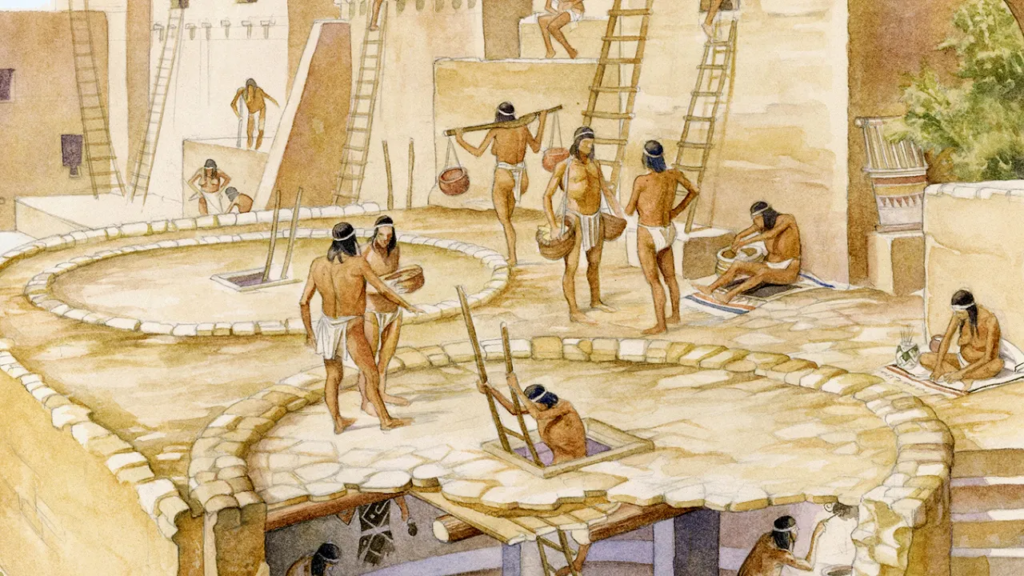
At their height, during what archaeologists call the Classic Period between roughly 1000 and 1300 CE, they built the great houses of Chaco Canyon in New Mexico and the cliff dwellings of Mesa Verde in Colorado. These were not primitive settlements. Chaco Canyon alone contained multistory stone buildings aligned with solar and lunar cycles, linked to outlying communities by a network of roads stretching hundreds of miles. These were people who understood the sky, organized complex societies, and fed thousands from land that most would consider too harsh to farm.
Their architecture was built without metal tools, without wheels, without horses. And yet structures they built stand a thousand years later, still facing the solstice sunrise.
What They Ate
Corn was the foundation of everything. Evidence of maize cultivation in the Four Corners region dates to at least 2100 BCE, and by the time the Ancestral Puebloans reached their peak, corn was not merely food but the center of spiritual life. White cornmeal was used in prayer. A man might bless his son, or some land, or the town by sprinkling a handful of meal as he uttered a blessing. Blue corn in particular carried sacred significance, connected in Hopi cosmology to a deliberate choice made at the beginning of time: the Creator offered different colored ears of corn to humanity, and the people who would become the Pueblo nations chose the short blue ear, the most modest, in exchange for a long and meaningful life on their land.
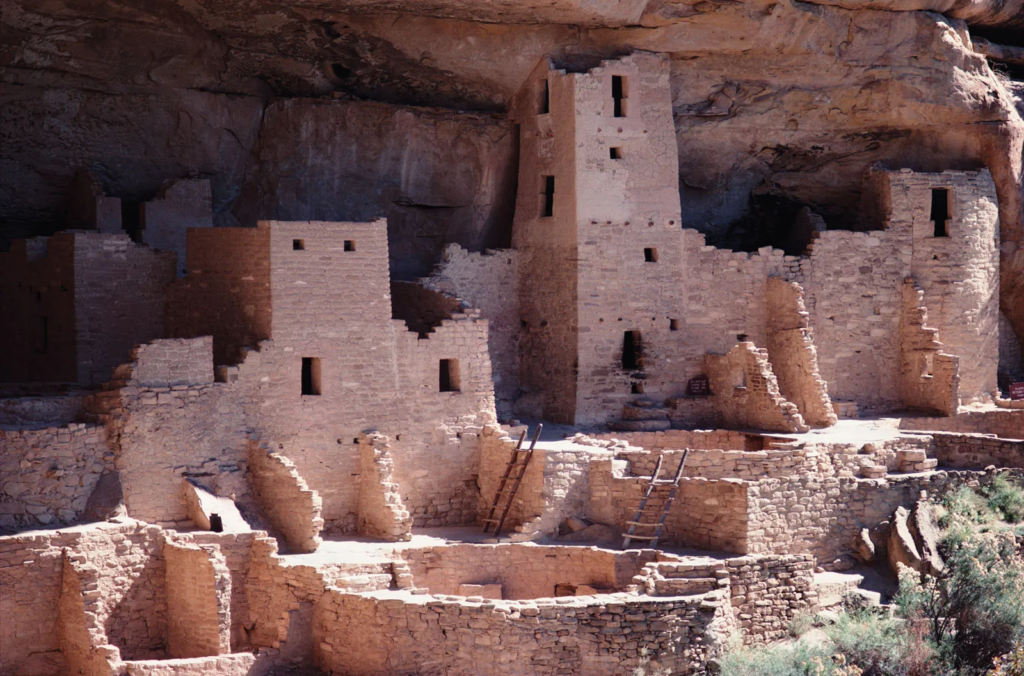
Beyond corn, they grew beans and squash alongside it in the companion planting system known as the Three Sisters, a method by which the three crops supported each other physically and nutritionally. The corn grew tall and the beans climbed it. The squash spread wide along the ground, holding moisture in the soil and choking out weeds. Together the three provided a nutritionally complete diet, corn and beans combining to form a full protein that no single crop could provide alone.
They supplemented this agricultural base with hunting. Deer bones appear consistently in the archaeological record at Ancestral Puebloan sites. Turkey was raised both for feathers and meat. Wild plants, including piñon nuts harvested from the surrounding forests and wild onions gathered from the landscape, rounded out a diet that was lean, varied, and deeply tied to the rhythms of the high desert year.
And they had chiles. Dried chile peppers have been cultivated in the American Southwest for over 4,000 years. They were not a condiment but a staple, providing heat, complexity, and in a diet without abundant fat, a depth of flavor that transformed simple ingredients into something worth eating again and again.
How They Cooked
Pottery arrived in Ancestral Puebloan culture around 500 CE and transformed the kitchen. Before ceramic vessels, cooking required stone boiling, dropping fire-heated rocks into skin or basketry containers to heat liquid. With pottery came the clay cooking pot, gray and corrugated on the outside, set directly over a fire. Archaeologists studying recovered Ancestral Puebloan cooking vessels have found evidence of cornmeal porridge, meat stews, and bean preparations cooked in these pots over thousands of years of continuous use.
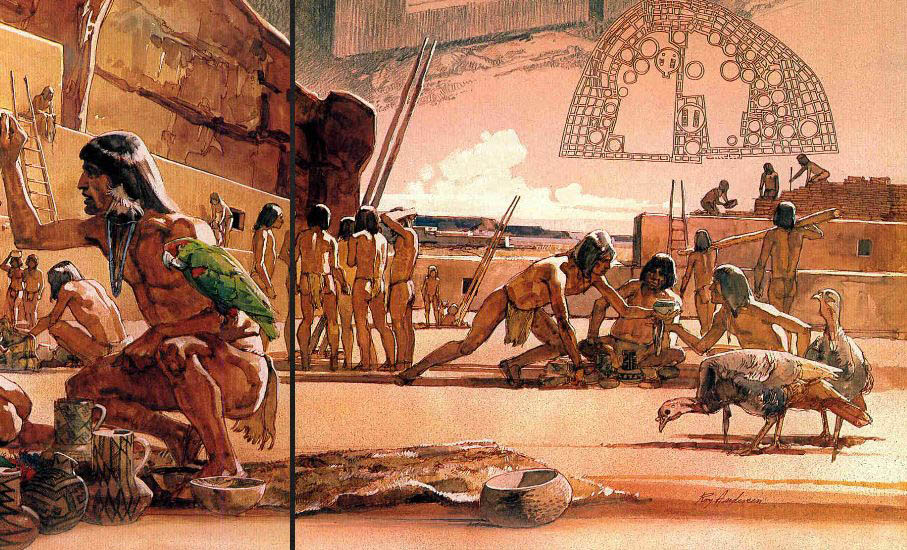
Corn was ground on stone metates, large flat grinding slabs, using smaller stones called manos. The grinding was women’s work, physical and communal, often done in groups with songs marking the rhythm. The resulting cornmeal ranged from coarse to fine depending on its intended use. Coarse meal became porridge or mush. Fine meal became flatbreads cooked on hot stones beside the fire.
Meat was roasted over open fires or slow-cooked in ceramic pots with whatever was available. The corrugated texture on the exterior of Ancestral Puebloan cooking vessels was not decorative. It increased surface area in contact with the fire, making cooking faster and more efficient in a world where fuel was precious. Every design choice was practical.
The Dish and Its Connection to This Reconstruction
The meal on this plate has three components, all of which are archaeologically documented in the Four Corners region during the Classic Period: blue corn ground into meal and cooked as a flat cake on a hot surface, venison as the primary protein, and dried chiles as the dominant flavoring agent.
What we are reconstructing honestly is the form. The folded flatbread with filling laid across it is not a documented Ancestral Puebloan preparation. It is a logical inference. We know they cooked flatbreads. We know they cooked meat. We know they ate together. The act of combining them in the hand is what we are imagining, and the meal earns that imagination by being genuinely excellent.
For seasoning, I made a deliberate choice to cook the first round without salt or pepper, the way it would have been made before European trade goods arrived in abundance. The chiles and the venison carry the dish on their own. I will tell you below what I found when I added salt for the second tasting. The difference was illuminating.
The green onion garnish is the closest accessible substitute for the wild spring onions that grew across the Pueblo landscape and were gathered seasonally. This is acknowledged as a modern approximation, not an archaeological claim.
The Spanish Arrive: What They Saw and What They Said
In February 1540, Francisco Vasquez de Coronado left Compostela in Mexico at the head of an expedition of over 1,100 men and several thousand animals, heading north in search of the Seven Cities of Cibola, fabled cities of gold that a Franciscan priest had reported seeing from a distance. What Coronado found instead was not gold. It was corn.
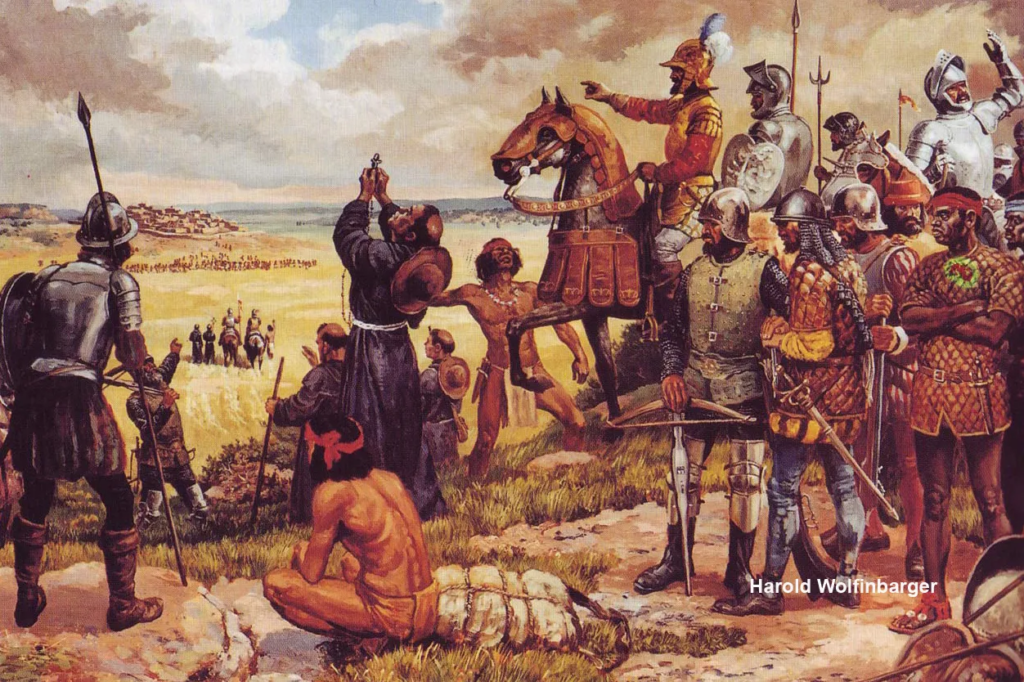
On July 7, 1540, Coronado’s forces reached Hawikuh, a Zuni pueblo in present-day western New Mexico. The battle that followed was brief. The Spaniards, with horses and steel, overwhelmed the defenders in about an hour. And then, starving from the long march north, they ransacked the pueblo for food. What they found was documented by expedition members in dispatches sent back to the King of Spain.
“We found in it what we needed more than gold and silver, and that was much corn and beans and fowls, better than those of New Spain, and salt, the best and whitest that I have seen in my life.” — Traslado de las Nuevas, member of the Coronado Expedition, 1540
More than gold and silver. A Spanish conquistador, having marched hundreds of miles through desert in search of riches, declared the Pueblo people’s food more valuable than what he came for. The corn, the beans, the salt. The exact ingredients that had sustained the Ancestral Puebloans and their descendants for a thousand years were, to a starving army, more precious than treasure.
At Tiguex province near modern Albuquerque, Coronado’s lieutenant Hernando de Alvarado documented what he observed in the pueblos along the Rio Grande:
“There are twelve pueblos. The people seem good, more given to farming than to war. They have provisions of maize, beans, melons, and chickens in great abundance.” — Account of Hernando de Alvarado, Narratives of the Coronado Expedition 1540–1542
More given to farming than to war. In a document written by a soldier of the Spanish conquest, that observation carried a specific meaning: these were not the warriors Coronado’s men expected and feared. They were farmers. People who had built their civilization not on conquest but on the careful cultivation of food from difficult land.
The contact that followed was devastating. The Spanish took what they needed. When Pueblo communities resisted, Coronado burned villages and executed resisters. The winter of 1540 to 1541 saw scattered fighting across New Mexico as the Spanish demanded food, clothing, and shelter and took it by force when it was not freely given. The expedition that came looking for gold left having consumed the food stores of dozens of Pueblo communities and killed an untold number of their inhabitants.
And yet the Pueblo people survived. More than survived.
The Modern Pueblo People: A Living Tradition
Today, approximately 75,000 Pueblo people live in 21 distinct communities across New Mexico, Arizona, and Texas. They are the direct descendants of the Ancestral Puebloans who built Chaco Canyon and Mesa Verde. The great southward migration of the 1200s and 1300s, driven by drought, resource exhaustion, and the arrival of new peoples from the north, brought the Ancestral Puebloan population down into the Rio Grande valley and the lands surrounding it, where the historic Pueblo communities have remained for the seven centuries since.

What is remarkable about the Pueblo peoples, and what makes their food tradition so significant for a channel like this, is the continuity. Pueblo pottery is still produced today in a manner almost identical to the method developed during the Classic Pueblo period. The corn is still grown. The ceremonies centered on the agricultural cycle are still observed. The blue corn that carried sacred meaning for the Ancestral Puebloans a thousand years ago is still grown, still ground, still eaten at feast days and ceremonial gatherings across New Mexico and Arizona.
Deb Haaland, appointed in 2021 as the first Native American to serve in a presidential cabinet as US Secretary of the Interior, is a member of the Pueblo of Laguna. She has spoken publicly about spending summers in Mesita, one of Laguna Pueblo’s six villages, irrigating cornfields with her grandfather and watching her grandmother cook bread, beans, and chile. The bread, the beans, the chile. The same three things Coronado’s men wrote about in 1540. The same three things that sustained the cliff dwellers of Mesa Verde five centuries before that.
The Pueblo Rebellion of 1680, led by a Tewa man named Pope, drove the Spanish out of New Mexico for twelve years, the only successful Indigenous revolt against Spanish colonization in North American history. When the Spanish returned in 1692 and eventually reestablished control, the Pueblo peoples did what they have always done: they adapted what they needed from the dominant culture while holding onto the core of their own. Sheep entered the Pueblo agricultural economy from the Spanish. Some Christian practices were incorporated alongside traditional ceremonies. But the corn remained. The kivas remained. The language, the pottery, the songs, the food.
There is a line, unbroken and direct, from the corrugated gray cooking pot found at a thousand-year-old Ancestral Puebloan site and the chile and corn that a Laguna Pueblo grandmother is cooking in New Mexico today. This recipe sits somewhere on that line, an outsider’s honest attempt to taste what that continuity has always tasted like.
The Verdict
I want to be upfront about something. I made this twice.
The first time I went as traditional as I could manage: no salt, no pepper, just the venison, the guajillo chiles, and the blue corn cakes. The chiles did serious work. Boiled whole with the ground venison, they released a dark, earthy heat into the broth that the meat absorbed over the simmer. The venison itself had a slight gaminess that I found deeply pleasant, a flavor that tasted genuinely like something hunted rather than farmed. The blue corn cakes pressed by hand and toasted dry on cast iron came off the heat a dark blue-grey that looked unlike anything you have seen on a plate before.
Eating it without salt the first time was interesting. Not bad. But flat in a way that made me understand immediately why salt was so prized by every civilization that ever lived. Coronado’s man writing home about the Pueblo salt being the best and whitest he had ever seen was not being poetic. Salt is the difference between food and a meal.
The second time I added salt to the venison broth and a pinch to the corn dough. The dish opened up completely. The chile heat became cleaner and brighter. The venison gaminess turned from slightly challenging to deeply appealing. The corn cake, with that small amount of salt, tasted like something you would choose to eat rather than something you were obligated to finish.
The green onion on top was the right call. A clean, sharp, vegetal freshness against the heavy dark broth and the earthy corn. Wild spring onions would have done the same thing a thousand years ago. The substitution holds.
What I made is not a taco in any meaningful historical sense, and I said so. But it is the thing that tacos are a very distant echo of: corn pressed flat, spiced meat, folded and eaten with your hands. A form so intuitive that cultures separated by a thousand miles and a thousand years arrived at versions of it independently. That is not a coincidence. That is a good idea.
7.9 / 10 — Slightly gamey, deeply spiced, and genuinely ancient.
The Recipe: Ancestral Pueblo Stewed Venison with Guajillo Chiles · Blue Corn Flatcakes · Wild Spring Onion
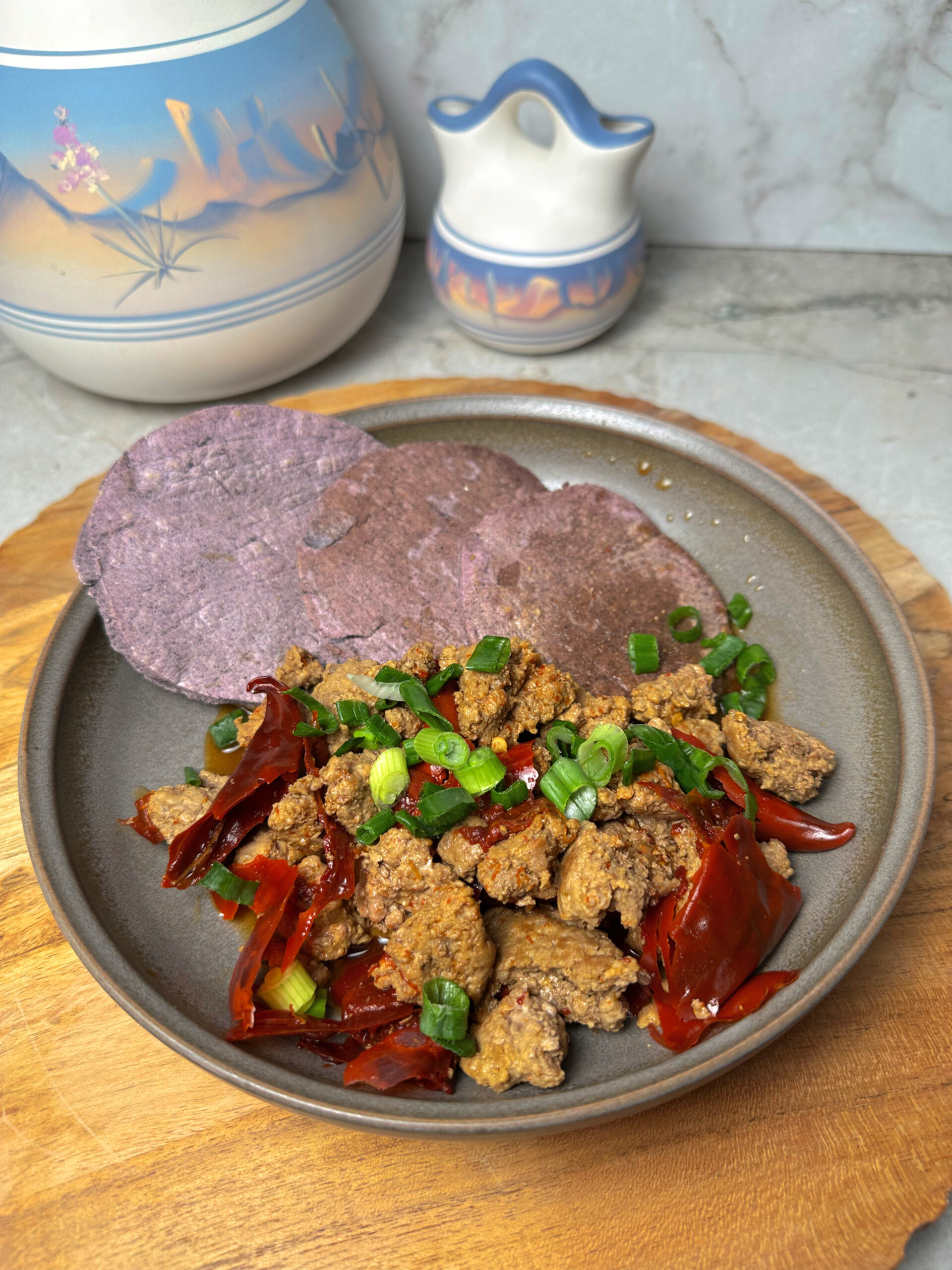
Ancestral Pueblo Stewed Venison with Guajillo Chiles · Blue Corn Flatcakes · Wild Spring Onion
Ingredients
For the Blue Corn Flatcakes
- 2 cups blue corn masa harina Maseca Azul, available at Latin grocery stores, Walmart, or Amazon
- 1½ cups warm water
- ½ teaspoon salt omit for maximum historical accuracy; include for maximum flavor
For the Stewed Venison
- 1 pound ground venison available at Whole Foods, specialty butchers, or online — lean ground beef works as a substitute
- 3 whole dried guajillo or ancho chiles
- Water to cover approximately 2 cups
- Salt to taste optional
For the Garnish
- 3 to 4 green onions sliced thin
Instructions
The Blue Corn Flatcakes
- Combine blue corn masa harina and salt in a bowl. Add warm water gradually, mixing with your hands until the dough comes together into something that feels like soft clay. It should be pliable and smooth, not sticky and not crumbly. If it cracks at the edges when you press it, add water one tablespoon at a time. Knead gently for 2 minutes.
- Cover with a damp cloth and rest for 15 minutes. The rest is not optional. The masa needs time to fully hydrate, and the dough will be significantly more workable after resting.
- Pull off a golf-ball sized piece of dough. Press flat between your palms to about 5 to 6 inches wide and a quarter inch thick. Use your hands, not a rolling pin or tortilla press. The hand-pressed shape is part of the authenticity of this preparation. The edges will be slightly uneven. That is correct.
- Heat a dry cast iron skillet over medium-high heat until genuinely hot. No oil. Place a flatcake in the dry pan. Cook 3 to 4 minutes per side until dark spots appear and the edges begin to lift. The cake will deepen from grey-blue raw dough to a darker, almost storm-cloud blue-grey as it cooks. Stack finished flatcakes in a clean cloth to keep warm and pliable while you cook the rest.
The Stewed Venison
- Heat a heavy skillet or Dutch oven over medium-high heat with no oil. Add the ground venison and cook, breaking it apart with a spoon, until browned and no pink remains. The venison is lean enough that it requires no fat in the pan.
- Add the whole dried guajillo chiles directly to the pan alongside the browned venison. Do not seed or stem them. Add water to cover, approximately 2 cups.
- Bring to a boil, then reduce to a steady simmer. Cook uncovered for 10 to 15 minutes, pressing the chiles occasionally with a spoon to keep them submerged. As they rehydrate, they will release their color, turning the broth a deep reddish-brown. Their heat and earthiness will slowly infuse the venison.
- Taste the broth after 10 minutes. Add salt if using. Simmer until the broth has reduced by about half and thickened slightly around the meat.
Assembly
- Lay a warm blue corn flatcake on a board. Spoon a generous portion of the stewed venison across the center.
- Lay one whole boiled chile from the pan directly on top of the meat. This is the visual anchor of the dish.
- Scatter sliced green onions over the top. Fold the cake around the filling and eat with your hands. No utensils. No sauce. Nothing else on the plate.
Video
Notes
- The salt decision is the most important choice you will make cooking this dish. Without salt the chiles and venison are interesting but flat. With salt everything opens up: the chile heat sharpens, the gaminess of the venison becomes an asset rather than a challenge, and the blue corn cake tastes like something you chose to eat. Cook a small tasting portion unsalted first so you understand what the dish is without it, then salt the broth and taste again. That moment of comparison is worth doing.
- The cast iron must be completely dry and genuinely hot before the first flatcake goes down. Blue corn masa harina behaves differently from yellow or white masa: it is slightly denser and needs real heat to develop those dark spots and lift at the edges properly. If the pan is lukewarm the cakes steam instead of toast and you lose both the color and the texture. Give the skillet a full two minutes over medium-high heat before the first cake goes in.
- Ground venison is widely available at Whole Foods and specialty butchers and is the most historically accurate protein for this dish. If venison is unavailable, lean ground bison is the best substitute and carries a similar slight gaminess that works well with the guajillo chiles. Standard lean ground beef works in a pinch but produces a noticeably milder result. Whatever you use, the meat is lean enough that no oil is needed in the pan for browning.