This is the drink that united the Tsar and Serf. There is a specific category of historical food and drink that tells you more about a civilisation than any political document ever could. Not the food of the elite, not the banquet menus of kings, but the thing that every single person in a society drank every single day, regardless of their station. The drink that the tsar and the serf, the priest and the merchant, the soldier and the farmer all consumed from the same basic recipe for over a thousand years.
That drink is kvass. And almost nobody outside of Eastern Europe has heard of it.
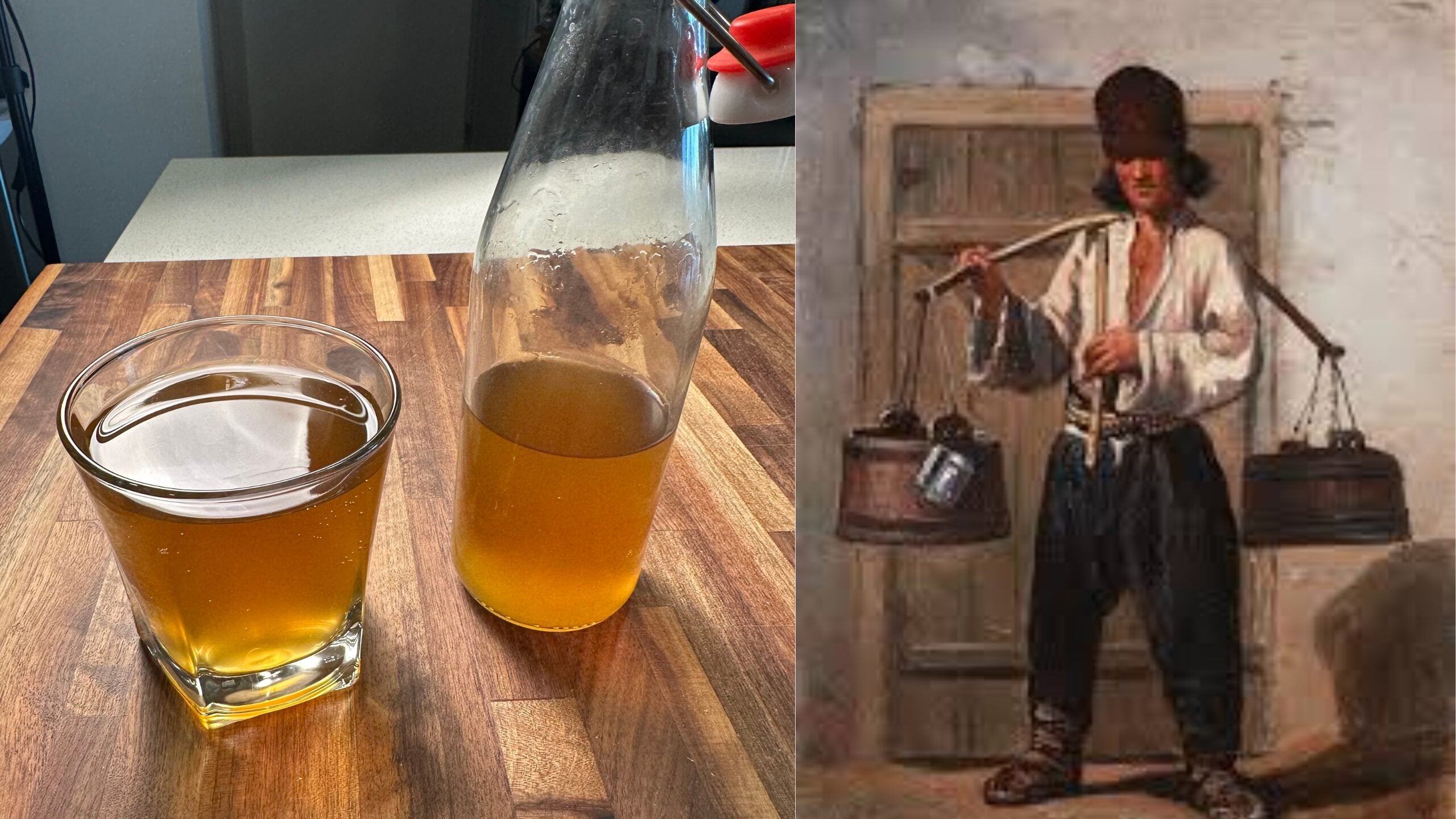
I made it using the traditional method, toasted rye bread, water, sugar and raisins, fermented for two to three days in a jar on my kitchen counter. It tastes malty with a slight sweetness and when cold it is genuinely refreshing. If you enjoy the flavour of beer but do not want the alcohol content, this may be exactly the drink you have been looking for. The full history is remarkable and the recipe could not be simpler. Here is everything.
The Origin: Documented From 988 AD
The earliest written reference to kvass is one of the most extraordinary origin documents in beverage history. The Russian Primary Chronicle, compiled around 1113 AD by the monk Nestor at the Kyiv-Pechersk Lavra monastery, documents that Grand Prince Vladimir of Kiev distributed food, honey and kvass to the people of Kiev in 988 AD to celebrate the Christianisation of Kievan Rus. That a fermented rye bread drink appears in the earliest surviving chronicle of Russian history, mentioned alongside honey as a celebratory provision for an entire population, tells you everything about the cultural status of kvass in the medieval Slavic world. It was not a luxury item. It was not a speciality. It was what people drank. It was as fundamental to daily life in medieval Russia and Ukraine as water, and in many respects considerably more important than water given the risks of untreated water sources in medieval urban settlements.
Next week
I cook these before I write them. Some of it never makes the post.
The failures, the source documents, the version that actually tasted good. That part goes out by email, and next week’s is already on the stove.
 Written and cooked by Donnie
The word kvass itself likely derives from the Proto-Slavic root kvasiti, meaning to ferment or to leaven, the same root that gives Russian the word for yeast and for sourdough starter. The linguistic connection tells you that kvass is not simply a drink but part of a foundational fermentation culture that ran through every aspect of Slavic food production. Bread, kvass, sauerkraut, fermented dairy, all emerged from the same cultural understanding of wild fermentation as both a preservation technique and a source of nourishment.
A Thousand Years of Universal Drinking
The extraordinary thing about kvass in the medieval Slavic world is not that it existed but that it crossed every social boundary simultaneously in a way that almost no other food or drink in history has managed. In virtually every culture across every period, what people eat and drink is one of the clearest markers of social class and economic status. The wealthy eat differently from the poor and the difference is visible, deliberate and meaningful. Kvass is the exception.
The tsar drank kvass. Ivan the Terrible drank kvass. Peter the Great, who transformed Russia into a European power and adopted countless Western cultural practices, never stopped drinking kvass. Leo Tolstoy, one of the most aristocratic writers in Russian literary history, documented drinking kvass throughout his life and serving it to guests at Yasnaya Polyana, his country estate. A serf in 1650 drank the same basic preparation from the same basic ingredients. The recipe did not change with the social status of the drinker. The vessel might have been finer, the ingredients might have been of slightly better quality, but the fundamental drink, toasted rye bread fermented in water with a sweetener, was universal in a way that wine, mead and imported beverages never were.

This universality was partly economic and partly practical. Rye grew across the entire Russian and Ukrainian steppe where wheat could not always be relied upon. Stale or surplus rye bread, which every household had in abundance, was the raw material. The fermentation happened naturally from wild yeast on the bread and in the air. No specialist equipment was required. No special knowledge beyond what was passed down through every family. The process was so straightforward and the ingredients so universally available that kvass was one of the few beverages that could genuinely be made by anyone, anywhere, at any time of year.
It was also, crucially, safer than water. The mild fermentation process, even at the very low alcohol levels kvass produces, was sufficient to inhibit many of the bacteria that made untreated water sources dangerous in medieval cities. Kvass was not consumed instead of water because it tasted better, though it did. It was consumed instead of water because it was demonstrably safer, a fact that medieval Russians understood empirically even without the germ theory of disease that would not be developed for another five centuries.
The Kvass Sellers and the Street Culture
By the medieval period kvass had developed an entire street economy around it that became one of the defining features of Russian urban life. Kvassniki, or kvass sellers, operated from barrels on the streets of Moscow, Kyiv, Novgorod and every other significant Russian and Ukrainian city, selling cups of chilled kvass to passersby in exactly the way that modern street food vendors sell drinks today. The barrels were often kept in cool cellars and the kvass was served cold, which was considered the correct temperature for drinking it in summer. In winter kvass was sometimes heated with spices, producing a warm version that served the same function as mulled wine in Western European cultures.
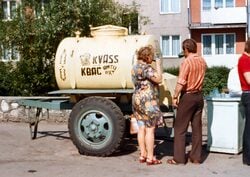
The kvassniki were such an established feature of Russian street life that they appear in paintings, literature and official records across the medieval and early modern period. Ivan the Terrible is documented as having visited kvass sellers on the street personally, an image that is difficult to square with his historical reputation but entirely consistent with the universality of the drink. Boris Godunov attempted to regulate the kvass trade in the late 16th century as part of broader efforts to control alcohol production and sale across Russia, which tells you both how economically significant the kvass trade had become and how the line between kvass and stronger fermented beverages was occasionally difficult to enforce.
The Variations: From Peasant to Palace
The basic kvass recipe, dark rye bread, water and a sweetener, was the foundation. What distinguished the kvass of different social classes, different regions and different seasons was what was added to that foundation.
The simplest and most common version, drunk daily by working people across Russia and Ukraine, was exactly the recipe I made. Dark rye bread, water, a small amount of honey or sugar, sometimes raisins for additional wild yeast and a faint sweetness. Fermented for two to three days and drunk young before it became too sour or too alcoholic. Light, mildly tart, faintly malty, very slightly fizzy. Refreshing in summer and warming in winter.
The more elaborate versions document the creativity that Russians brought to a simple base. Fruit kvass incorporated cherries, bilberries, lingonberries or cranberries, the wild berries of the Russian forest, fermented alongside the bread to produce a more complex, more brightly flavoured drink. Mint kvass added fresh or dried mint to the fermentation, producing a cooling herbal quality that made it particularly popular in summer. Honey kvass, made with a higher proportion of honey and fermented longer, approached the alcohol content of light mead and was considered more of a special occasion drink than an everyday staple. Beetroot kvass, made from fermented beetroot rather than bread, was a completely separate tradition used as much for its deep red colour and nutritional properties as for its flavour.
The wealthy households of medieval Russia maintained dedicated kvass cellars with multiple barrels of different varieties fermenting simultaneously, each at a different stage of the process so that fresh kvass was always available. The cellar master responsible for the kvass production was a skilled and valued household employee. The idea that kvass was simply a poor person’s drink is a modern misunderstanding. It was a universal drink that happened to also be accessible to the poor, which is a meaningfully different thing.
My Rating
Kvass is exactly what it tastes like it should be. The toasted rye bread produces a malty, slightly earthy base note that is immediately recognisable as related to beer without tasting exactly like beer. The sugar and raisins contribute a faint sweetness and help the fermentation produce enough carbonation to give the finished drink a light, pleasant fizz. When cold from the fridge on a warm day it is genuinely refreshing in a way that surprised me.
The closest modern comparison I can offer is a non-alcoholic dark wheat beer with a slightly more pronounced bread flavour and considerably less bitterness. If you enjoy the flavour of a malty beer but do not drink alcohol or are looking for a lower alcohol alternative, kvass is worth making. The process is simple, the ingredients are inexpensive, and the result is something you can drink every day without any concern, which is precisely what Russians did for a thousand years.
The one adjustment I would make on a second batch is to let it ferment for the full three days rather than pulling it at two, which would produce a slightly more sour and more complex result. The two-day version is pleasant but a little sweet for my personal preference. Three days and an extra day in the fridge would be my recommendation for anyone who likes their fermented drinks with a bit more edge.
Rating: 7.1 / 10
The Recipe: Traditional Russian Kvass

Traditional Russian Kvass

Don’t lose this one.
I’ll email it to you so it’s waiting when you’re ready to cook.
Ingredients
Instructions
Notes
- Serve cold. Always cold. Room temperature kvass is a completely different and considerably less enjoyable drink. The cold temperature is what makes it refreshing and what brings the malt and subtle sweetness into balance.
- The raisins are not optional if you want reliable carbonation. They contribute additional wild yeast and fermentable sugar that makes the fizz more consistent than relying on the wild yeast from the bread alone.
- If your kvass is too sweet at the 2-day mark, leave it for the full 3 days. The longer fermentation converts more of the sugar to alcohol and carbon dioxide, reducing the sweetness and increasing the sour complexity.
- For the fruit versions documented in Russian historical sources, add a handful of fresh or frozen cherries, lingonberries or blueberries to the fermentation container alongside the raisins. Each will produce a noticeably different flavour profile. The cherry version is the most immediately approachable for a modern palate.