
Go Back

Traditional Russian Kvass

Print Recipe
Documented from 988 CE in the Russian Primary Chronicle, compiled by the monk Nestor at the Kyiv-Pechersk Lavra monastery, c.1113 AD. Traditional preparation using dark rye bread, water, sugar and raisins, the most widely documented method across Russian and Ukrainian household cooking.
Prep Time 35 minutes
Fermenting Time 3 days

Ingredients

  • 300 g approximately 10 oz dark rye bread, preferably a dense sourdough rye loaf — the darker and denser the better. A standard supermarket dark rye bread works. Do not use wheat bread or light rye. The darker the bread the more complex and malty the finished kvass
  • 2 litres water divided — 1.5 litres for the first steep, 500ml for the second steep
  • 2 tbsp raw honey or sugar — honey is the most traditional and most historically documented sweetener. Regular sugar dark brown sugar or molasses all work. Honey produces the most authentic flavour
  • Small handful of raisins — documented in historical Russian kvass preparations and worth including. They contribute additional wild yeast and a faint fruit sweetness that improves the flavour and carbonation of the finished drink

Instructions

Toast the bread

  • Slice or tear the dark rye bread into rough chunks. Arrange in a single layer on a baking sheet and toast in the oven at 325°F for 25 to 30 minutes until very dark brown, completely dry and hard throughout. The bread should be deeply coloured, approaching but not quite burnt. This toasting step converts the starches in the bread into fermentable sugars and develops the malty flavour compounds that define kvass. Bread that is not dark enough produces a pale, flat, underwhelming result. When in doubt, toast it darker.

First steep

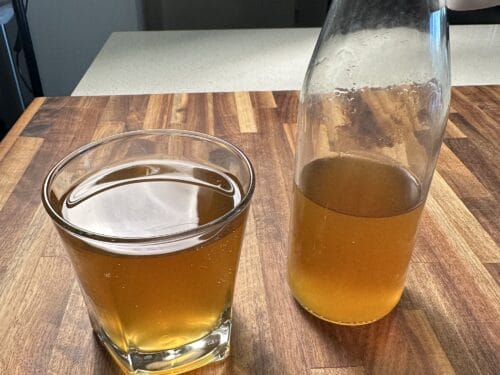
  • Bring 1.5 litres of water to a boil then remove from heat and allow to cool to approximately 175°F, hot but not boiling. Pour the hot water over the toasted bread pieces in a large clean container, a 3 litre glass jar or ceramic crock works well. Stir briefly to make sure all the bread is submerged. Cover loosely with a clean cloth and leave to steep at room temperature for 30 minutes. The water will turn a deep amber brown as it extracts the sugars and flavour compounds from the toasted bread.

Second steep

  • Strain the liquid through a fine mesh strainer into a separate container, pressing the bread firmly with a spoon to extract as much liquid as possible. Reserve the spent bread solids. Bring the remaining 500ml of water to a boil, cool to 175°F and pour over the reserved bread solids. Leave to steep for a further 30 minutes then strain again. Combine both strained liquids together in your fermentation container. Discard the bread solids.

Add sweetener and raisins

  • Allow the combined liquid to cool completely to room temperature, approximately 70 to 75°F. Add the honey or sugar and stir until completely dissolved. Add the handful of raisins. Cover the container loosely with a clean cloth secured with a rubber band. Do not use an airtight lid. The fermentation needs to breathe.

Ferment

  • Leave the covered container at room temperature in a warm spot, ideally 70 to 78°F, for 2 to 3 days. Do not move it or disturb it unnecessarily. After 24 hours you may begin to see small bubbles rising slowly through the liquid and gathering at the surface. By 48 hours there should be a light foam forming on top and the liquid should smell pleasantly yeasty and faintly sour. Taste it. At 2 days it will be mildly sweet and just beginning to develop sourness. At 3 days it will be more sour, more complex and slightly more alcoholic. Pull it when the balance tastes right to you.

Strain and bottle

  • Strain the fermented liquid through a fine mesh strainer or cheesecloth into clean plastic bottles using a funnel. Discard the raisins and any sediment. Leave approximately one inch of headspace at the top of each bottle. Seal the caps.

Carbonate and refrigerate

  • Leave the sealed bottles at room temperature for a further 12 to 24 hours. Squeeze a plastic bottle periodically to check the pressure. When the bottle feels firmly pressurised and resists when you squeeze it, move all bottles immediately to the refrigerator. The cold temperature will slow the fermentation significantly and lock in the carbonation. Leave in the fridge for at least one more day before drinking. The flavour improves noticeably after the extra day of cold conditioning.
  • Open carefully over a sink. The kvass is a live fermentation and continues building carbonation even in the fridge. Drink within 3 to 5 days for the best result.

Notes

  • Serve cold. Always cold. Room temperature kvass is a completely different and considerably less enjoyable drink. The cold temperature is what makes it refreshing and what brings the malt and subtle sweetness into balance.
 
  • The raisins are not optional if you want reliable carbonation. They contribute additional wild yeast and fermentable sugar that makes the fizz more consistent than relying on the wild yeast from the bread alone.
 
  • If your kvass is too sweet at the 2-day mark, leave it for the full 3 days. The longer fermentation converts more of the sugar to alcohol and carbon dioxide, reducing the sweetness and increasing the sour complexity.
 
  • For the fruit versions documented in Russian historical sources, add a handful of fresh or frozen cherries, lingonberries or blueberries to the fermentation container alongside the raisins. Each will produce a noticeably different flavour profile. The cherry version is the most immediately approachable for a modern palate.