When you think of hummus today, you probably imagine the smooth, creamy dip we buy in tubs or whip up quickly in a blender. But the roots of hummus stretch back centuries, and in the 14th-century Egyptian cookbook Kanz al-Fawa’id fi Tanwi’ al-Mawa’id (“Treasure Trove of Benefits and Variety at the Table”), we find one of the earliest written versions: himmas kassa. This recipe is rustic, nutty, and full of spices that make it quite different from the hummus you know, but all the more fascinating for it.
The History Behind Medieval Hummus
The word himmas means chickpeas, and in medieval Arab kitchens, chickpeas were a staple of both everyday cooking and formal banquets. Hummus recipes existed in many variations across the Middle East, often paired with tahini, herbs, and spices. What makes this medieval version distinct is the inclusion of walnuts, fragrant spices like caraway and cinnamon, and the tang of vinegar and lemon. It is a dish that bridges nourishment with sophistication.
At banquets, hummus was usually served as part of the starter course alongside breads, pickles, and small salads, offering guests a flavorful beginning before heavier meat and rice dishes. Dips like this also reflect the highly refined food culture of the medieval Islamic world, where balance of flavors and variety at the table were markers of sophistication.
The World of the Kanz al-Fawa’id
The cookbook that preserves this recipe, Kanz al-Fawa’id fi Tanwi’ al-Mawa’id, was compiled in 14th-century Egypt, though many of its recipes reflect older traditions passed down orally or through earlier texts. This was a period when Cairo stood as one of the greatest cultural capitals of the Islamic world, bustling with merchants, scholars, and cooks from across North Africa, the Levant, and the Mediterranean.
Next week
I cook these before I write them. Some of it never makes the post.
The failures, the source documents, the version that actually tasted good. That part goes out by email, and next week’s is already on the stove.
 Written and cooked by Donnie
Food in such a setting was more than nourishment. It was a display of refinement, an art form, and in many ways a symbol of empire. Recipes like himmas kassa show how the cuisines of the Islamic world were both local and global, incorporating ingredients like chickpeas grown in the Levant, walnuts from Persia, and spices that traveled along the Silk Road. In this way, the hummus of the medieval era was a microcosm of the broader world.
Chickpeas in the Ancient and Medieval World
Chickpeas themselves have an extraordinary history that predates Islam by millennia. Archaeological evidence shows they were cultivated as far back as 7000 BCE in what is now Turkey and Syria. By the time of the ancient Greeks and Romans, chickpeas were consumed widely, roasted as snacks or boiled into stews. They carried with them a reputation as both hearty peasant food and a protein-rich staple suitable for soldiers.
In the medieval Islamic world, chickpeas maintained this dual identity. They were practical, filling, and cheap, but in dishes like himmas kassa they were elevated with rich tahini, nuts, and spices. The combination demonstrated how medieval cooks had a gift for transforming humble ingredients into foods that dazzled the senses and carried symbolic meaning.
Hummus at the Banquet Table
Banquets in the Islamic Golden Age were carefully orchestrated events, often lasting hours with multiple courses designed to show off the host’s wealth and refinement. Small dishes such as himmas kassa were part of the mezze-like introductions to the meal. These first courses were meant to stimulate the appetite, offer balance to the meal, and display the cook’s creativity in layering flavors.
Guests might dip flatbread into a series of spreads, each slightly different in spice, texture, and richness. Serving such dishes not only satisfied hunger but also communicated generosity. In a society where hospitality was a virtue, hummus served with nuts, herbs, and spices showed the care taken to honor the guests.
The Flavor Profile of Himmas Kassa
What sets this medieval recipe apart from today’s hummus is the layering of unusual flavors. Walnuts add a rich nuttiness that deepens the base of chickpeas and tahini. Spices like cinnamon and ginger bring warmth and fragrance, while caraway and coriander add a complexity that feels both familiar and surprising. The vinegar provides an acidic counterpoint, balancing the richness with sharpness.
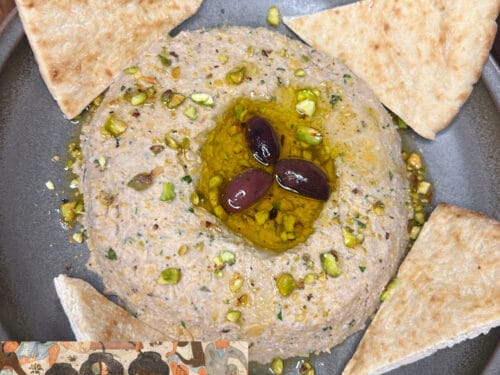
This creates a hummus that feels rustic and textured, closer to a coarse mash than the smooth purée most of us expect. Yet, this texture may have been prized in its time, offering contrast against soft flatbreads or the crisp vegetables and herbs often served alongside it. Tasting this dish is tasting a different philosophy of food, one where texture and fragrance mattered as much as smoothness.
Recreating Himmas Kassa Today
When I made this dish, I was struck by how familiar it felt and yet how different. The parsley and mint give it freshness, while the walnuts add a grounding richness. Spices like ginger and cinnamon remind us that medieval cooking loved complexity, weaving together sweet and savory. And unlike the silky hummus of today, this version has more texture, a reminder that it was made by hand, not in a blender.
It is one of those recipes that instantly connects you to the cooks and diners of the 14th century, letting you taste the flavors they enjoyed.
Recipe: Medieval Himmas Kassa
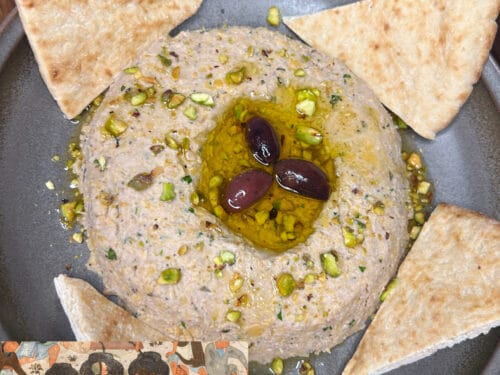
Medieval Hummus Recipe

Don’t lose this one.
I’ll email it to you so it’s waiting when you’re ready to cook.
Ingredients
Instructions
Notes
- Rustic Texture – Do not over-purée the chickpeas. This hummus was meant to be coarse, offering contrast against soft flatbread and other dishes.
- Balance of Flavors – The unusual spice mix of cinnamon, ginger, and caraway gives warmth and complexity, so taste as you go to balance the sharpness of vinegar with the richness of walnuts.
- Authentic Garnish – Garnishing with olives, pistachios, and a drizzle of olive oil not only adds flavor but also reflects how medieval cooks presented their food with care and beauty.