Fourteen thousand four hundred years ago, long before Rome, long before Egypt, long before the first fields were plowed, someone knelt beside a hearth in what is now northeastern Jordan and baked bread.
Not symbolic bread. Not ritual bread. Real bread.
In 2018, archaeologists from the Universities of Copenhagen and Cambridge, and University College London, uncovered 24 charred fragments of flatbread at the site of Shubayqa 1, a Natufian settlement dated to roughly 14,400 years before present. Published in the Proceedings of the National Academy of Sciences, the findings pushed the origin of bread back thousands of years before agriculture. This wasn’t Neolithic farming bread. This was hunter-gatherer bread.
And that changes everything.
Because it suggests something radical: bread may not have followed agriculture. Agriculture may have followed bread.
Who Were the Natufians?
The Natufians were a semi-sedentary hunter-gatherer culture that lived in the Levant — modern-day Israel, Jordan, Syria, and Lebanon — between roughly 12,800 and 10,200 BP. They stand at one of the most important thresholds in human history: the bridge between Paleolithic foraging and Neolithic farming.
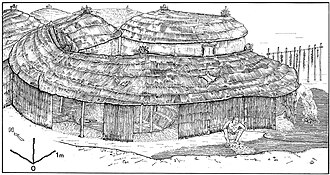
Unlike earlier nomadic groups, the Natufians built permanent, circular stone-walled homes. At sites like Ain Mallaha, they constructed semi-subterranean dwellings that suggest long-term settlement. They were not wandering aimlessly across the landscape. They were staying.
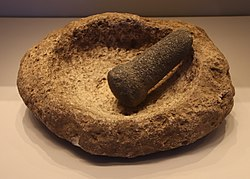
This shift in lifestyle changed everything. With permanence came storage. With storage came planning. With planning came the first steps toward domestication. The Natufians intensively gathered wild cereals — barley, einkorn wheat, and oats — and processed them using stone mortars, grinding slabs, and sickles.
They hunted gazelle and wild game, likely domesticated dogs, created early art like the Ain Sakhri Lovers figurine, and buried their dead in organized cemeteries. They were complex. They were rooted. And they were experimenting.
The Discovery at Shubayqa 1
The site of Shubayqa 1 in northeastern Jordan is one of the most remarkable Natufian settlements ever excavated. It consists of two well-preserved superimposed buildings, including a semi-subterranean structure with a carefully laid basalt flagstone floor.
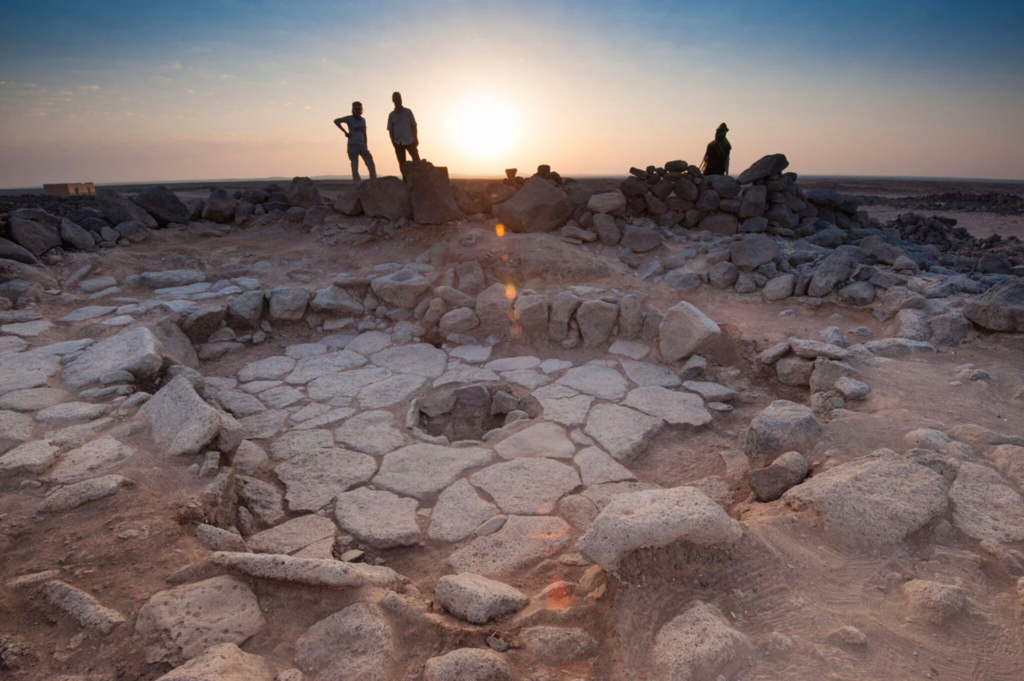
Inside these structures, archaeologists found rich deposits of ground stone tools, chipped flint, animal bones, and plant remains. But among the debris were 24 small, charred food fragments that turned out to be something extraordinary.
Microscopic analysis revealed that wild ancestors of domesticated cereals — barley, einkorn, and oat — had been ground, sieved, kneaded, and then cooked. The structure of the fragments closely resembled unleavened flatbreads later found in Neolithic and even Roman contexts.
This wasn’t porridge. It wasn’t gruel.
It was bread.
The grains had been processed intensively. The flour was refined. The dough was kneaded. The final product was baked on hot stones or in hearth ash. The labor investment was enormous for a hunter-gatherer society. And that is precisely what makes it significant.
Bread Before Farming
Why go through the effort?
Grinding wild cereals is laborious. You must gather them, de-husk them, dry them, grind them, sift them. Then mix with water. Then bake.
For a foraging society, that is an investment.
Researchers have suggested that the appeal of bread — its portability, flavor, texture, and caloric density — may have encouraged greater reliance on wild cereals. And greater reliance may have encouraged cultivation. In other words, the desire for bread could have nudged humanity toward farming.
That idea reframes the agricultural revolution. Instead of farming giving rise to bread, perhaps bread created the incentive to farm.
The Natufians were already intensively harvesting wild stands of grain. They were already storing food. They were already semi-sedentary. Bread may have been one of the tipping points.
A simple flat disc of ground wild barley might have been one of the sparks that eventually led to cities.
What This Bread Actually Was
Natufian flatbread was not fluffy. It was not soft. It was not salted or yeasted.
It was dense. Unleavened. Likely coarse.
Alongside cereals, archaeological evidence suggests the inclusion of pulverized plant material — including tubers such as club-rush roots. These starchy wetland plants would have been dried, pounded, and incorporated into the dough. In this recreation, crushed tiger nuts serve as a stand-in for those prehistoric tubers.
The dough would have been shaped by hand and baked directly on hot stones or buried in hearth ash. No ovens. No fermentation. Just heat and patience.
The result would have been nutty, earthy, slightly bitter, and sustaining. It was survival food elevated by technique.
And when you hold a piece in your hand, you are holding a food that predates farming, pottery, and metal.
That is almost impossible to comprehend.
Recreating Natufian Flatbread
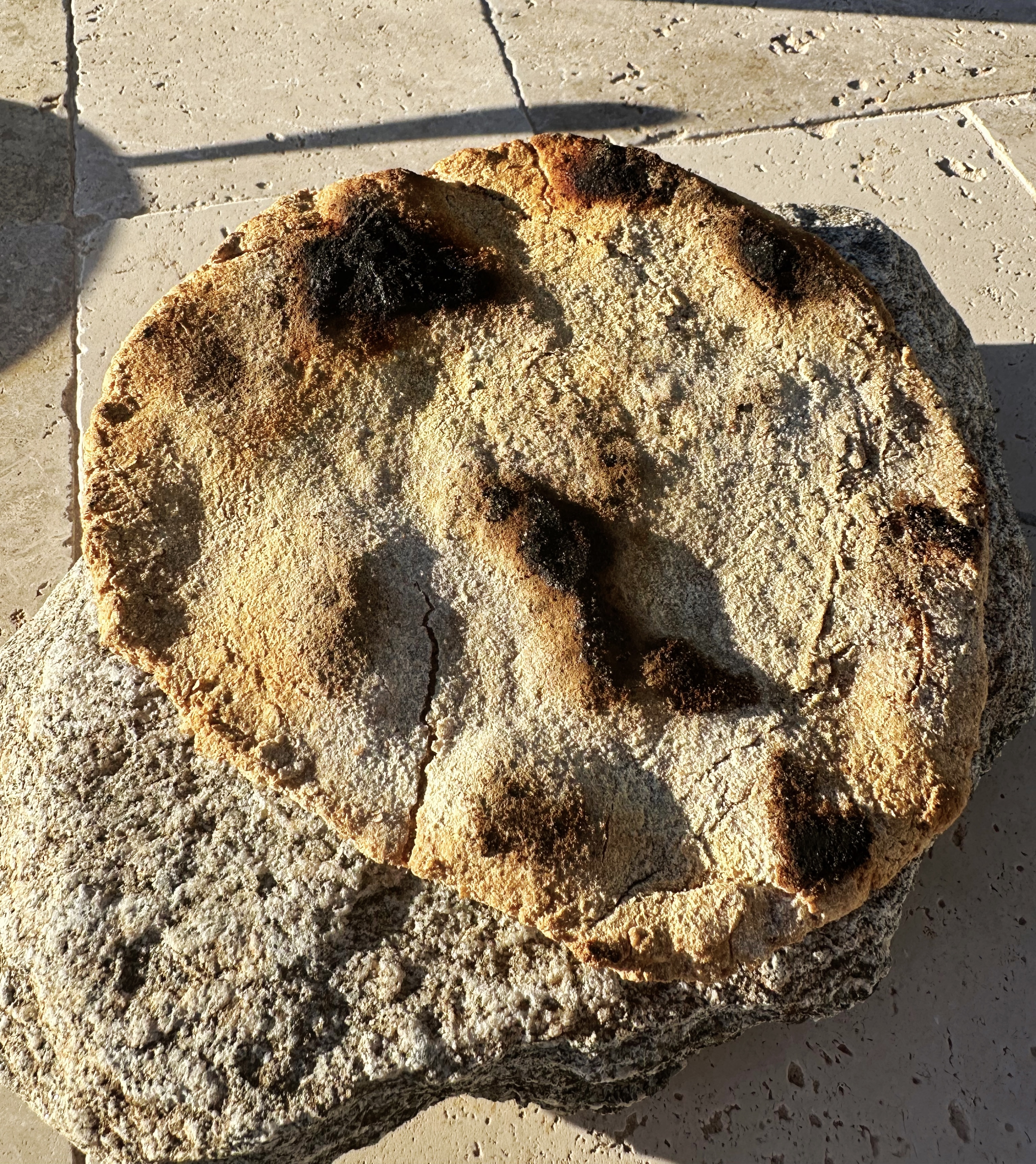
Natufian Flatbread
Ingredients
- 1 cup whole einkorn flour
- ½ cup barley flour
- ½ cup crushed tiger nuts as a stand-in for prehistoric tubers
- About ¾ cup warm water add gradually
Instructions
Step 1: Prepare the Flour Blend
- In a large bowl, combine the einkorn flour, barley flour, and crushed tiger nuts. If you want a slightly more authentic texture, pulse the flours briefly in a food processor to create a coarser grind — Natufian flour would not have been finely milled.
- Mix thoroughly so the tiger nuts are evenly distributed. These represent the pulverized tubers found in archaeological analysis and add both starch and subtle sweetness.
Step 2: Form the Dough
- Slowly add warm water a few tablespoons at a time, mixing with your hands or a wooden spoon.
- You are aiming for a stiff, dense dough, not soft and elastic like modern bread. It should feel firm and slightly coarse, but hold together when pressed. If it cracks slightly when pressed, that is completely normal — this is closer to a primitive flat cake than a kneaded loaf.
- Once it holds together, press firmly into a rough ball and let it rest for 10–15 minutes. This allows the coarse grains to hydrate fully.
Step 3: Shape
- Flatten into a single disc about ¼ inch thick. Keep the edges irregular. Press with your palms rather than rolling thin — prehistoric breads were hand-shaped.
- If cracks appear around the edges, gently press them back together. Avoid overworking the dough.
Cooking Methods (Choose Your Preferred Method)
Method 1: Oven with Baking Stone (Most Controlled)
- Preheat oven to 500°F (260°C) with a pizza stone or baking steel inside for at least 45 minutes.
- Carefully transfer the flatbread directly onto the hot stone. Bake for 8–10 minutes. Flip halfway through if needed.
- You are looking for: Light blistering, Dry surface, Some browning or mild charring.
- The bread should not puff dramatically. It should firm up and dry out slightly.
Method 2: Grill with Stone (More Rustic)
- Preheat a grill to high heat (450–550°F). Place a flat stone or cast iron griddle on the grill grates and allow it to heat thoroughly.
- Place the flatbread directly on the hot surface. Close the lid and cook 4–5 minutes per side.
- This method gives you more char and smokiness — closer to hearth-style cooking.
Method 3: Fire Pit or Open Flame (Most Authentic)
- Build a hardwood fire and allow it to burn down to glowing embers.
- Place a flat stone near or partially over the coals and allow it to heat fully.
- Lay the flatbread directly on the heated stone. Cook 4–6 minutes per side.
- You can also experiment with lightly covering the bread with hot ash for part of the bake to mimic prehistoric ash baking (ensure only clean hardwood ash is used).
- This method produces the most authentic texture and uneven charring.
Step 4: Rest and Break
- Remove from heat and allow to cool for several minutes.
- Do not slice — break it apart by hand. The interior should be dense, slightly chewy, and rustic.
Video
Notes
- Keep the Dough Firm: If the dough feels too soft, you’ve added too much water. This bread should feel sturdy and slightly coarse — that texture is part of its authenticity.
- Do Not Overbake: You want light charring and dryness, not complete brittleness. Overbaking will turn it into a hard cracker rather than a flatbread.
- Embrace Imperfection: Irregular shape, cracks, and uneven browning are historically accurate. The more “primitive” it looks, the closer you are to recreating a 14,400-year-old food tradition.