
Go Back

Basque Burnt Cheesecake

Print Recipe
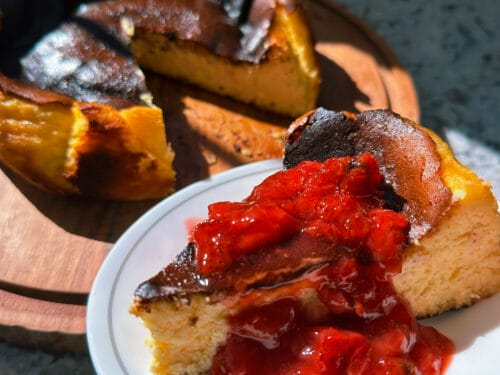
Created by Santiago Rivera at La Viña bar in San Sebastián in 1990, it is a crustless cheesecake baked at high heat until the exterior is deeply caramelised and almost black, while the interior remains pale, custardy and barely set. Five ingredients, ten minutes of preparation, and the most dramatic contrast of textures and flavours you will find in a baking dish. It went from a single bar in the Basque Country to the most talked about cheesecake in the world, and once you taste it you will understand exactly why.
Prep Time 10 minutes
Cook Time 50 minutes
Chill Time 12 hours

Ingredients

  • 2.2 lbs full fat cream cheese room temperature — four standard 8oz Philadelphia blocks is exactly right. Mascarpone produces a milder, more authentic result closer to the original Spanish San Millan cheese if you can find it
  • 2 cups sugar
  • 5 large eggs room temperature
  • 2 cups heavy cream
  • Nothing else. No flour. No salt. No vanilla. No crust. Five ingredients and that is the complete recipe

Instructions

Prepare the pan

  • Preheat your oven to 410°F. Line a 10-inch springform pan with two overlapping sheets of parchment paper pressed into the pan with at least 2 inches rising above the rim. Do not grease it. The crumpled, irregular parchment is not just functional. It is the authentic La Viña aesthetic and produces the characteristic rippled edges of the finished cheesecake.

Make the batter

  • Combine the cream cheese and sugar in a large bowl and mix until completely smooth with absolutely no lumps remaining. If your cream cheese is cold this will be difficult and the result will be grainy. Room temperature is essential and non-negotiable.
  • Add the eggs one at a time, mixing well after each one before adding the next. Pour in the heavy cream and mix until fully combined and the batter is completely smooth and pourable. It will be very liquid, much more so than a standard cheesecake batter. This is correct and expected. Do not be alarmed.

Bake

  • Pour the batter into the lined pan. Place on the upper third rack of the oven. Bake for 40 to 50 minutes until the top is deeply caramelised, genuinely dark brown to nearly black at the edges and across much of the surface. The centre should wobble dramatically when you move the pan. The wobble should concern you slightly. Pull it at that point. Do not wait for the centre to look set. It will not look set. That is correct.

Cool and refrigerate

  • Remove from the oven and allow to cool completely at room temperature for at least one hour. The cheesecake will sink and deflate as it cools. This is correct and expected. Once fully cooled, refrigerate overnight. Do not attempt to serve it the same day it is baked. The texture the following morning after a full night of refrigeration is the intended result and is completely different from the warm version.

Serve

  • Run a thin knife around the inside edge of the springform pan before releasing the latch. Peel back the parchment at the table for the reveal. Serve in wedges directly from the parchment lined base. A small glass of Pedro Ximénez sherry alongside is the authentic La Viña accompaniment and is worth doing if you can find it.

Notes

  • Room temperature ingredients are the single most important factor in this recipe. Cold cream cheese will not combine smoothly regardless of how long you mix it and the resulting batter will be uneven and the final texture will be affected throughout. Take the cream cheese and eggs out of the fridge at least two hours before you start.
 
  • Do not add flour. Multiple versions of this recipe online add flour or cornstarch for stability. These produce a denser, cakier result that loses the custard-like centre that defines the original. The authentic La Viña recipe contains no flour and the instability of the flourless batter is what produces the extraordinary texture.
 
  • The burnt top is not optional and cannot be avoided. Do not pull the cheesecake early because the surface looks overdone. The deeply caramelised, almost black exterior is the entire point of the recipe, and the bitter-sweet contrast with the mild interior is what makes this extraordinary rather than merely good.