Go Back
–+ servings

Duelos y Quebrantos

Donnie
No ratings yet
From Don Quixote, Chapter 1, Miguel de Cervantes, 1605
The Saturday dish of Alonso Quijano, recreated from the La Mancha cooking tradition as documented by Spanish food historians and regional culinary sources.
Original Spanish: duelos y quebrantos los sábados, consumed as part of the modest weekly menu described in the novel's second sentence.
Prep Time 5 minutes
Cook Time 15 minutes
Servings: 2

Jump To

Donnie Dodson

Don’t lose this one.

I’ll email it to you so it’s waiting when you’re ready to cook.

Ingredients
  

  • 100 g pancetta cut into small rough cubes — this is the bacon or salted pork fat element documented in the historical reconstruction of the dish. Thick-cut pancetta produces the best result. Bacon or any cured pork belly is an acceptable substitute
  • 100 g Spanish chorizo sliced into rounds approximately 5mm thick — the cured, semi-dried Spanish chorizo rather than the fresh cooking variety. The paprika oil that releases from the chorizo as it cooks is essential to the dish's flavour
  • 2 to 3 cloves garlic finely diced
  • 4 large eggs
  • Salt to taste — the pancetta and chorizo are both already salty so taste before adding any
  • Fresh flat-leaf parsley roughly chopped, for garnish
  • Toasted crusty bread for serving
  • A glass of red wine because this is what Cervantes intended

Instructions
 

Render the pancetta

  1. Place a wide pan over medium-low heat with no added oil. Add the pancetta cubes and leave them without moving for 3 to 4 minutes until the fat begins to render and the edges start to colour. The rendered fat is the cooking medium for everything that follows and it needs time to develop. Do not rush this step and do not drain the fat at any point.

Add the chorizo and garlic

  1. Add the sliced chorizo to the pan with the rendered pancetta and its fat. The chorizo will immediately begin releasing its paprika-infused oil into the pan, turning everything a vivid orange-red. Add the finely diced garlic. Stir and cook over medium heat for 3 to 4 minutes until the chorizo is lightly caramelised at the edges and the garlic is fragrant and golden. The pan should smell extraordinary at this point.

Add the eggs

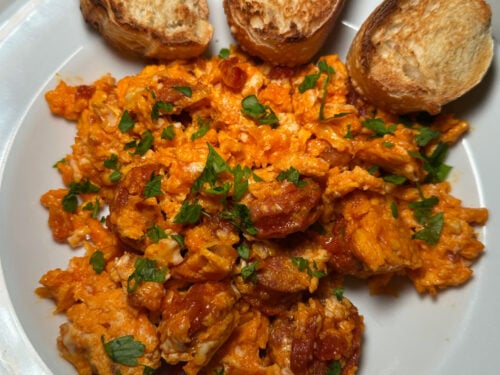
  1. Crack the 4 eggs directly into the pan over the pancetta, chorizo and garlic. Do not beat them first. Let them hit the hot fat and begin to set for 10 to 15 seconds, then begin scrambling gently with a wooden spoon or spatula, pulling the eggs through the pork fat and meat continuously. The eggs should absorb the paprika-red cooking fat as they cook, turning a warm orange colour rather than the pale yellow of plain scrambled eggs. Cook over medium heat, pulling from the heat slightly before the eggs are fully set. The residual heat will finish them. They should be soft and slightly custardy, not dry.
Season and taste

  1. Taste before adding any salt. The pancetta and chorizo together may have provided all the salt the dish needs. Add a pinch if required.

Serve

  1. Pile the duelos y quebrantos onto warm plates immediately. The dish does not wait and does not improve with time. Scatter fresh parsley over the top. Serve with toasted crusty bread alongside for mopping up the paprika-red oil that remains in the pan, which is the best part of the entire dish. Pour the wine.
  2. This is the Saturday breakfast of a man who became the most famous fictional knight in the history of literature. It is considerably better than his later adventures suggested his life was going.

Video

Notes

  • The quality of the Spanish chorizo matters more than the quantity. Use a cured Spanish chorizo with visible paprika content. The fat that renders from good chorizo is deeply flavoured and coloured and is what gives the dish its characteristic appearance and taste. A fresh Mexican-style chorizo or a spicy Italian sausage will not produce the same result.
 
  • The eggs should be scrambled soft. Overcooked scrambled eggs in any context are less pleasant than properly soft ones, but in this dish where the eggs are carrying the flavour of the cured meats and their fat, the soft custard texture is particularly important. Pull the pan from the heat while they still look slightly underdone.
 
  • The lamb brain version, for those interested in the historically complete preparation, involves adding approximately 100g of cleaned lamb brain to the pan after the chorizo and pancetta are rendered, cooking it gently until just set before adding the eggs. It produces a richer, more unctuous result. It is genuinely good if you can source the ingredient and approach it without hesitation. I will cover it in a separate episode.

Tried this recipe?

Let us know how it was!