Go Back

Medieval Hot Cross Buns

Print Recipe
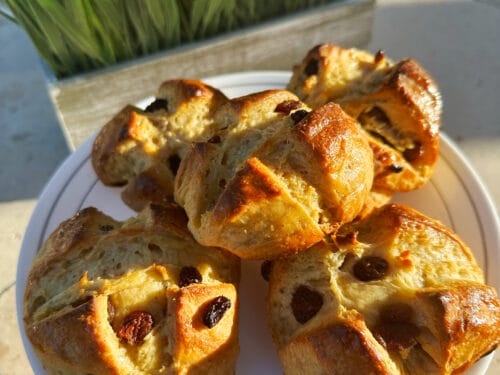
The Alban Bun is the direct ancestor of every hot cross bun eaten on Good Friday, first baked by Brother Thomas Rocliffe at St Albans Abbey in 1361 and given away free to the poor with a basin of fortified wine. Made with honey rather than refined sugar, spiced with cardamom and grains of paradise, and marked with a cross cut into the dough with a knife rather than piped on top, this medieval version is noticeably different from the commercial hot cross bun most people know.
Prep Time 20 minutes
Cook Time 15 minutes
Resting Time 2 hours

Ingredients

  • 2 cups strong white bread flour or all-purpose bread flour
  • 1 tsp instant yeast
  • ½ tsp salt
  • tbsp honey
  • 1 egg
  • cup warm whole milk
  • tbsp warm water
  • 4 tbsp unsalted butter softened
  • ½ cup currants
  • ¾ tsp ground cardamom or half cardamom, half black pepper
  • ½ tsp ground cinnamon
  • ¼ tsp ground ginger
  • tsp ground cloves
  • 1 tsp grains of paradise (optional), if using sub all other spices

Instructions

  • Combine the flour, yeast, salt and all the ground spices in a large bowl and mix together. Add the honey, egg, warm milk and warm water and mix to a shaggy dough. Add the softened butter and knead for 8 to 10 minutes until smooth and elastic. The dough will be enriched and slightly tacky, which is correct.
  • Fold in the currants and knead briefly to distribute them evenly through the dough. Place in a lightly oiled bowl, cover, and leave to rise for 1 to 1½ hours until doubled in size.
  • Divide the dough into 6 equal pieces, roughly 90g each, and shape each piece into a tight round. Place on a lined baking tray with space between each bun. Cover and prove for a further 45 minutes to 1 hour until noticeably puffed.
  • Using a sharp knife or a razor blade, cut a deep cross into the top of each bun, pressing firmly enough to divide the surface into four clear quarters. This is the medieval method and the defining visual difference from a modern hot cross bun. Do not pipe a cross.
  • Bake at 400°F for 15 to 18 minutes until deep golden brown. Medieval ovens ran hotter and more aggressively than a modern domestic oven, so do not be nervous about colour. Check at 15 minutes and give them the full 18 if they look pale.
  • Glaze immediately on coming out of the oven with warmed honey brushed generously over the top. Serve warm with butter.
Notes

  • The honey glaze applied immediately out of the oven is not optional. It is what finishes the bun, seals the crust, and gives the surface its characteristic sticky shine. Use a good quality honey and be generous.
 
  • Grains of paradise is the most period-accurate spice for this recipe and can be ordered online. Ground freshly, it has a warm, floral, peppery character that cardamom alone does not fully replicate. If you want the most authentic medieval flavour, it is worth seeking out.
 
  • These buns are best eaten the day they are baked, warm from the oven with cold butter. They were designed to be given away on Good Friday and eaten that day. Brother Thomas Rocliffe knew what he was doing.