
Go Back
+ servings

Recipe Two: Ulipki on Rosemary — The Baroque Dessert

Donnie
No ratings yet
Compendium Ferculorum, Recipe LXV: To Make Ulipki, and Recipe XCIV: Froth
Original text, Recipe LXV: Take of the finest wheat flour, sift it through a sieve, mix it with milk in the same fashion as you would for wafers, having added sugar according to your need. Then use a spoon to pour your mixture onto irons made ready for that very purpose, then bake it as you would bake wafers. Being baked, roll them onto round timber sticks or rollers, and being sprinkled with sugar, serve forth, or you may serve them with froth.
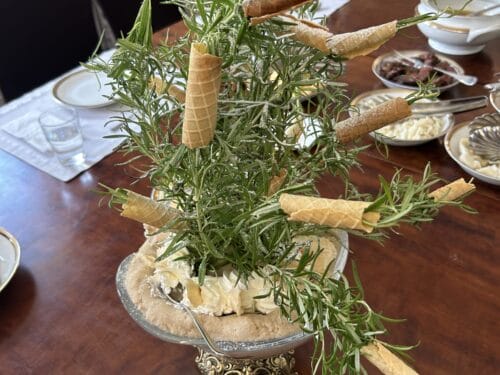
Original text, Recipe XCIV: Take of thick sweet cream (as much as you think useful), add pounded sugar and shake it in a syringe used for making dough until it be all frothy, then transfer the froth thus obtained into a bowl, arrange your ulipki all around, and serve forth sprinkled with sugar. You can also place a bush of rosemary in your bowl and pour your froth over it. And this is how to go about it. Take a loaf of rye bread and cut it into two flat halves. Hollow out one of them, coat it with butter and press it to the bowl so that your butter holds the bread fast in place. Stick a bush of rosemary inside your hollowed-out bread, pour the froth over it and serve forth surrounded with ulipki and sprinkled with sugar.
Note: The Compendium's footnote confirms that ulipki means wafers rolled to make rolls, confirming the cone shape.
Prep Time 15 minutes
Cook Time 30 minutes
Servings: 8 people

Jump To

Donnie Dodson

Don’t lose this one.

I’ll email it to you so it’s waiting when you’re ready to cook.

Ingredients
  

For the ulipki wafer cones:
  • 1 cup plain flour sifted — the finest wheat flour as specified
  • 1 cup whole milk
  • 2 tbsp white sugar
  • 1 large egg — not specified in the original but aids adhesion in a modern waffle iron
  • 1 tbsp melted unsalted butter — greases the iron and adds flavour
  • Pinch of fine salt
  • Powdered sugar for sprinkling
For the froth, whipped cream:
  • 500 ml heavy cream very cold
  • 3 tbsp powdered sugar pounded fine as the Compendium specifies
  • ½ tsp vanilla extract — not in the original but consistent with the period's flavouring conventions
For the rosemary presentation:
  • 1 small dense rye bread loaf or sturdy bread roll
  • 1 to 2 tbsp softened butter
  • 1 large fresh rosemary bush or several large rosemary sprigs bundled together firmly
  • Additional powdered sugar for the snow effect

Instructions
 

Make the ulipki batter

  1. Whisk together the sifted flour, milk, sugar, egg, melted butter and salt until completely smooth with no lumps. The batter should be thin, approximately the consistency of double cream, much thinner than pancake batter. This thinness is what produces the delicate, paper-thin wafer that rolls cleanly rather than the thick, spongy result that a thicker batter would produce. Allow to rest for 10 minutes.

Roll the ulipki — timing is everything

  1. Heat your waffle iron or, for the most historically appropriate result, a flat-plate waffle iron rather than a deep honeycomb grid. Brush with melted butter. Pour a small spoonful of batter, approximately 2 tablespoons, onto the centre of the hot iron. Close and cook for 45 to 60 seconds until golden and lacy. Open the iron carefully. The wafer must be removed and rolled immediately while still warm and pliable. It will harden within 10 to 15 seconds of being removed from the heat.
  2. Working very quickly, lift the wafer from the iron with a spatula and wrap it around a clean round stick, dowel or the handle of a wooden spoon. Press it into a tight cone shape and hold for 5 seconds until it sets firm. Slide off and place point-side down in a glass to hold its shape while you make the next one. If the wafer begins to crack before you can roll it, it has cooled too much. Return it briefly to the warm iron to soften slightly.
  3. Continue until all the batter is used. Sprinkle the finished cones with powdered sugar.

Make the froth

  1. Combine the very cold heavy cream, powdered sugar and vanilla in a large cold bowl. Whisk vigorously by hand or with electric beaters until the cream holds stiff peaks. The Compendium specifies shaking in a syringe used for making dough, which was the 17th century equivalent of a cream whipper. The result should be thick, stable and snow-white.

Assemble the rosemary tree presentation

  1. Take the rye bread and cut it horizontally in half. Take one half and hollow out the centre to create a cavity. Coat the cut surface generously with softened butter and press it firmly butter-side down into the centre of your serving bowl. The butter holds it in place exactly as the Compendium specifies. Insert the rosemary bush firmly into the hollowed centre of the bread so it stands upright, creating a small fragrant tree.
  2. Pour the whipped cream over and around the base of the rosemary bush, allowing it to flow around the bread base and fill the bowl. Arrange the ulipki cones upright around the rosemary bush in a ring, points upward, like a decorative fence surrounding the tree. When all the cones are in place, dust the entire construction generously with powdered sugar until it looks like a light snowfall has covered the tree and all the cones around it.

Serve

  1. Bring to the table as a spectacle. Each person takes an ulipki from the tree, fills it with the cream from the bowl using a small spoon, and eats it immediately. The rosemary perfumes the cream as people reach in to fill their cones. Sprinkle each filled cone with additional powdered sugar before eating.

Notes

  • The ulipki rolling step is the only technically demanding element of the entire recipe and it becomes easier very quickly with practice. Have your rolling stick ready before you open the iron for the first time. The first one will probably be imperfect. The third will be fine. The tenth will be easy.
 
  • The rosemary bush needs to be densely branched enough to stand upright on its own when inserted into the bread base. A single rosemary sprig will not work. Bundle several large sprigs together and tie them at the base with kitchen twine before inserting into the bread. The rosemary fragrance as people reach in to fill their ulipki is a significant part of the experience.

Tried this recipe?

Let us know how it was!