In 1937, the United States Army approached the Hershey Chocolate Company with one of the most unusual product briefs in the history of food manufacturing. They wanted a chocolate bar. But they needed it to taste, in the exact words of the Army Quartermaster who commissioned it, only a little better than a boiled potato.
If you’re enjoying my content, consider picking up an e-cookbook at Eats History Shop!
This was not a budget constraint or a failure of ambition; it was a deliberate engineering specification. The Army wanted bad chocolate, and they wanted it on purpose, and Hershey’s chief chemist Sam Hinkle dutifully spent months making it worse.
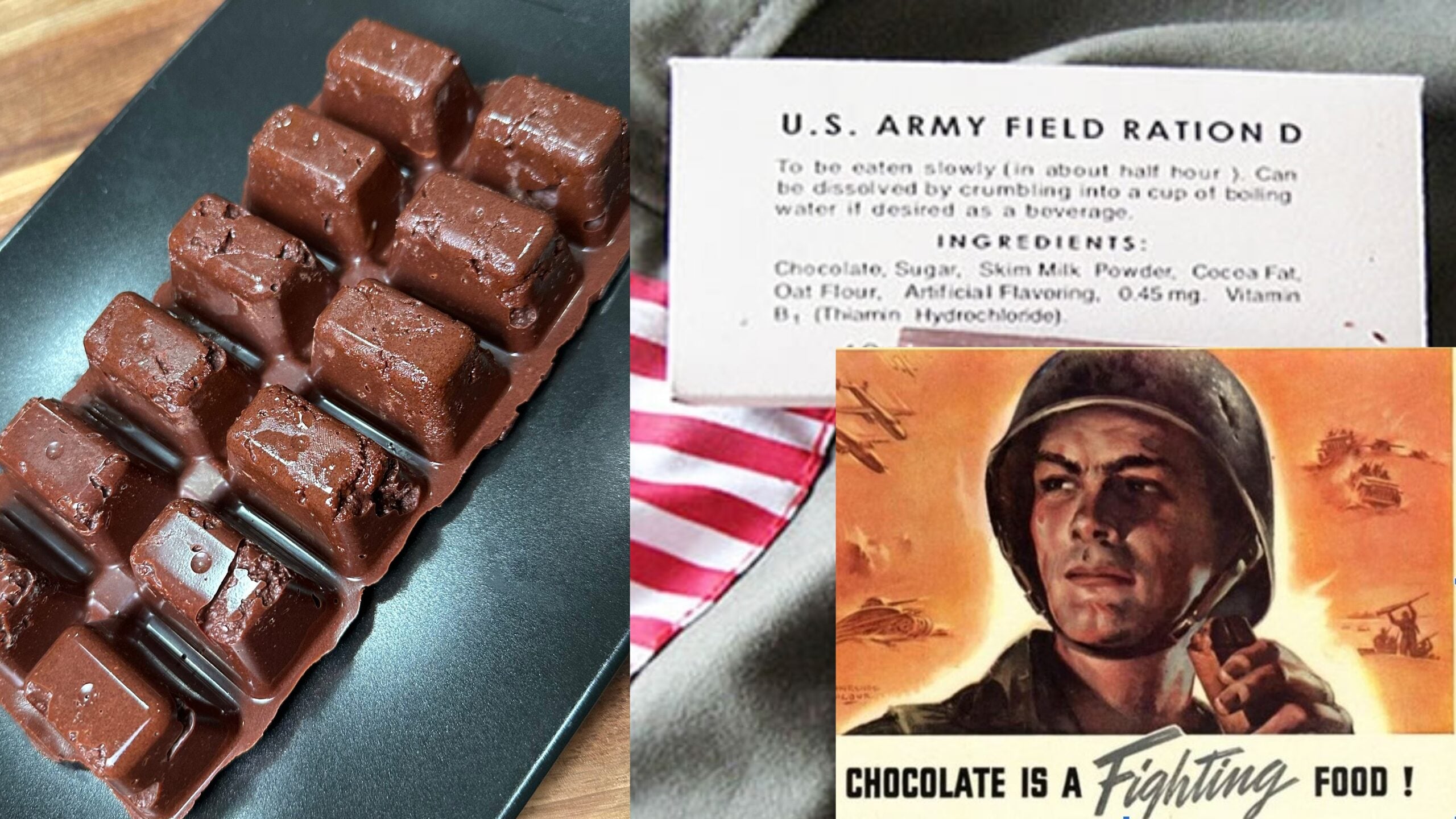
I made my own version at home. I pressed it into an ice cube tray because that is the closest thing most people have to a military ration mold. I tasted it. It was not as bad as I was expecting, which is either a compliment to the recipe or a concern about my own palate.
Next week
I cook these before I write them. Some of it never makes the post.
The failures, the source documents, the version that actually tasted good. That part goes out by email, and next week’s is already on the stove.
 Written and cooked by Donnie
Why the Army Made a Chocolate Bar Taste Terrible
In April 1937, Captain Paul Logan of the US Army Quartermaster General’s office sat down with William Murrie, president of Hershey’s Chocolate Corporation, and chief chemist Sam Hinkle, and laid out four very specific requirements for what he needed.
The bar had to weigh exactly four ounces. It had to have a high energy value, delivering substantial calories in a small, portable package. It had to withstand high temperatures without melting, which ruled out normal milk chocolate formulations. And it had to taste, Logan specified, only a little better than a boiled potato.
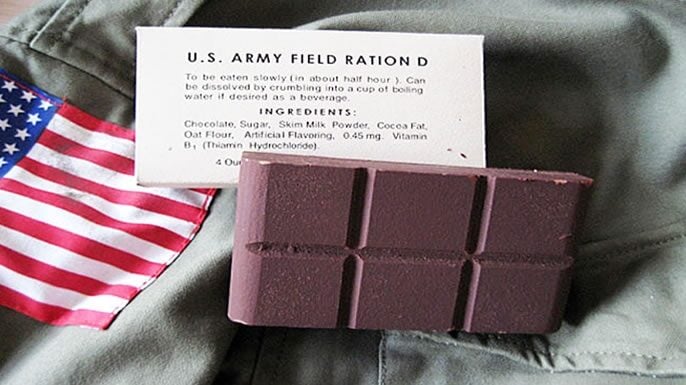
That last requirement was not a cost-cutting measure. It was a tactical decision of genuine sophistication. Logan did not want the soldiers to eat their emergency ration chocolate in non-emergency situations. If the bar was delicious, soldiers would eat it whenever they felt like it and have nothing left when they genuinely needed it. The solution was to engineer the palatability out of it on purpose. Make it just edible enough that a starving man would eat it. Make it just unpleasant enough that a man who was not starving would leave it alone.
Hinkle and his team got to work. They reduced the sugar content dramatically, increasing the chocolate liquor to make the flavour more bitter and less appealing. They added oat flour, which created a dry, dense, unpleasant texture that had the additional benefit of binding the mixture so tightly that it would not melt in heat. They added nonfat dry milk powder and cocoa butter. The resulting mixture was so thick and stiff that it could not be poured into molds at all. Every single bar had to be pressed in by hand. Factory workers at Hershey’s reported that the molds were deep and narrow and the chocolate would not cool properly and the job of making them was genuinely unpleasant. The bars themselves, once made, were nearly impossible to bite into. The official instructions recommended eating them slowly over the course of half an hour, or dissolving them in water as a drink.
The Army ordered 90,000 bars for field testing in 1937. They worked. Once the United States entered the war in December 1941, Hershey’s ramped up production to an extraordinary scale. Before the war ended the company had produced more than three billion D ration bars, earning five Army-Navy Excellence in Production awards in the process. Milton Hershey, at the award ceremony in 1942, was reportedly overjoyed, which suggests either that he had not tasted the bars or that he understood the difference between a good product and a useful one.
Stories From the Field: The Most Hated Chocolate in History
The soldiers who received the D ration bars had opinions. Virtually all of them were negative.
The most commonly reported problem was the texture. The bars were so dense and hard that soldiers with poor teeth could not eat them at all. Those with good teeth typically had to shave slices off with a penknife before they could get a piece small enough to chew. The instructions that the bar should be eaten slowly over thirty minutes were read by most soldiers as an acknowledgment that eating it quickly was physically impossible rather than medically inadvisable.
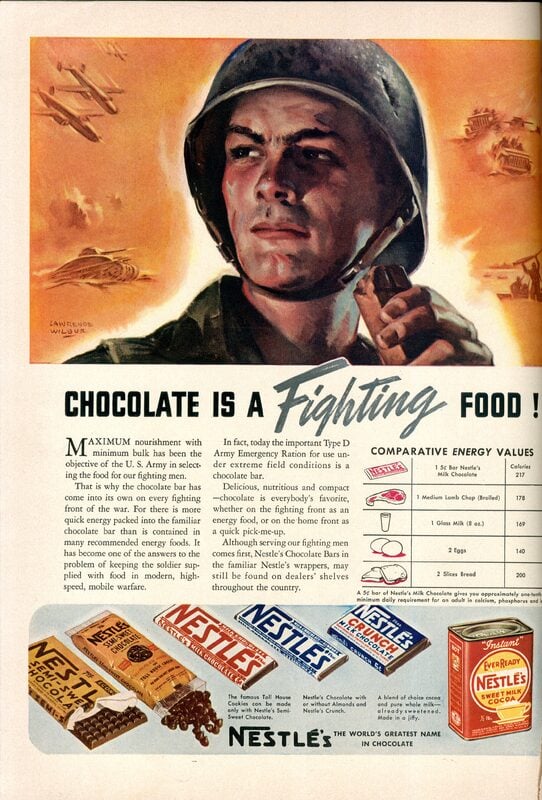
The flavour was described variously as bitter, chalky, waxy and unpleasant. The oat flour gave the chocolate an aftertaste that soldiers found difficult to ignore and impossible to enjoy. Some reported that the bars had a slightly greasy quality from the cocoa butter raising the melting point. The general consensus, expressed with the creativity that military personnel reliably bring to complaints about their rations, was captured in the nickname the bars acquired within months of being issued: Germany’s secret weapon.
The scam, however, is the detail I find most revealing about human nature in wartime. American soldiers discovered relatively quickly that European and Pacific civilians, who had never encountered the D ration bar and had no established low expectations of it, would receive a piece of American military chocolate with genuine enthusiasm. The brand name Hershey’s carried enormous prestige internationally. Soldiers traded their D ration bars to civilians who had not tasted real chocolate in years, received cigarettes, local food, goodwill, and various other things of value in exchange, and watched the civilian take a bite with mounting guilt or amusement depending on the soldier’s character. A French woman who received her first taste of American chocolate from a GI after the liberation of Paris in 1944 described it as a revelation, which is either a testament to how bad things had been in occupied France or evidence that she had very different taste to the American soldiers who had been trying to give the bars away.
The most extraordinary documented story involving the D ration bar belongs to Louis Zamperini, an Olympic distance runner and Army Air Corps lieutenant whose aircraft crashed into the Pacific Ocean in 1943. Zamperini survived 47 days adrift on a life raft, sustained in part by the D ration bars he had on board when the plane went down. Laura Hillenbrand documented his survival in her 2010 book Unbroken. The bar that soldiers traded to civilians and called Germany’s secret weapon kept a man alive for 47 days on the open ocean. Both things are true simultaneously and together they capture something important about what the D ration bar actually was. Not a good chocolate bar. A survival tool that happened to be made of chocolate.
In 1943 the Army commissioned a second bar, the Tropical Chocolate Bar, designed to withstand temperatures of 120 degrees Fahrenheit for an hour without melting, for use in the Pacific Theatre. It tasted slightly better than the D ration bar. Soldiers called it the dysentery bar because it was the only thing they could tolerate when they had dysentery, which was considered a step up from Germany’s secret weapon and yet not quite a compliment.
My Version and My Rating
I made the D ration bar at home using an ice cube tray as the mold, which is not historically accurate but is the closest practical equivalent most domestic kitchens can offer. The process of making it was genuinely interesting and the mixture behaved exactly as the historical accounts describe. It was extraordinarily thick and stiff, far beyond what normal chocolate production involves, and pressing it into the molds by hand gave me a real appreciation for the Hershey’s factory workers who made three billion of these things.
Coming out of the fridge after two hours it was hard. Very hard. Harder than I expected. I tried to bite into one and immediately understood why soldiers needed a penknife. The texture is dense and dry in a way that resists rather than yields to pressure. I ended up breaking off pieces rather than biting through.
The taste was not as bad as I was expecting and I want to be honest about that. It is bitter, it is chalky, it is not something I would choose to eat voluntarily, and the oat flour adds a slightly dusty quality that lingers. But it is recognisably chocolate. The flavour is there under the bitterness and the density. It is not atrocious. It is just deeply unpleasant in a very specific and deliberate way that you respect even as you wish it tasted better.
On a normal chocolate bar scale this is a 2 out of 10. Rated as what it actually is, a survival ration designed to be bad enough that soldiers would not eat it recreationally and dense enough to sustain a man for 47 days on the Pacific Ocean, it is a 3.9 out of 10. It does exactly what it was designed to do. It just was not designed to be enjoyed.
Rating: 3.9 / 10
The Recipe: WWII D Ration Chocolate Bar
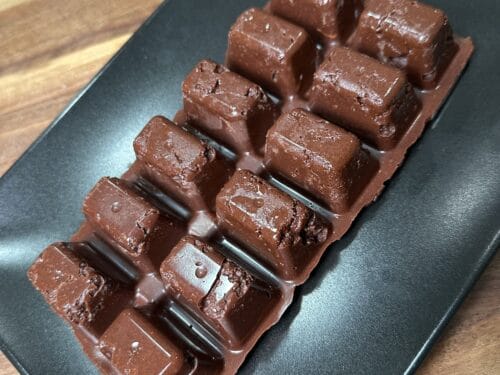
Homemade WWII D Ration Chocolate Bar

Don’t lose this one.
I’ll email it to you so it’s waiting when you’re ready to cook.
Ingredients
Instructions
Notes
- Paraffin wax is the historically accurate substitute for cocoa butter in the original D ration formula and produces a slightly waxier texture. Cocoa butter produces a result closer to normal chocolate in texture while still being far denser than any commercial bar. Either is correct for this recipe.
- The oat flour is essential to the authentic texture and aftertaste. Do not substitute regular flour. The oat flour is what gives the bar its characteristic dry, slightly gritty quality and is one of the main reasons soldiers disliked it.
- The bar can be stored at room temperature but will soften slightly in warm conditions. The original D ration bar was engineered to withstand temperatures of up to 120 degrees Fahrenheit, which this home version will not achieve because it lacks the specific cocoa butter ratios of the military formula. Keep it cool.