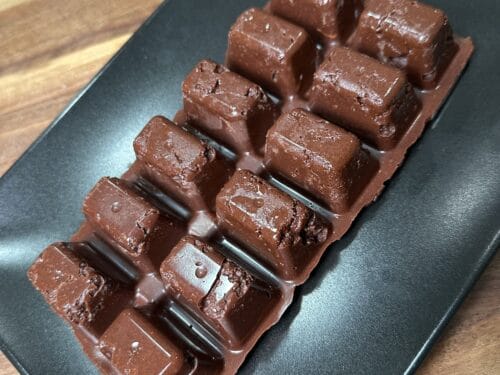

A home version of the Field Ration D bar, developed by Hershey's Chocolate Corporation for the US Army, first produced in 1937. Primary source: US Army Quartermaster specifications as recorded in the Hershey Community Archives and documented by the Smithsonian National Museum of American History. Makes enough to fill half a standard ice cube tray with a little extra
Prep Time 5 minutesmins
Cook Time 15 minutesmins
Set Time 2 hourshrs
Ingredients
6⅔ozunsweetened baking chocolateroughly 1⅓ cups chopped or broken up
6⅔ozpowdered sugarapproximately 1½ cups sifted
3⅓oznonfat dry milk powderapproximately ¾ cup
1¼ozcocoa butter or paraffin waxapproximately 2½ tbsp
1ozoat flourapproximately 3½ tbsp
5drops vanilla extract
Instructions
Melt the chocolate and cocoa butter
Place the chopped unsweetened chocolate and cocoa butter or paraffin in a heatproof bowl set over a pot of barely simmering water. The water should not touch the bottom of the bowl. Melt together over the lowest heat possible, stirring occasionally. This will take longer than normal chocolate melting because the mixture is very dense. Do not rush it with higher heat. The original D ration mixture was so thick it had to be pressed into molds by hand rather than poured, so do not expect this to behave like normal melted chocolate.
Combine the dry ingredients
Once the chocolate and cocoa butter are fully melted and combined, remove the bowl from the heat. Add the powdered sugar, dry milk powder, oat flour and vanilla extract. Stir thoroughly and vigorously until completely combined. The mixture will become extremely stiff and paste-like almost immediately as the dry ingredients absorb the melted chocolate. This is correct and historically accurate. The D ration mixture was described by Hershey's factory workers as a heavy paste that had to be pressed rather than poured. If your mixture seems too dry to combine, return it briefly to the heat for 30 seconds to soften it slightly.
Press into molds
Using the back of a spoon, your fingers, or a small spatula, press the mixture firmly into your ice cube tray molds. It will absolutely not pour. Pack each cavity as firmly as you can, pressing down to eliminate air pockets and smooth the tops flat. The original bars were pressed into their molds by hand by factory workers at the Hershey plant in Pennsylvania. You are doing the same thing they did, at a dramatically smaller scale and without being paid for it.
Set
Refrigerate for at least two hours until completely set and firm. The bars will be very hard when cold, which is correct.
Unmold and taste
If using a silicone tray the bars will pop out easily. If using a rigid plastic tray run the bottom briefly under warm water for 10 seconds to help release them. Do not try to bite directly through one. Break off a piece. Eat it slowly. Consider what it would mean to be on a life raft in the Pacific Ocean and have this be the best food available to you. Appreciate it accordingly.
Video
Notes
Paraffin wax is the historically accurate substitute for cocoa butter in the original D ration formula and produces a slightly waxier texture. Cocoa butter produces a result closer to normal chocolate in texture while still being far denser than any commercial bar. Either is correct for this recipe.
The oat flour is essential to the authentic texture and aftertaste. Do not substitute regular flour. The oat flour is what gives the bar its characteristic dry, slightly gritty quality and is one of the main reasons soldiers disliked it.
The bar can be stored at room temperature but will soften slightly in warm conditions. The original D ration bar was engineered to withstand temperatures of up to 120 degrees Fahrenheit, which this home version will not achieve because it lacks the specific cocoa butter ratios of the military formula. Keep it cool.