
Go Back

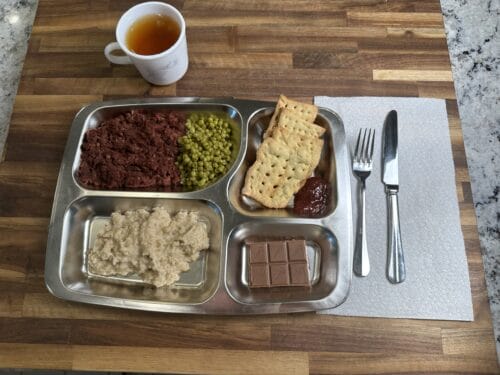
A British Soldier's WW2 Field Ration Tray

Donnie
No ratings yet
Reconstructed from documented British Army Compo ration components, 1939 to 1945
Primary sources: Private Maurice Meritt, Royal Army Service Corps, Western Desert account; Captain Anthony Irwin, Burmese Outpost, 1945; Key Military, World War Two Rations; Keep Military Museum, D-Day Assault Ration Pack; National Geographic, The Radical Wartime Diet That Saved Britain
Note: This post covers the British Army experience specifically. Commonwealth forces including Australia, Canada, India and New Zealand had distinct ration experiences covered in future episodes.
Prep Time 10 minutes
Cook Time 15 minutes

Jump To

Donnie Dodson

Don’t lose this one.

I’ll email it to you so it’s waiting when you’re ready to cook.

Ingredients
  

For the hardtack and jam:
  • 4 to 6 plain hardtack biscuits or service-style crackers — military surplus hardtack is available from specialist suppliers. Plain unsalted water crackers are the most accessible substitute
  • A generous spoonful of jam any fruit variety — jam was a documented Compo ration item and the most important component for making hardtack tolerable
For the bully beef and peas:
  • 1 can of corned beef — Fray Bentos brand is the most historically accurate choice and is still manufactured and sold today carrying a direct unbroken line from the tins issued to British troops in both World Wars
  • 1 cup peas canned or fresh
For the oatmeal:
  • ½ cup rolled oats
  • 1 cup water or milk
  • Pinch of salt
For serving:
  • 1 bar of Cadbury chocolate any variety
  • Strong black tea with sugar and condensed or evaporated milk

Instructions
 

Prepare the bully beef and peas

  1. Open the corned beef tin and slice or roughly break the beef into portions. Warm gently in a pan over medium heat until lightly coloured at the edges, approximately 4 to 5 minutes. Warm the peas separately, either from a tin or briefly boiled from fresh. Serve alongside.

Make the oatmeal

  1. Combine the rolled oats with water or milk in a small saucepan over medium heat. Bring to a gentle simmer, stirring regularly, and cook for 4 to 5 minutes until thickened to a porridge consistency. Season with a pinch of salt. Serve plain. The oatmeal was functional, not decorative.

Prepare the hardtack

  1. If the biscuits are genuinely hard, dip briefly in tea or water to soften slightly before eating. Spread with jam. This is the documented soldier's improvement on an otherwise tooth-challenging food and it makes a material difference to the eating experience.

Brew the tea

  1. Bring water to a full boil. Add loose black tea generously and allow to stew for 2 to 3 minutes rather than gently steeping. Strain into a cup. Add sugar and a generous splash of condensed milk. The tea should be dark, sweet and strong. This is not optional.

Assemble and serve

  1. Plate the warmed bully beef alongside the peas. Serve the oatmeal in a separate bowl. Arrange the jammed hardtack biscuits on the plate. Place a square or two of Cadbury chocolate alongside. Serve the tea in whatever vessel is available. Eat it the way a soldier in the field would have: quickly, without ceremony, and with genuine appreciation for the tea.

Video

Notes

  • Fray Bentos corned beef is available at many British food import retailers and on Amazon, and is the single most historically accurate ingredient you can source for this recreation. The tin itself has barely changed in design since the Second World War and opening one produces a genuine sense of historical connection that no generic supermarket corned beef replicates.
 
  • The tea should be brewed considerably stronger and stewed longer than a typical modern cup. Front-line brewing did not involve careful steeping or temperature-controlled kettles. It involved boiling water and a handful of tea leaves in whatever tin was available. The result was strong, dark and reviving rather than refined, and that is the correct target.
 
  • For the most authentic chocolate experience note that wartime Cadbury bars were made with dried skimmed milk rather than fresh milk due to the 1941 rationing restrictions. The modern Cadbury bar is a richer formulation than what soldiers actually received, but provides the same fundamental morale function and is significantly more enjoyable than any historically accurate wartime substitute would be.

Tried this recipe?

Let us know how it was!