Winston Churchill, the man who presided over Britain’s entire war effort and who ate extremely well throughout it, reportedly declared:
“The way to lose the war is to try to force the British public into a diet of milk, oatmeal, potatoes, washed down on gala occasions with a little lime juice. “
That quote tells you two things simultaneously. It tells you that Churchill understood the relationship between morale and food with unusual clarity. And it tells you that the food being proposed for the British public, and by extension for British soldiers, was exactly that uninspiring.
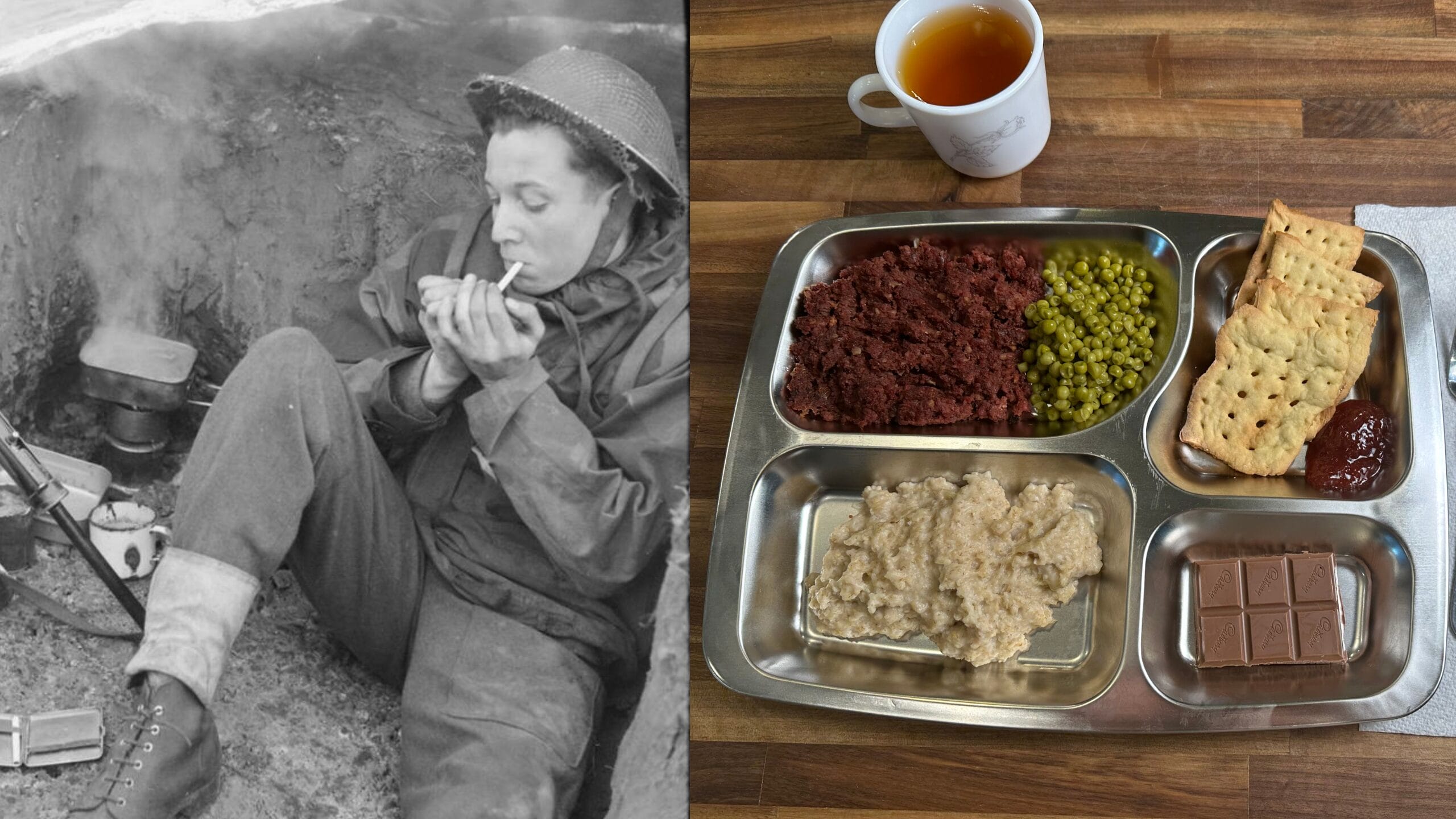
So let’s see what a British soldier ate like in WW2. It’s a tray representing what a British soldier in the field during the Second World War was likely eating on a reasonable day: hardtack biscuits with jam, canned bully beef and peas, oatmeal porridge, a square of Cadbury chocolate and a strong cup of tea.
Next week
I cook these before I write them. Some of it never makes the post.
The failures, the source documents, the version that actually tasted good. That part goes out by email, and next week’s is already on the stove.
 Written and cooked by Donnie
A note before we begin: this post covers the British Army experience specifically. The Commonwealth forces, Australia, Canada, India, New Zealand and others, had their own distinct rations, preferences and supply situations that deserve their own dedicated coverage. That is coming.
The WW1 Inheritance: Different War, Same Food
One of the more striking facts about British military rations in the Second World War is how little they had changed from the First. The core components of the British soldier’s field ration, bully beef, hardtack biscuits, tea and oatmeal, were essentially identical to what British soldiers had been eating in the trenches of the Somme a generation earlier. The British Army had updated its weapons, its tactics, its armoured vehicles and its aircraft between 1918 and 1939, but its field rations were largely the same.
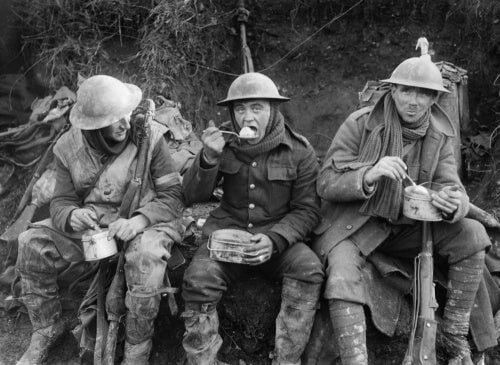
The British military provisioning system was built around ingredients with specific properties: long shelf life, adequate caloric density, ease of transport and the ability to be consumed without cooking if necessary. Bully beef met every one of those criteria and had been doing so since the Boer War. Hardtack biscuits had been the military’s portable bread since the Napoleonic era and before. Tea had been the British soldier’s daily beverage for over a century.
The mainstays of bully beef, M and V, biscuits and tea, sometimes supplemented with chocolate, were the foundation of the British soldier’s diet from the Boer War through Korea and beyond. The Second World War added the Compo system and better packaging, but the fundamental ingredients were inherited directly from the military provisioning traditions of the previous war. A Tommy who survived the trenches of 1917 and had a son fighting in Normandy in 1944 would have recognised everything on his son’s ration tray.
Bully Beef: The Meat That Crossed Two World Wars
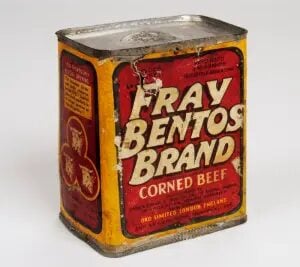
Bully beef, officially designated preserved meat in military terminology, derived its nickname from the French boeuf bouilli, meaning boiled beef, and had been issued to British troops since the Anglo-Boer War at the turn of the century. Most of it was manufactured in South America, and during both World Wars the Fray Bentos brand from Uruguay was the dominant supplier. Fray Bentos is still manufactured today and is still sold in British supermarkets, an unbroken commercial line from the tins issued to soldiers at Gallipoli and the Somme to the product on supermarket shelves in 2026.
The British 14-man, one-day ration, designed to feed fourteen men for twenty-four hours, was one of the innovations the British Army developed during the war to cater for the fast-moving mobile warfare that had become prevalent. Within these Compo ration boxes, bully beef appeared alongside a range of other preserved and canned ingredients, providing the protein component of a field meal that could be eaten cold directly from the tin if no cooking was possible, or warmed over a portable stove or campfire when the situation permitted.
The relationship soldiers had with bully beef was complicated in exactly the way that any food you eat in large quantities under difficult circumstances becomes complicated. It kept men fed reliably in conditions where almost nothing else would survive transport and storage. It also became, within weeks of issue, the subject of every British soldier’s complaints and the standard reference point for everything wrong with military food. Both things were simultaneously and permanently true.
The Hardtack Biscuit: Three Centuries of Dental Suffering
Service biscuits were unsalted, hard, dry and shelf-stable for extended periods when stored in sealed tins. They had little flavour of their own and were widely referred to by soldiers as tooth dullers, a description that requires no elaboration for anyone who has eaten one without first soaking it in tea or water. The standard practice was to soften the biscuit in liquid before eating, a technique documented by soldiers in virtually every war in which the British Army participated.
The lineage of the British service biscuit is extraordinary. The ordinary British soldier’s rations during the Napoleonic War comprised among other things biscuit as a bread substitute. The biscuit issued to a British soldier landing at Normandy in June 1944 was functionally the same object that British sailors had been eating since the Age of Sail and that soldiers of Wellington’s army had carried at Waterloo in 1815. One hundred and twenty-nine years of military biscuit history, essentially unchanged, from Waterloo to D-Day. The packaging had improved. The biscuit had not.
The Compo System: The British Army’s Answer to Field Feeding
By the middle of the war the British Army had developed a more sophisticated provisioning approach than simply distributing individual tins of bully beef and bags of biscuits. The composite ration, known universally as Compo, was a boxed multi-day ration designed for group feeding in the field. A 14-man, one-day Compo box contained everything needed to feed fourteen men for twenty-four hours: tins of instant tea, chocolate, boiled sweets, salt, margarine, soap, latrine paper and cigarettes, along with variable items depending on the box variant, including sausages, bacon, luncheon meat, baked beans, sardines, fruit, condensed soup, salmon, jam, cheese and sweet puddings.
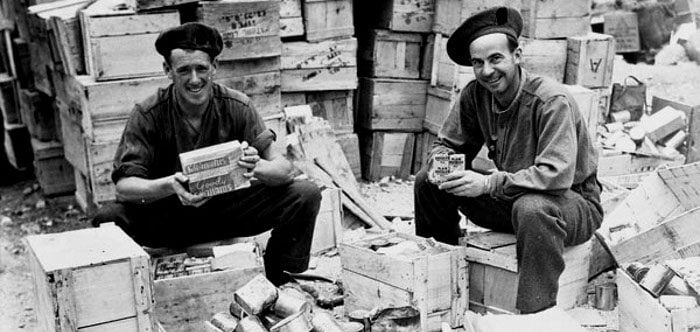
An extraordinary surviving example of this system exists at the Keep Military Museum in Dorset: a D-Day Assault Ration Pack, believed to be the only intact surviving example in existence, containing the exact biscuits, oatmeal block, raisin chocolate and tea ingredients that soldiers of the 2nd Devons and 1st Dorsets carried when they landed on Gold Beach near Arromanches at 7:30am on the morning of June 6 1944. That object, a seventy-eight year old ration pack in a museum in Dorset, is a direct physical connection to what British soldiers were eating on the most significant military operation in modern history.
Cadbury’s Wartime Chocolate: Not Quite the Real Thing
The chocolate issued to British soldiers during the Second World War was not the chocolate those same men had grown up eating in the 1930s. In 1941 the British government banned the use of fresh milk in chocolate production as part of the broader rationing programme, which meant Cadbury had to suspend production of Dairy Milk entirely. The replacement was a ration chocolate manufactured with dried skimmed milk powder rather than fresh milk, supplemented in some versions with oat flour and additional vitamins to improve its nutritional profile.
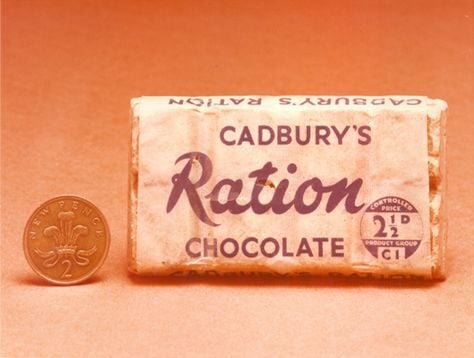
The soldiers eating Cadbury chocolate in the Western Desert in 1942 or in the hedgerows of Normandy in 1944 were eating a wartime reformulation that bore the Cadbury name and provided genuine morale benefit and caloric value, but tasted noticeably different from the prewar product most of them remembered. The real Dairy Milk did not return until after rationing ended. The version that sustained British soldiers through the war was a functional substitute for the thing it replaced, which is a fitting description of most of what appears on this tray.
The Science of Rationing: The Irony That Changed British Public Health
One of the more counterintuitive facts about British wartime food history is that the rationing system, widely complained about and genuinely restrictive, actually improved the health of the British population overall.
Despite strict rations, the nation emerged from the war with improved health, thanks to the vision of Sir Jack Drummond. Drummond was a nutritional scientist who served as scientific adviser to the Ministry of Food throughout the war and who approached the problem of feeding a nation under siege with scientific rigour rather than simply distributing whatever was available. He prioritised the nutritional quality of what remained available, ensured that protein, vitamins and calories were distributed more equitably across social classes than they had been before the war, and insisted that the ration system protect the nutritional needs of the most vulnerable, particularly children and pregnant women.
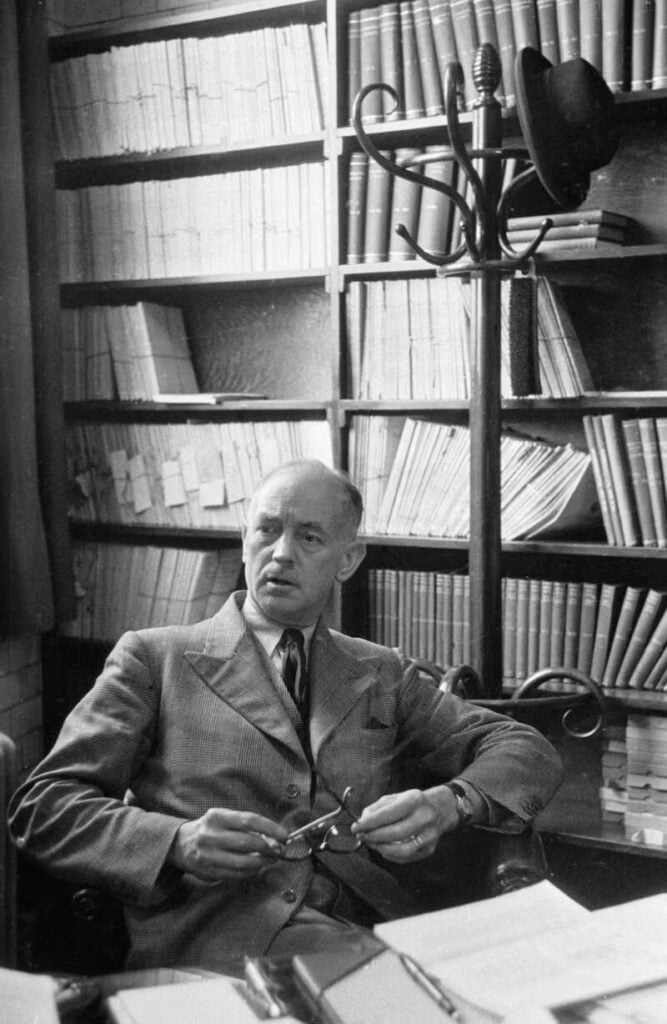
Rationing resulted in a levelling-down of rich people’s diets and a levelling-up of the diets of the lower classes, whose nutrition before the war had been poor. Before the war, class-based inequality in food access meant that working-class British families were frequently nutritionally deficient while the wealthy ate abundantly. Rationing removed that disparity by enforcing equitable distribution of what was available. Children who grew up during the war were, in measurable nutritional terms, healthier than the generation immediately before them. The man whose vision produced this outcome was murdered with his wife and daughter in 1949 in a case that was never solved, one of the great unsolved crimes in British history. Sir Jack Drummond deserves considerably more recognition than food history has given him.
Tea: The Drink That Outranked Everything
No discussion of British military food in any era is complete without addressing tea, and the Second World War is no exception. The British Army’s commitment to ensuring tea was available to front-line troops was institutional, consistent and treated as seriously as the provision of ammunition.
Private Maurice Meritt, serving in the Royal Army Service Corps as a driver in the Western Desert, described the daily brewing ritual in terms that capture its emotional centrality to the soldier’s experience more precisely than any official document: that smoked, begrimed, battered, black and dented teapot produced the most lovely refreshing dark brown drink, with lashings of sugar, not in short supply. The tea was brewed in any container available, in field conditions that bore no resemblance to the domestic circumstances in which most of these men had learned to drink it, and it was invariably described as the best cup of tea they had ever tasted. The privations of the context amplified the comfort of the drink in a way that is genuinely documented across hundreds of individual soldier accounts.
Tins of sweetened condensed milk were specifically issued alongside tea rations because fresh milk was impossible to maintain in field conditions but the British preference for tea with milk was so culturally fundamental that the Army provisioning system found a way to accommodate it even on the front line. That decision, to include condensed milk in field rations specifically for the purpose of making tea correctly, tells you something real about the relationship between tea, morale and British military culture that no amount of official documentation quite captures.
My Rating
This tray is not designed for pleasure and I want to be honest about that before giving the rating. The hardtack biscuit with jam is the best version of the hardtack experience available, the jam doing essential work in making something that would otherwise be close to inedible into something moderately pleasant. The bully beef warmed and served with peas is genuinely adequate in a way that its reputation does not entirely prepare you for. It is salty, dense and protein-rich and it tastes exactly like what it is: preserved beef from a tin, which is not terrible and is considerably better than nothing.
The oatmeal porridge is the plainest component of the tray and the one that most clearly communicates the functional rather than pleasurable purpose of military rations. It provides calories. It provides warmth if made with hot water. It provides virtually nothing in the way of culinary satisfaction, which is exactly what it was designed to do.
The Cadbury chocolate is the tray’s best moment and it earns that position simply by being chocolate, which requires no culinary skill but delivers genuine morale value that the bully beef cannot match on any comparable level.
The tea is doing more work than everything else on this tray combined. After the bully beef, the biscuit and the oatmeal, a strong sweet cup of tea genuinely does feel like the best part of the meal. Reading Private Meritt’s account of brewing up in the Western Desert while drinking it made that connection feel immediate rather than historical.
Rating: 6.8 / 10
The Recipe: A British Soldier’s WW2 Field Ration Tray
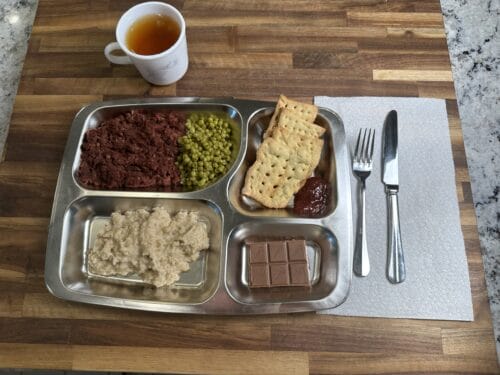
A British Soldier’s WW2 Field Ration Tray

Don’t lose this one.
I’ll email it to you so it’s waiting when you’re ready to cook.
Ingredients
Instructions
Notes
- Fray Bentos corned beef is available at many British food import retailers and on Amazon, and is the single most historically accurate ingredient you can source for this recreation. The tin itself has barely changed in design since the Second World War and opening one produces a genuine sense of historical connection that no generic supermarket corned beef replicates.
- The tea should be brewed considerably stronger and stewed longer than a typical modern cup. Front-line brewing did not involve careful steeping or temperature-controlled kettles. It involved boiling water and a handful of tea leaves in whatever tin was available. The result was strong, dark and reviving rather than refined, and that is the correct target.
- For the most authentic chocolate experience note that wartime Cadbury bars were made with dried skimmed milk rather than fresh milk due to the 1941 rationing restrictions. The modern Cadbury bar is a richer formulation than what soldiers actually received, but provides the same fundamental morale function and is significantly more enjoyable than any historically accurate wartime substitute would be.