I am writing this from Seville, having just arrived from Scotland, and the timing could not be more perfect for this particular recipe. Two weeks ago I was eating haggis in Edinburgh. Today I am sitting in the heat of Andalusia, where the still-hot September temperature does not suggest a warm bowl of anything and where the locals have understood this for approximately two thousand years.
Ajo blanco is the cold soup that most people have never heard of and that every food history channel is obligated to cover. It predates the version of gazpacho most people know by several centuries. It has roots in Roman soldier rations and Moorish almond cultivation. It requires no tomatoes because tomatoes had not arrived in Andalusia when this soup was already being eaten. And it is, in the heat of a Seville afternoon with a cold glass of something alongside it, one of the most refreshing and quietly extraordinary things you can eat.
Before the Tomato: The Ancient History of Cold Soup in Andalusia
The first thing to understand about ajo blanco is what its existence tells you about the region that produced it. Andalusia is the southernmost region of the Iberian Peninsula, the part of Spain that is closest in climate and geography to North Africa, where summer temperatures routinely exceed 40 degrees Celsius and where working in the fields from sunrise to sunset under that sun without adequate hydration and nutrition is genuinely dangerous. Cold soups did not develop in Andalusia because Andalusians were being fashionable. They developed because the climate demanded a food that could be prepared without heat, stored cold, transported easily to the fields and consumed quickly by people who needed to cool down, rehydrate and take on enough calories to keep working.
Next week
I cook these before I write them. Some of it never makes the post.
The failures, the source documents, the version that actually tasted good. That part goes out by email, and next week’s is already on the stove.
 Written and cooked by Donnie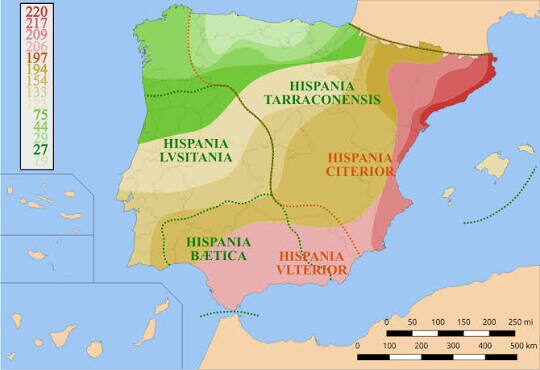
This is the practical logic that underlies the entire family of Andalusian cold soups, gazpacho included, and understanding it reframes ajo blanco completely. This is not a starter you order at a nice restaurant to be interesting. This is the food that kept agricultural workers alive through the Andalusian summer for two thousand years. That it is also genuinely delicious is a bonus that the workers in question were probably grateful for.
The Roman connection is the oldest layer of the story and the most difficult to document with precision. When the Romans conquered the Iberian Peninsula beginning in the 3rd century BC, they established significant colonies in what is now Andalusia and Extremadura, the two regions most strongly associated with ajo blanco today. Roman soldiers and settlers were given land grants in return for service and the poorest of them ate a diet built around what was cheapest and most available: bread, olive oil, garlic, vinegar and water. The Roman preparation called posca, a mixture of water and wine vinegar sometimes extended with bread, served as a daily beverage and basic food for soldiers and poor civilians throughout the empire. The similarities between posca and the bread-vinegar-garlic base of ajo blanco are not accidental. The Roman food culture that permeated Andalusia for several centuries laid the foundation of an ingredient combination that was already present when the next civilisation arrived.
That next civilisation was the Moorish one. From 711 AD until the reconquista was completed in 1492, the Iberian Peninsula was under the governance of Islamic caliphates and emirates that brought with them one of the most sophisticated culinary traditions in the medieval world. The Moors transformed the agricultural landscape of Andalusia in ways whose effects are still visible today. They introduced or massively expanded the cultivation of oranges, lemons, figs, pomegranates and crucially almonds. The almond tree, Prunus dulcis, had been present in the Iberian Peninsula since antiquity but the Moors cultivated it on an entirely different scale, establishing the almond groves across Andalusia, Granada and Málaga that remain significant today.
It is this Moorish almond cultivation that transforms the Roman bread-garlic-vinegar base into ajo blanco. Almonds added to the existing preparation brought fat, protein, a rich creaminess and a specific nutty flavour that changed the character of the soup entirely. The combination of bread, garlic, olive oil, vinegar and now almonds, all blended to a smooth cold soup, is specifically a Moorish Andalusian development documented from the medieval period. Ajo blanco, in the form we recognise today, is listed among the many dishes Spain inherited from the Moors before the unification of the country.
The first documented mentions of ajo blanco as a named preparation in Andalusian culinary literature appear in the medieval period, making it considerably older in written form than the tomato-based gazpacho that most people associate with Andalusia. The red gazpacho cannot appear in the record before the tomato arrives from the Americas in the 16th century and gains widespread culinary acceptance in Spain, a process that took considerably longer than most people assume. For most of the medieval period and well into the early modern era, the cold soup of Andalusia was white, not red. Ajo blanco was the original. Gazpacho in its modern form is the adaptation.
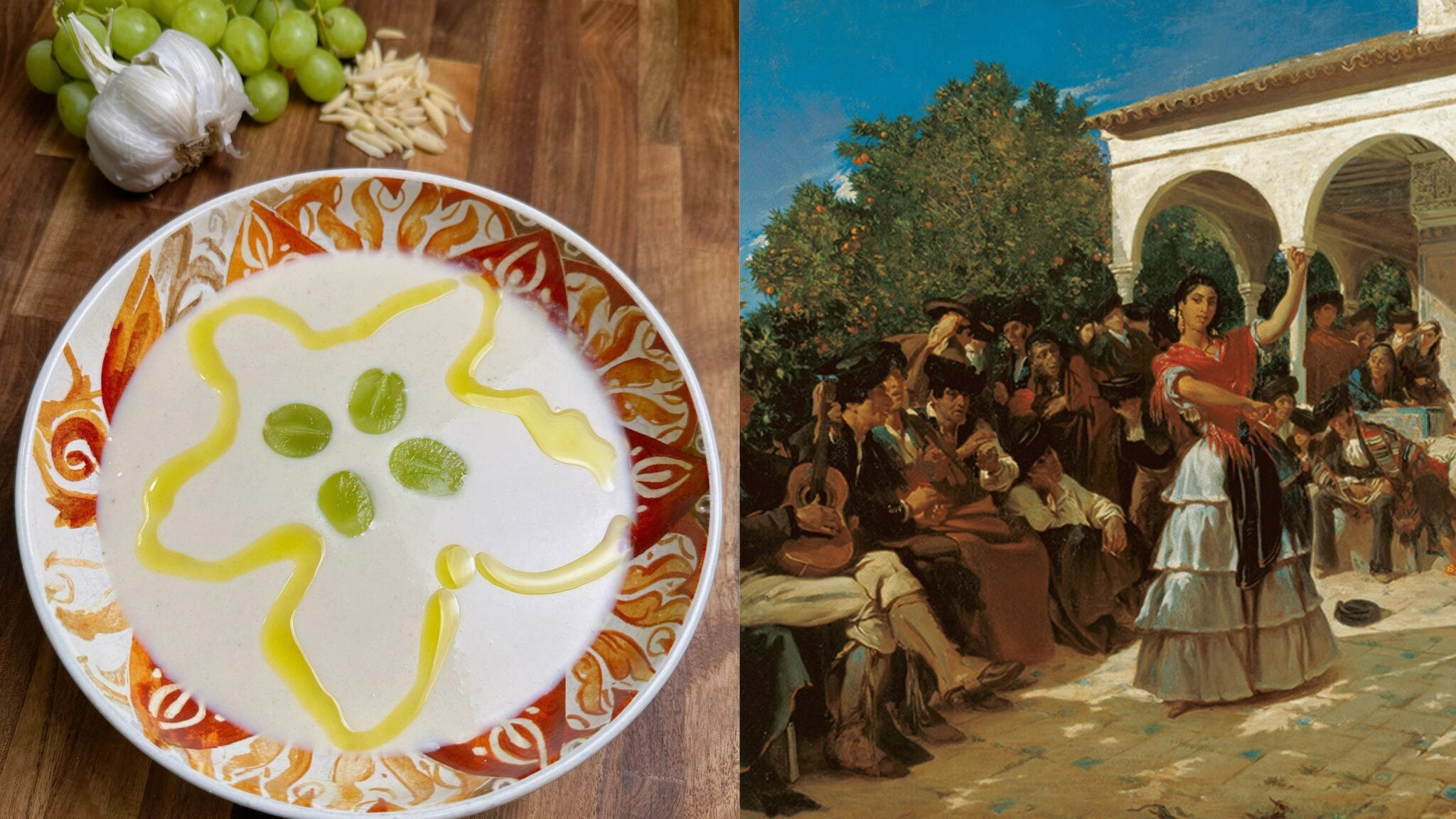
The food historian Clifford Wright, who has written extensively on the culinary history of the Mediterranean world, documented the historical composition of ajo blanco directly: originally it contained garlic, almonds, bread, olive oil, vinegar and salt. The grape garnish associated specifically with Málaga, the halved green grapes that balance the rich, sharp cold soup with sweetness and juice, is documented in the Málaga tradition and represents the kind of local agricultural specificity that characterises the most authentic regional food, the grape added not as decoration but because the vineyards of Málaga produced the grapes and the logic of serving the local fruit alongside the local soup was immediate and obvious.
Ajo Blanco in the Modern Era: From Peasant Staple to Rediscovered Classic
The trajectory of ajo blanco through the 19th and early 20th centuries is the trajectory of a peasant food that was never fashionable enough to receive the attention it deserved. While gazpacho, particularly after Eugenia de Montijo, wife of the French Emperor Napoleon III and a Spanish-born aristocrat, helped bring it to the attention of the wider world in the 19th century, ajo blanco remained largely local and largely unnoticed outside Andalusia and Extremadura.
During the Spanish Civil War and the subsequent Franco-era economic hardship of the post-war period, ajo blanco demonstrated the adaptability that characterises the most resilient food traditions. When almonds were scarce or unaffordable, cooks substituted flour from dried beans, maintaining the character of the soup with whatever was available. A preparation that had survived Roman colonisation, Moorish transformation, Christian reconquest and centuries of Andalusian summer heat was not going to be stopped by an ingredient shortage.
The rediscovery of ajo blanco by Spanish chefs in the latter half of the 20th century, and its adoption by international culinary culture in the 21st century, happened in the context of a broader appreciation for the depth and sophistication of Andalusian cuisine that had for too long been reduced in popular imagination to paella and sangria. The town of Almáchar in the Axarquía region of Málaga holds an annual Fiesta del Ajoblanco on the first Saturday of September, coinciding with the local grape harvest, a festival that has been declared of Tourist Interest in Andalusia and that represents the most direct institutional expression of the dish’s ongoing cultural significance.
In Málaga specifically, ajo blanco is still served in the traditional way: thinned to a consistency that allows it to be drunk directly from a glass rather than eaten from a bowl, a serving style that connects it directly to its origin as a field worker’s sustenance that had to be consumed quickly and carried easily. That a preparation first documented as food for Roman soldiers and Moorish-era peasant farmers is now served in glasses at tapas bars across Seville and Málaga is one of the more satisfying food history trajectories I have encountered for this channel.
The Traditional Process: Why This Soup Requires Patience
The character of ajo blanco is entirely determined by technique. The ingredients are simple and few. What separates an extraordinary ajo blanco from an adequate one is the specific sequence of steps and the willingness to execute each one properly.
The almond is the foundation and must be blanched. Skin-on almonds produce a beige, slightly bitter soup that is a completely different thing from the ivory-white, clean-flavoured result that blanched almonds produce. The skin contains tannins that affect both colour and flavour. Removing it is not an option. It is the soup.
Blending the almonds alone before any liquid is added is the step that most modern recipes skip and that makes the most significant difference to the finished texture. Dry-blending almonds for a full minute produces a fine, almost floury paste that blends with liquid into something fundamentally smoother than almonds blended from the start with other ingredients. It is the same logic as blooming spices in dry heat before adding liquid. You are extracting what the ingredient has to offer before you dilute it.
The sherry vinegar is not a substitutable ingredient. White wine vinegar produces a sharper, more one-dimensional acidity. Sherry vinegar, made from Andalusian sherry wine through the solera ageing process in the bodegas of Jerez, carries a depth and a slightly woody, oxidative complexity that matches the richness of the almond base in a way that no other vinegar does. Using white wine vinegar in ajo blanco is like using a different grape variety for Champagne. The method is the same. The result is not.
The sieving step is the one that separates the genuinely authentic version from a home approximation, and it is the step that most home cooks skip because it appears to add effort without obvious reward. The reward is enormous. Unsieved ajo blanco is a thick, rustic blended almond soup. Sieved ajo blanco is a smooth, silky, almost miraculously white liquid with a texture that is genuinely unlike anything else in cold soup culture. The difference is immediately and dramatically apparent. Do not skip the sieve.
The cold rest is the final step that cannot be negotiated. Two hours minimum, overnight if possible. The flavour of ajo blanco develops dramatically with cold and time in a way that is almost chemical in its obviousness. A freshly blended ajo blanco tastes flat and sharp. An ajo blanco that has rested overnight tastes round, complex and complete. The garlic mellows. The almond deepens. The vinegar integrates. The soup becomes itself.
My Rating
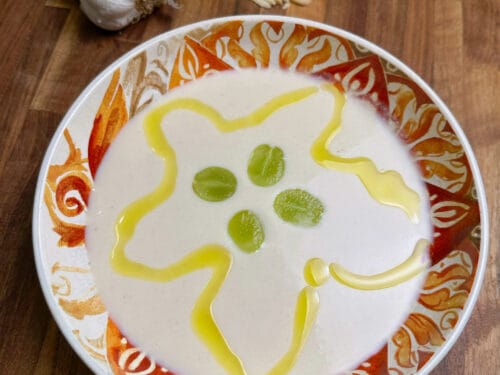
The flavour is unlike any other cold soup. It is simultaneously rich and refreshing, which sounds contradictory and is not. The almond provides body and fat and a specific creaminess that makes the soup satisfying rather than merely light. The raw garlic, present and sharp, cuts through that richness with a clarity that cooked garlic could not produce. The sherry vinegar adds the acidity that lifts everything without dominating. And the green grapes, halved and placed in the cold white soup, provide a sweetness and a burst of juice with each bite that is not decoration but balance, the same balance that the Moorish-era Andalusians who developed this combination understood intuitively.
The grape garnish specifically is the detail that elevates the finished bowl from excellent cold soup to something that makes you pause before the second spoonful. It is sweet and sharp and cold against the rich white background of the almond base and it is exactly right. Do not serve ajo blanco without the grapes.
Rating: 8.7 / 10
The Recipe: Ajo Blanco
Ajo Blanco

Don’t lose this one.
I’ll email it to you so it’s waiting when you’re ready to cook.
Ingredients
Instructions
Notes
- The blanched almond requirement is not flexible. Pre-blanched almonds are available at most supermarkets and any health food store. If you can only find skin-on almonds, blanch them yourself by covering with boiling water for 60 seconds, draining and slipping the skins off with your fingers while still warm. Do not proceed with skin-on almonds.
- The sherry vinegar is available at most good supermarkets and any Spanish food importer. The bodegas of Jerez produce sherry vinegar through the same solera ageing system used for sherry wine and the result has a depth and complexity that no other vinegar replicates in this application. It is worth finding.
- Raw garlic is essential and should not be tempered or roasted before going into the blender. The pungency of raw garlic against the richness of the almond base is the defining flavour tension of ajo blanco. Roasted garlic would produce something smoother and milder that is a different and inferior dish. Start with 2 cloves if you are uncertain about your garlic tolerance and adjust after tasting the blended but not yet sieved soup.