There are days on the Eats History Project that exceed all expectations. Days where the history is so immediate and so present that the gap between the legends of what happened centuries ago and the days of modernity collapses into something I can touch, taste, and smell. My day at the Museum of King Jan III’s Palace at Wilanów in Warsaw was that kind of day.
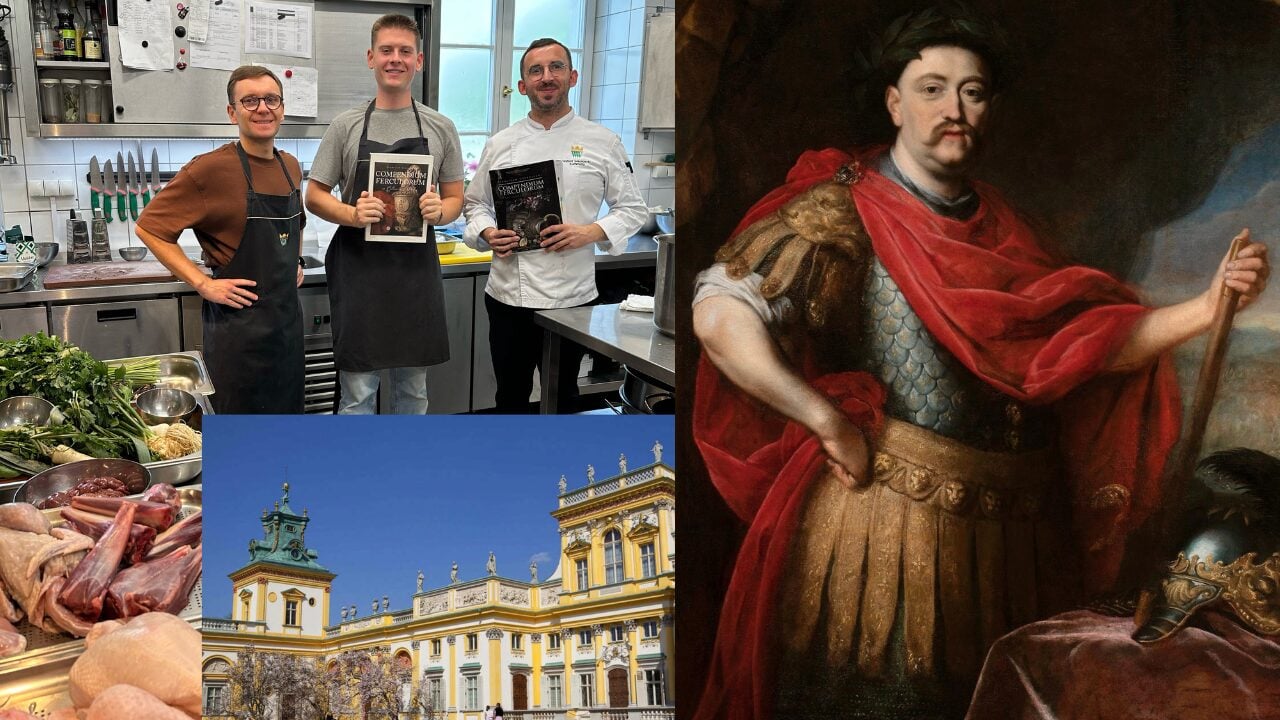
I spent the morning cooking in the kitchens of one of the most significant royal palaces in Central Europe, working alongside the museum’s culinary historians with a copy of the Compendium Ferculorum, albo Zebranie potraw, A Collection of Dishes, the oldest surviving Polish cookbook, first published in 1682. I pulled vegetables from the king’s own garden in the baroque palace grounds. I made the Polish broth from the cookbook’s very first recipe. I rolled warm wafer cones into the shape the book describes. And I arranged them on a bush of rosemary surrounded by whipped cream and dusted with powdered sugar to produce a dessert that a Baroque Polish king returning from the most decisive military victory of the 17th century would have recognised and demanded.
The man who lived in this palace and ate food from this cookbook saved Europe. This is his story and his recipes.
The King: Jan III Sobieski, Lion of Lechistan and Saviour of Christendom
Next week
I cook these before I write them. Some of it never makes the post.
The failures, the source documents, the version that actually tasted good. That part goes out by email, and next week’s is already on the stove.
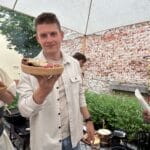 Written and cooked by Donnie
John III Sobieski was born on August 17, 1629, at Olesko Castle in the Polish-Lithuanian Commonwealth, the son of the Voivode of Ruthenia. He was educated in the classical tradition, spent two years travelling Western Europe in the conventional manner of a nobleman’s son, and returned to Poland to begin a military career that would make him the most celebrated warrior king in the history of the Commonwealth.
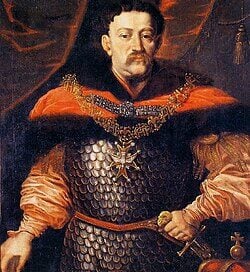
His path to the throne was not straightforward. He allied himself with Sweden during the invasion of 1655 and then changed sides to help expel the Swedish forces, a flexibility of allegiance that was characteristic of the fractious politics of the Polish nobility. By 1666 he was field commander of the Polish army. A year later he defeated a combined force of Cossacks and Tatars at Podgaytsy in what is now Ukraine. In 1673, the year the king died, he led the Polish army to a major victory at the Battle of Khotin against the Ottoman Empire. The following year, 1674, he was elected King of Poland.
He was fifty-three years old and already showing the obesity and poor health that would mark his later years when he rode out from Kraków in August 1683 wearing at his neck a gorget bearing the likeness of the Black Madonna of Częstochowa. Before him lay one of the most significant military decisions in European history.
The Ottoman Empire had placed Vienna under siege in July 1683. The city, the capital of the Holy Roman Empire and the symbolic gateway to Western Europe, was on the brink of collapse after weeks of fighting. The Ottoman army numbered somewhere between 140,000 and 300,000 men depending on the source. The defenders inside the walls were starving. The inhabitants of Perchtoldsdorf, another Austrian town, had already been massacred after surrendering. Europe was genuinely at risk.
Sobieski led a coalition of Polish, Austrian, German, and other European forces up the Kahlenberg ridge overlooking Vienna. On September 12, 1683, he personally led the largest cavalry charge in history, 20,000 horsemen including the famous Polish Winged Hussars thundering down the slope into the Ottoman lines. The charge broke the Ottoman army completely. By evening, Vienna was safe and the Ottoman camp below the city, containing treasure, livestock, documents and the personal tent of the Grand Vizier Kara Mustafa Pasha, was in Christian hands.
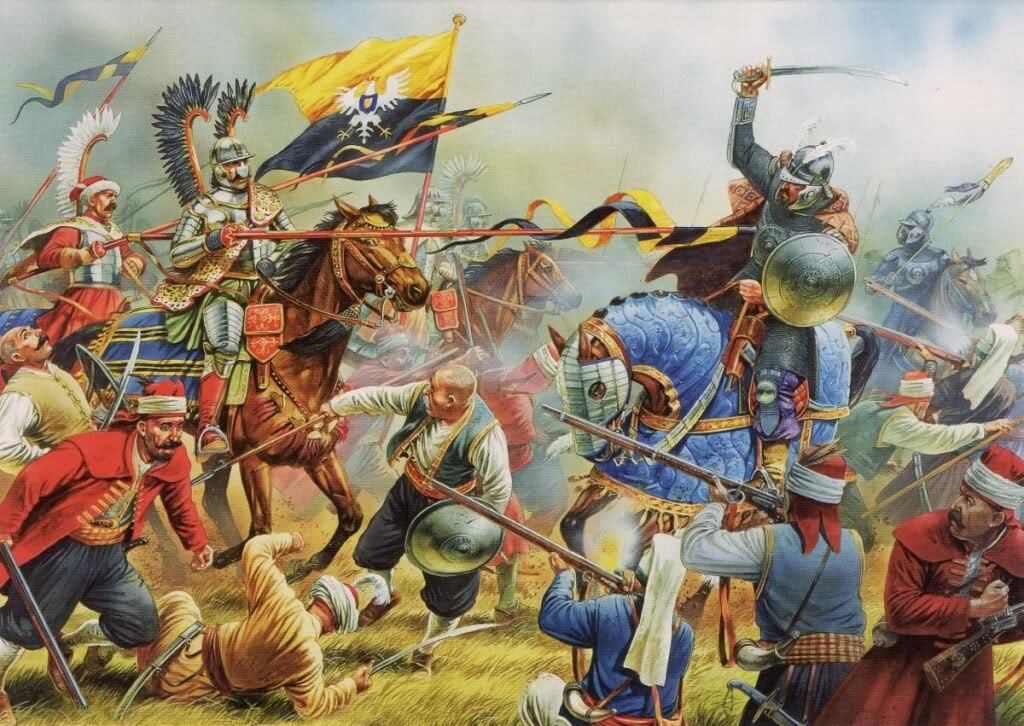
Sobieski wrote to Pope Innocent XI the same night using words that have echoed across three centuries: Venimus, vidimus, Deus vincit. We came, we saw, God conquered. His deliberate echo of Julius Caesar’s Veni, vidi, vici, corrected to give the victory to God rather than himself, captured something specific about the man. He was pious, he was literate, he was theatrically aware of his own historical significance, and he understood that what he had just done at the gates of Vienna mattered beyond the immediate tactical victory.
Pope Innocent XI hailed Sobieski as the saviour of Western Christendom. The defeated Ottomans named him the Lion of Lechistan. The J.R.R. Tolkien scholar Dwight Longenecker has argued that the cavalry charge of the Rohirrim at the Siege of Minas Tirith in The Lord of the Rings was partly inspired by Sobieski’s charge at Vienna, an influence Tolkien reportedly acknowledged. The king who saved Europe in 1683 may also have saved Middle-earth 3 centuries later.
He returned to Warsaw having extended the Polish-Lithuanian Commonwealth’s political influence across Central Europe but having secured nothing permanent for Poland itself. His later years were marked by poor health, political frustration, and the painful dissension of his sons over the succession. He died on June 17, 1696, at the palace of Wilanów, the palace where I spent the day cooking from his court’s cookbook. He was buried at Wawel Cathedral in Kraków. He was succeeded by Augustus II the Strong, a German prince, and the decline of the Polish-Lithuanian Commonwealth that would eventually lead to the Partitions had already begun.
Wilanów Palace: The King’s Country Retreat
The Palace at Wilanów, approximately ten kilometres south of Warsaw’s old town, is one of the finest examples of Baroque architecture in Central Europe and one of the few royal palaces in Poland to have survived the devastation of the Second World War largely intact.
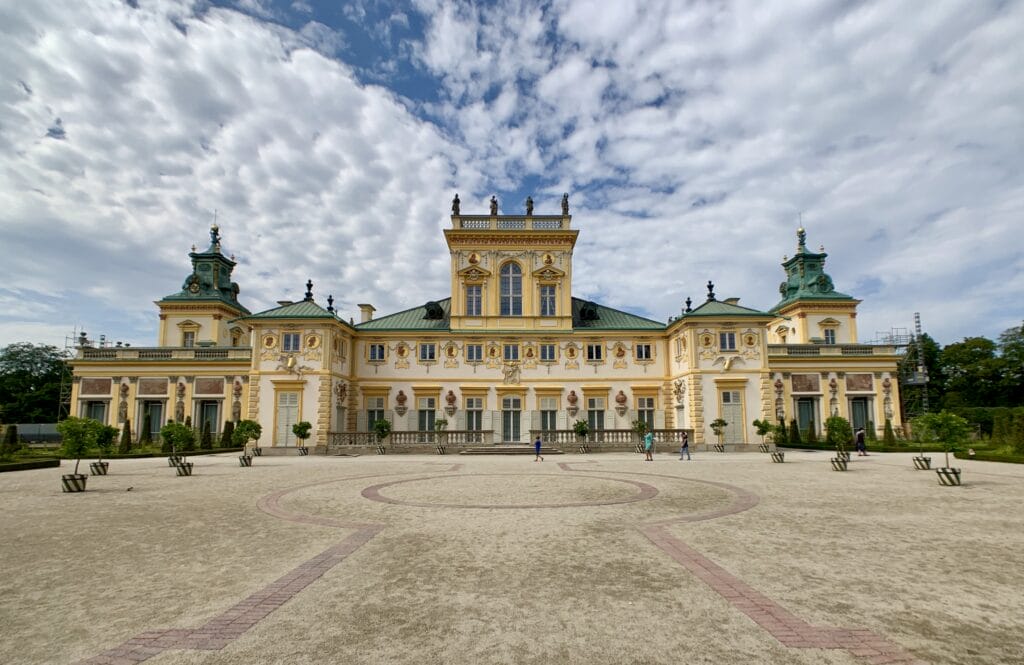
Sobieski purchased the village of Milanów in 1677 and immediately began transforming it into the private retreat that he would develop for the rest of his life. He renamed it Wilanów, a contraction of Willa Nuova, New Villa, reflecting the Italian Baroque architectural tradition he was deliberately emulating. The palace he built was not a seat of government or a display of state power. It was a private family home, designed in consultation with his wife Marie Casimire d’Arquien, the French-born queen he called Marysieńka in his extraordinarily tender surviving letters to her.
Marie Casimire was a significant figure in the cultural life of the Commonwealth and at Wilanów specifically. She was French-born, educated in the French court, and brought with her the French aristocratic aesthetic of the period. The garden at Wilanów, designed in the formal Baroque style with geometric beds, fountains and the kitchen garden from which we harvested vegetables for the day’s cooking, reflects her influence as much as the king’s. The palace’s interior decoration, with its extraordinary painted ceilings celebrating Sobieski’s military victories, reflects his.
The combination of French aesthetic sensibility and Polish military pride that defines Wilanów was replicated in the food of the court. The Compendium Ferculorum, the cookbook we cooked from that day, was written by Stanisław Czerniecki, the head chef of the Lubomirski court in Kraków, and published in 1682, a year before the Battle of Vienna. It is the first cookbook published in Polish in Poland. Every recipe in it, including the two we made, was being prepared in the kitchens of the Polish aristocracy at exactly the moment Sobieski was riding to Vienna.
The Day: Garden, Kitchen and Baroque Hospitality
The museum team and chefs at Wilanów are doing something genuinely extraordinary. They are not simply preserving the palace as a historic artefact. They are recreating the living culinary culture of the Sobieski court using the Compendium Ferculorum as their primary source document and the palace’s kitchen garden as their larder.
The morning began in the garden. The formal baroque kitchen garden attached to the palace contains period-appropriate vegetable and herb varieties, some of them directly descended from plants cultivated at Wilanów in the 17th century. Pulling vegetables from the same soil where the king’s own garden supplied his table, carrying them into the kitchen where the cooking began, is the kind of direct physical connection to history that no amount of research can fully replicate.
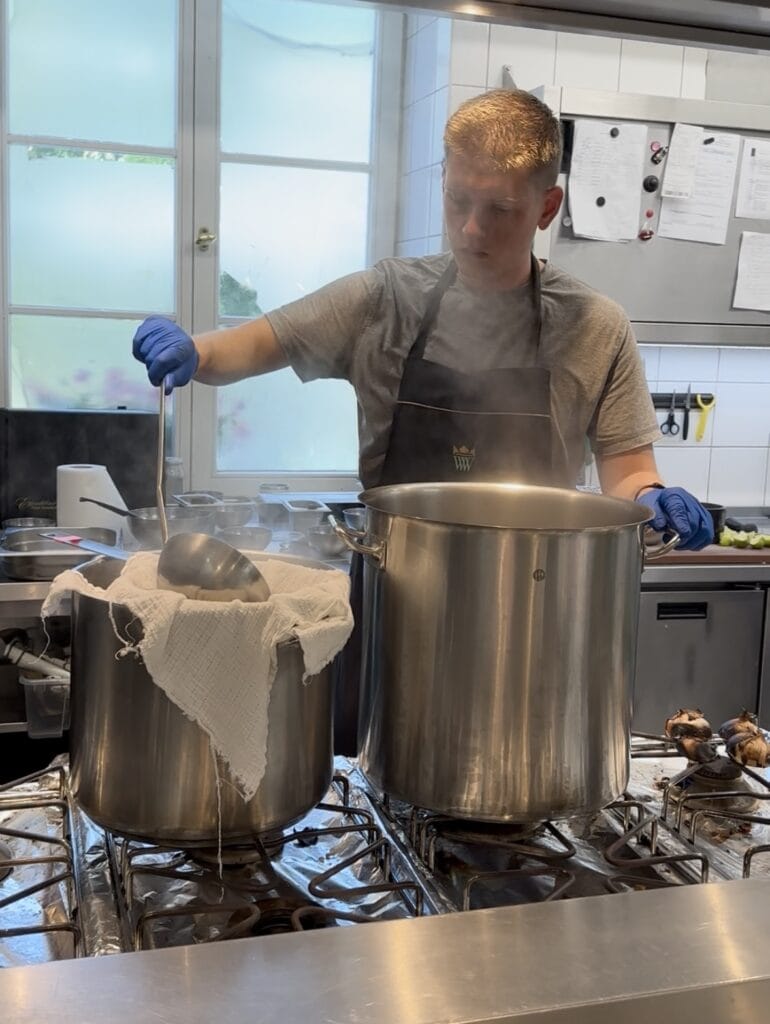
The broth preparation began with the building of the base, beef, poultry, and vegetables simmered together into the clear, golden liquid that the Compendium calls Polish broth. The specific flavouring that distinguishes this from a plain consommé is the combination the cookbook specifies. Saffron, which gives the finished broth a warm golden colour that deepens beyond what the natural meat and vegetables alone would produce. Fresh lime juice, which was documented as a standard flavouring for Polish broths of the period. Freshly grated ginger, which appears repeatedly in the Compendium and reflects the extraordinary importance of spices in 17th century Polish aristocratic cooking.
The broth was served the way it would have been served at a Baroque Polish feast: hot, in bowls, with an array of accompaniments arranged separately for each diner to add at their own discretion. Small meatballs. Venison from the table. Traditional noodles. Vegetables and dumplings. The broth is the vehicle. The choice of what goes into it is the diner’s own.
This serving style, the broth as a base for individually customised additions, is genuinely medieval and Baroque rather than modern. It reflects a different understanding of how a formal meal should be structured, one in which hospitality is expressed not by prescribing what each guest receives but by providing abundance and allowing each person to compose their own bowl from what is available.
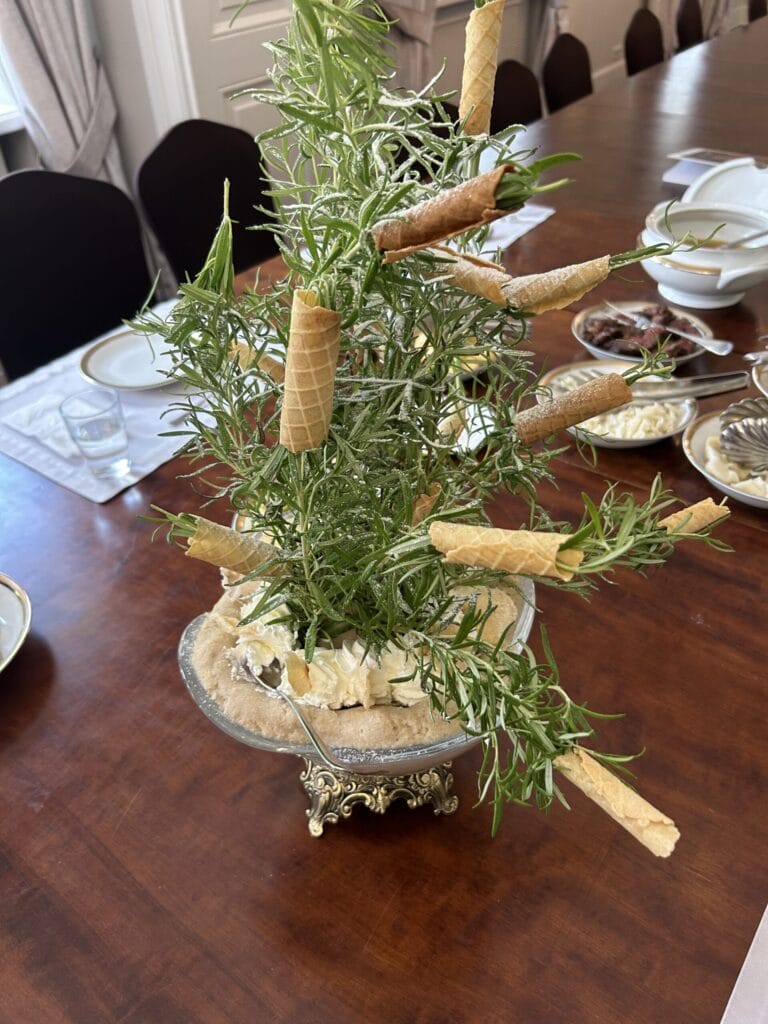
The dessert, the ulipki, was the most theatrical element of the day and the one that most directly connects to the specific entertaining culture of the Sobieski court. The wafer batter, a thin mixture of flour, milk and sugar, was ladled onto a hot waffle iron and pressed into thin wafers that came off the iron pliable and warm. They had to be rolled immediately, while still hot, onto cylindrical sticks to form the cone shapes the book describes. Within seconds they harden completely as they cool. Timing was everything.
The cones, once formed, were arranged around a large bush of rosemary set into a base of sugar-crusted bread, the hollowed rye bread base that Recipe XCIV describes specifically as the traditional presentation. The whipped cream, the froth of Recipe XCIV, was poured around the rosemary bush. The ulipki stood upright around the rosemary like a decorative tree. Then the whole construction was dusted generously with powdered sugar to produce what the book calls a snow effect.
You pulled an ulipki from the tree, filled it with whipped cream, sprinkled it with powdered sugar, and ate it. A dessert designed as a spectacle and a participation, the dessert itself the entertainment as much as the flavour.
A meal truly fit for a Baroque Polish king coming home from battle victorious.
My Rating
This is one of the most significant days of the Eats History Project, and I want to say that clearly before any specific rating. Cooking from the oldest Polish cookbook in the kitchen of the palace where its recipes were being made at the time of publication, harvesting vegetables from the kitchen garden, serving a meal that recreates what the court of one of the most significant military figures of 17th century European history would have eaten, is the exact thing this project exists to do.
The rosół is extraordinary. The saffron, lime, and ginger combination produces a broth that is simultaneously familiar as the ancestor of modern Polish rosół and distinctly different in a way that immediately communicates the Baroque spice culture that produced it. The warmth of the ginger, the floral complexity of the saffron and the clean acidity of the lime work together in a way that I would not have predicted and that I found genuinely revelatory. The ability to customise the bowl with dumplings, noodles, meatballs and venison according to your own preference is the kind of dining experience that modern restaurant culture has largely abandoned and that the Compendium makes clear was central to Baroque Polish hospitality.
The ulipki are a revelation. Thin, crisp, warm from the iron, filled with cold whipped cream and dusted with sugar. The contrast of the warm cone freshly rolled against the cold cream is one of the more satisfying single bites I have experienced for this channel. The rosemary tree presentation is the kind of theatrical Baroque dessert service that deserves to come back.
Rating: The meal as a complete experience: 9.5 / 10
The Recipes: From the Compendium Ferculorum, 1682
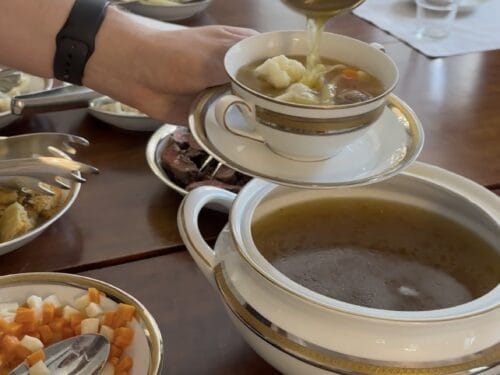
Recipe One: Rosół — Polish Broth

Don’t lose this one.
I’ll email it to you so it’s waiting when you’re ready to cook.
Ingredients
Instructions
Notes
- The saffron in the broth cannot be substituted with turmeric. Turmeric produces a similar yellow colour and no flavour resemblance to saffron whatsoever. The saffron provides a specific floral, slightly honeyed complexity that is the defining flavour note distinguishing this Baroque Polish broth from its modern descendant. Use real saffron. A small amount is sufficient and the price per recipe is not significant when measured against the difference it makes.
- The lime juice in the broth is documented in the Compendium and should not be replaced with lemon juice if you want the historically accurate flavour. Lime was available in 17th century Poland through trade networks and was specifically preferred over lemon in this application by Czerniecki. The flavour difference is noticeable in a simple preparation like broth where nothing masks it.
Tried this recipe?
Let us know how it was!
Recipe Two: Ulipki on Rosemary — The Baroque Dessert
Don’t lose this one.
I’ll email it to you so it’s waiting when you’re ready to cook.
Ingredients
Instructions
Notes
- The ulipki rolling step is the only technically demanding element of the entire recipe and it becomes easier very quickly with practice. Have your rolling stick ready before you open the iron for the first time. The first one will probably be imperfect. The third will be fine. The tenth will be easy.
- The rosemary bush needs to be densely branched enough to stand upright on its own when inserted into the bread base. A single rosemary sprig will not work. Bundle several large sprigs together and tie them at the base with kitchen twine before inserting into the bread. The rosemary fragrance as people reach in to fill their ulipki is a significant part of the experience.