Go Back
+ servings

Recipe One: Rosół — Polish Broth

Donnie
No ratings yet
A special and heartfelt thank you to the Museum of King Jan III's Palace at Wilanów for hosting me and for the extraordinary work they do preserving and recreating the culinary culture of 17th century Poland.
Compendium Ferculorum, Chapter 1, Recipe I: Polish BrothOriginal text from the Compendium: This is the way to cook Polish broth. Take a joint of beef or veal, a grouse or partridge, pigeons and whatever meat you have at hand that is fit for broth. Soak it, season finely with salt, and put in a pot, then blanch. Being cleared, strain your broth through a sieve, and pour over the meat, add parsley, butter, salt, and scum it clean. Boil up and serve forth hot. One must also know that all broths, as not to reek of water or wind, need what they do, that is to say parsley root or dill, onions or garlic, nutmeg or rosemary, or whole pepper according to taste and liking, lime or rosemary will taint none broth, either.
Prep Time 30 minutes
Cook Time 3 hours
Servings: 8 people

Jump To

Donnie Dodson

Don’t lose this one.

I’ll email it to you so it’s waiting when you’re ready to cook.

Ingredients
  

For the broth base:
  • 1 kg bone-in beef short rib or beef shin — the Compendium specifies joint of beef or veal as the primary meat
  • 1 whole chicken or equivalent poultry pieces — grouse or partridge would be most historically accurate; chicken is the most accessible modern equivalent
  • 2 medium carrots peeled
  • 2 stalks celery with leaves
  • 1 large parsnip peeled — parsley root is specified in the Compendium; parsnip is the most accessible substitute
  • 1 large onion halved and charred cut-side down in a dry pan until deeply dark — the charring adds colour and depth to the finished broth
  • 1 head garlic halved horizontally
  • Small bunch of fresh parsley including stems
  • 2 bay leaves
  • 10 whole black peppercorns
  • 1 tsp whole allspice berries
  • 2 tsp fine salt plus more to taste
  • 2 tbsp unsalted butter — specified in the Compendium
For the Baroque spice flavouring, what separates this from modern rosół:
  • Generous pinch of saffron approximately ½ tsp, steeped in 2 tbsp of warm water for 10 minutes — the Compendium specifies saffron throughout. It gives the finished broth a warm golden colour and a floral complexity that plain broth does not have
  • Juice of 1 lime freshly squeezed — lime is specifically documented in the Compendium as a standard Polish broth flavouring of the period
  • 2 cm piece of fresh ginger root finely grated — ginger appears repeatedly in the Compendium and reflects the importance of spice in 17th century Polish court cooking
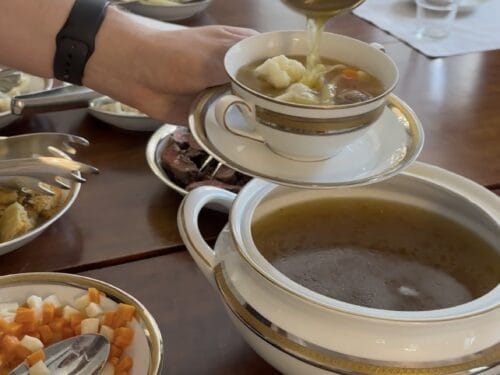
For the table accompaniments, add at discretion:
  • Small meatballs cooked separately in the broth
  • Thin noodles or pasta cooked separately
  • Small dumplings cooked separately
  • Thinly sliced cooked venison or roasted poultry
  • Blanched vegetables (such as brocolli, green beans, carrots, or cauliflower)

Instructions
 

Prepare and blanch the meat

  1. Place the beef and chicken in a large pot. Cover with cold water and bring to a boil over high heat. A large amount of grey foam will rise to the surface. After 5 minutes of boiling, drain the meat completely and discard the blanching water. Rinse the meat and the pot. This blanching step, which the Compendium specifies as being cleared, removes impurities from the meat and produces a significantly clearer finished broth than skimming alone would achieve.

Build the broth

  1. Return the blanched meat to the clean pot. Add all the vegetables, parsley, bay leaves, peppercorns and allspice. Cover with approximately 3 litres of fresh cold water. Add the salt. Bring very slowly to a gentle simmer over medium-low heat. The water should barely shiver rather than boil vigorously. A hard boil produces a cloudy broth. A gentle simmer produces a clear one.
  2. Simmer uncovered for 2 to 3 hours, skimming any foam or fat that rises to the surface periodically. The Compendium specifies scum it clean, meaning the surface should be kept clear throughout the cooking.

Finish and flavour

  1. After 2 to 3 hours the broth should be deeply golden and intensely flavoured. Remove all the meat and vegetables with a slotted spoon. Strain the broth through a fine mesh strainer lined with a clean cloth, pressing the solids firmly to extract every drop of liquid.
  2. Return the strained broth to a clean pot over gentle heat. Add the butter and stir until melted. Add the steeped saffron with all its soaking liquid and stir through. The broth will deepen in colour to a warm amber gold. Add the freshly squeezed lime juice. Add the grated ginger. Stir to combine. The Compendium notes that lime or rosemary will taint none broth, either, meaning these additions will not harm the broth but will elevate it.
  3. Taste carefully and adjust salt. The finished broth should be clear, deeply golden from the saffron, with a warm complexity from the ginger and a faint acidity from the lime sitting beneath the primary meat and vegetable flavour.

Serve

  1. Bring to a full boil immediately before serving and ladle into deep bowls while hot. The Compendium is specific: boil up and serve forth hot. Provide the accompaniments separately at the table for each diner to add according to their own preference. This is the authentic serving style.

Notes

  • The saffron in the broth cannot be substituted with turmeric. Turmeric produces a similar yellow colour and no flavour resemblance to saffron whatsoever. The saffron provides a specific floral, slightly honeyed complexity that is the defining flavour note distinguishing this Baroque Polish broth from its modern descendant. Use real saffron. A small amount is sufficient and the price per recipe is not significant when measured against the difference it makes.
 
  • The lime juice in the broth is documented in the Compendium and should not be replaced with lemon juice if you want the historically accurate flavour. Lime was available in 17th century Poland through trade networks and was specifically preferred over lemon in this application by Czerniecki. The flavour difference is noticeable in a simple preparation like broth where nothing masks it.

Tried this recipe?

Let us know how it was!