I have been in Seville for a week now and every single day this city reveals something else that connects the food I am making to the history happening around me. Today I visited the monument to Miguel de Cervantes near the old Royal Jail of Seville, a statue of the man holding his manuscript inscribed with the most famous opening line in Spanish literature, and I thought about the fact that the greatest novel ever written in the Spanish language was most likely conceived in a prison cell in this city. And somewhere inside that novel, in the second sentence of the very first chapter, is a recipe.
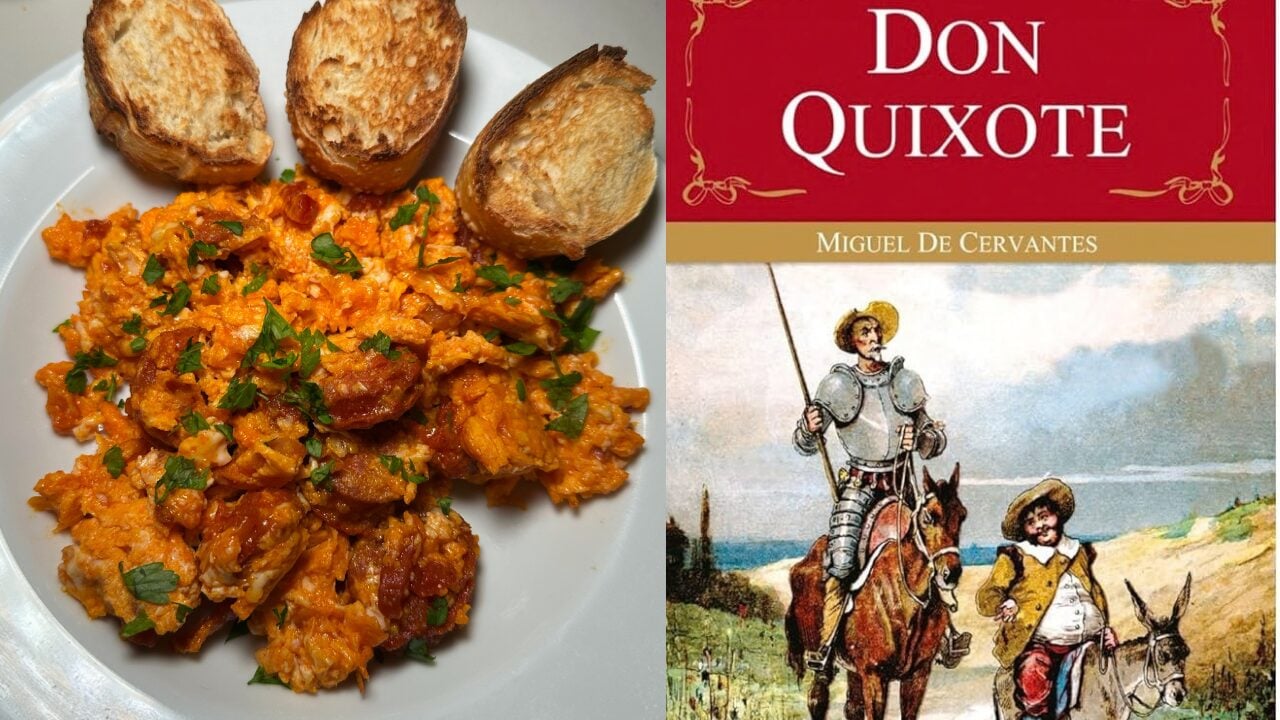
Duelos y quebrantos. Sorrows and breakages. Trials and wounds. The name has been translated differently by every English translator who has attempted it and debated by literary scholars for over four hundred years. What is not debated is that it was a dish, that it was eaten every Saturday by Don Quixote in the novel that bears his name, and that it was almost certainly eggs scrambled with bacon and chorizo and sometimes lamb brain, the kind of simple, hearty, inexpensive food that sustained working people across La Mancha in the 16th century.
I made it this week in Seville, a few streets from the jail where Cervantes first had the idea for the novel it appears in. I rated it 8.8 out of 10. Here is the full story.
Cervantes in Seville: The Jail That Gave the World Don Quixote
Next week
I cook these before I write them. Some of it never makes the post.
The failures, the source documents, the version that actually tasted good. That part goes out by email, and next week’s is already on the stove.
 Written and cooked by Donnie
Before getting to the dish, the story of how Cervantes ended up in Seville deserves to be told properly, because it is one of the more remarkable biographies in the history of literature.
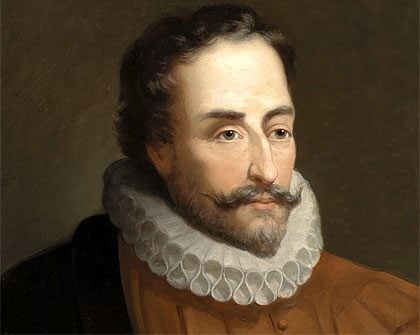
Miguel de Cervantes Saavedra was born in Alcalá de Henares in 1547, the son of a barber-surgeon. By his mid-twenties he had lost the full use of his left hand at the Battle of Lepanto, one of the largest naval battles in history, which he described as the most glorious occasion that past or present ages have witnessed. He spent five years enslaved in Algiers after being captured by Ottoman corsairs on his return to Spain. He was ransomed in 1580, returned to a country where his literary ambitions were not producing income, and eventually took a job as a royal tax collector and commissary agent, first for the Spanish Armada and subsequently for the royal treasury.
It was this job that brought him to Seville, and it was this job that put him in prison here. He was accused on two separate occasions of misconduct in his accounts. The first time, in 1592, he was held briefly in Castro del Río in Córdoba for allegedly selling wheat he had collected without authorisation. The second time, in 1597, he was imprisoned in the Royal Jail of Seville, the Cárcel Real, because a banker to whom he had entrusted tax money he had collected went bankrupt, leaving Cervantes unable to account for the funds. He remained in the Seville jail for several months. He was not found guilty of intentional fraud either time. He was simply a poorly paid royal official caught in the bureaucratic and financial chaos of the Spanish imperial system at its most strained.
Cervantes suggested in the prologue to Don Quixote that the novel was born in a prison. The Spanish phrase he used is se engendró la historia en una cárcel, the story was engendered in a jail. The jail he most likely meant was the Royal Jail of Seville. A man who had lost the use of his hand at Lepanto, been enslaved in North Africa for five years, and was now sitting in a prison cell in Seville over a bankruptcy that was not his fault, with a failed literary career behind him and no obvious future ahead, conceived the idea of a delusional knight tilting at windmills. The monument to Cervantes that I visited today stands near the site of that jail. The inscription on the manuscript he holds is the line that came from inside it.
The Second Sentence of the Greatest Novel: A Culinary Mystery
Don Quixote opens with one of the most famous lines in the Spanish language. Everyone knows it. In a place in La Mancha, the name of which I have no desire to call to mind. What follows in the second sentence is less celebrated but, for this channel at least, considerably more interesting.
The original Spanish from Chapter 1, published 1605, reads: “una olla de algo más vaca que carnero, salpicón las más noches, duelos y quebrantos los sábados, lentejas los viernes, algún palomino de añadidura los domingos, consumían las tres partes de su hacienda.”
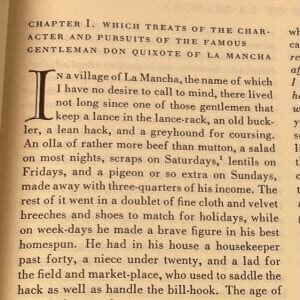
Translated: “a pot of something more cow than mutton, hash on most nights, duelos y quebrantos on Saturdays, lentils on Fridays, some extra pigeon on Sundays, consumed three quarters of his estate.“
This is the weekly menu of Alonso Quijano, the man who will become Don Quixote. Cervantes described his hero through what he ate before he described what he looked like. That choice is itself a statement about how Cervantes understood identity. You are what you eat. And Alonso Quijano eats like a provincial hidalgo of modest means doing his best to maintain appearances.
The duelos y quebrantos on Saturdays is the entry that has generated more scholarly debate than any other food reference in world literature. Cervantes himself never explained the dish by name elsewhere in the novel. The term appears again in Chapter 2 when Sancho Panza is delighted by food an innkeeper offers him, but the connection to the same dish is contextual rather than explicit.
What does the name mean? Literally, it translates as sorrows and breakages, or trials and wounds. Every English translation of the novel has handled it differently. Edith Grossman, whose 2005 translation is considered the most authoritative modern version, rendered it simply as scraps on Saturdays, acknowledging that the term was untranslatable in its full ambiguity. John Ormsby’s 19th-century translation left it out of the menu description altogether. The Aramco World journal described it as trials and sorrows, noting that Don Quixote certainly had his share. In modern Spanish the word duelos still means grief or mourning.
The scholarly debate about what duelos y quebrantos actually was has been running since 1614, one year before Cervantes published Part 2 of the novel, which tells you that his contemporaries were already puzzled by it. The most widely accepted interpretation among food historians today is that it was an egg dish made with the mixed animal products that religious law complicated for different communities. Some scholars connect the Saturday timing to the Jewish observance of Shabbat, noting that openly eating a dish made with pork and eggs on Saturday could serve as a public demonstration of Old Christian status at a time when conversos were under suspicion. Cervantes scholar Américo Castro wrote extensively about this interpretation, and it is now the most commonly cited reading of the dish’s cultural significance. However, the cooking itself, whatever its social meanings, was practical and accessible: inexpensive animal products, eggs, and a fire.
What Historians Think It Was: The Lamb Brain Question
The most thoroughly researched reconstruction of what duelos y quebrantos actually contained combines documented La Mancha cooking traditions with the available evidence from Cervantes’s own time.
The dish is generally accepted by food historians and La Mancha culinary authorities to have consisted of eggs scrambled or cooked together with some combination of bacon, pancetta or salted pork fat, chorizo or cured pork sausage, and, in the version considered most historically complete, lamb or sheep brain. The lamb brain connection is the detail that most modern recipes leave out and that most modern diners are relieved to see omitted.
The inclusion of lamb brain was not unusual in 16th century Spanish cooking. The Spanish word sesos, brain, appears in multiple contemporaneous recipe sources as an ingredient in egg dishes across La Mancha and Castile. A shepherd who had just slaughtered an animal would have used every available part, including the brain, which is protein-rich and was wasted otherwise. The sesos mixed with eggs and cured pork produced a richer, more unctuous result than eggs alone and made the dish more satisfying as a weekly protein source for people with limited access to more expensive cuts.
The dish is still made today in La Mancha, the region of central Spain where Don Quixote is set. Tavernas and restaurants along the Ruta de Don Quijote serve versions of duelos y quebrantos as a heritage dish, some with the lamb brain in the historically complete version and many without it. The modern La Mancha versions without brain are still considered authentic to the spirit of the dish even if they omit the most challenging ingredient. Mine is in this category. I used pancetta, chorizo and eggs. The lamb brain remains a historical curiosity I will document in a separate episode for the enthusiasts.
My Rating
This is an extremely satisfying breakfast-adjacent egg dish that deserves significantly more recognition outside of La Mancha than it currently receives. The pancetta renders its fat slowly into the pan and that fat becomes the cooking medium for everything that follows. The chorizo releases its paprika-infused oil into the same pan, producing a deeply red, smoky cooking base that the eggs absorb completely as they go in. The result is scrambled eggs that taste of smoked pork, paprika, garlic and fat in a way that no plain scrambled egg can approach.
Served with toasted bread for dragging through the pan and a glass of wine because this is a Cervantes recipe and the wine is non-negotiable, it is exactly the kind of Saturday food that a provincial Spanish hidalgo would have eaten every week. Rich without being heavy. Simple without being plain. The kind of food that costs almost nothing to make and tastes considerably more expensive than it is.
The 8.8 out of 10 reflects how genuinely good this is as a dish rather than any historical sentiment. I would make this on a Saturday morning without any Cervantes connection required and it would earn the same rating.
Rating: 8.8 / 10
The Recipe: Duelos y Quebrantos
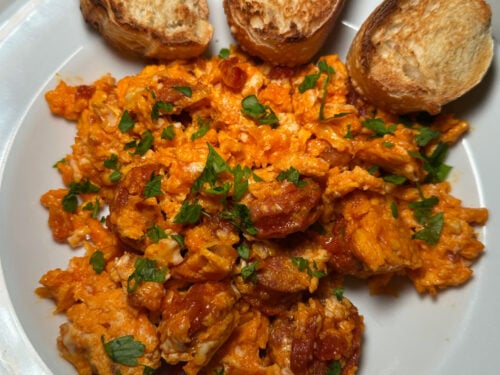
Duelos y Quebrantos

Don’t lose this one.
I’ll email it to you so it’s waiting when you’re ready to cook.
Ingredients
Instructions
Notes
- The quality of the Spanish chorizo matters more than the quantity. Use a cured Spanish chorizo with visible paprika content. The fat that renders from good chorizo is deeply flavoured and coloured and is what gives the dish its characteristic appearance and taste. A fresh Mexican-style chorizo or a spicy Italian sausage will not produce the same result.
- The eggs should be scrambled soft. Overcooked scrambled eggs in any context are less pleasant than properly soft ones, but in this dish where the eggs are carrying the flavour of the cured meats and their fat, the soft custard texture is particularly important. Pull the pan from the heat while they still look slightly underdone.
- The lamb brain version, for those interested in the historically complete preparation, involves adding approximately 100g of cleaned lamb brain to the pan after the chorizo and pancetta are rendered, cooking it gently until just set before adding the eggs. It produces a richer, more unctuous result. It is genuinely good if you can source the ingredient and approach it without hesitation. I will cover it in a separate episode.