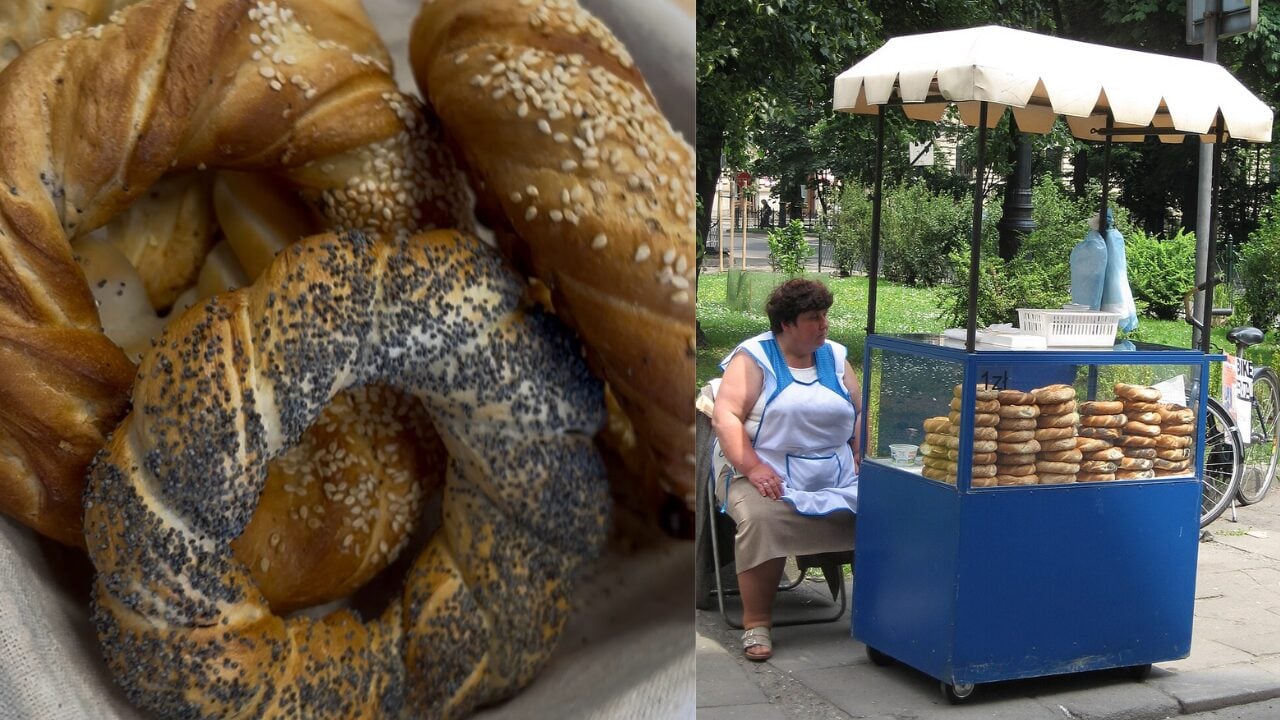
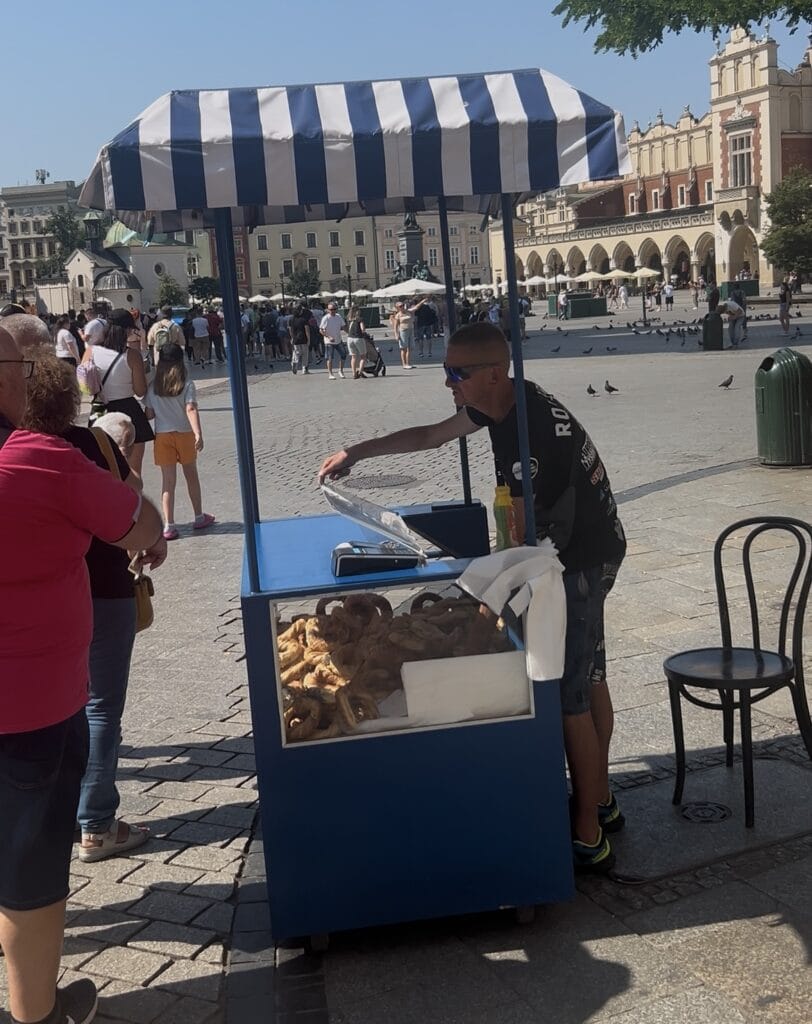
When I arrived in Kraków in the beginning of August, the first thing I noticed was not the medieval architecture, not the Wawel Castle on the hill above the Vistula, not the extraordinary sweep of the Rynek Główny main square. It was the blue stalls.
They are everywhere in this city. Hundreds of them, positioned on street corners and at tram stops and outside university gates, each one selling a single product. A ring-shaped baked good dusted with poppy seeds, sesame or coarse salt, twisted and braided and golden from the oven. My American brain processed the information immediately and filed it under bagel. But watching the locals interact with this thing told me immediately that something was different. No cream cheese. No bacon egg and cheese. No toasting. No schmear of any kind. People grabbed one from the stall on their way to work or school, tucked it over their wrist like a bracelet because Kraków tradition holds that this is the correct way to carry one, and ate it on the move.
This is not a bagel, this is what came before the bagel. And the story of how this specific baked good, made in Kraków since 1394, became the 29 billion bagels Americans eat every year is one of the most fascinating food history journeys I have encountered for this channel.
I visited the Muzeum Obwarzanka, the Live Bagel Museum of Kraków, where I learned to make them by hand and had the full history explained to me by the people who have dedicated themselves to preserving it. This post is built on everything I learned there. A huge thank you to the Muzeum Obwarzanka for hosting me and for the extraordinary work they do keeping this tradition alive and documented.
Next week
I cook these before I write them. Some of it never makes the post.
The failures, the source documents, the version that actually tasted good. That part goes out by email, and next week’s is already on the stove.
 Written and cooked by Donnie
The Origins: German Merchants, Royal Accounts and a Medieval Latin Entry
The obwarzanek krakowski is older than most countries. Its technique begins not in Poland but in the Germanic world, carried eastward by the waves of German merchants and craftsmen who settled in Central Europe during the high medieval period under what historians call the Ostsiedlung, the eastward settlement.
These German immigrants brought with them the tradition of the pretzel, the Brezel, and specifically a technique that defines the entire family of baked goods that includes the pretzel, the obwarzanek, and the bagel. The technique is parboiling. Before baking, the shaped dough is briefly submerged in hot water, which gelatinises the starch on the exterior surface, producing the distinctive shiny, crisp crust that you cannot achieve through baking alone. The Polish word obwarzanek derives directly from the verb obwarzać, meaning to parboil. The name is the technique. The bread tells you how it is made every time you say its name.
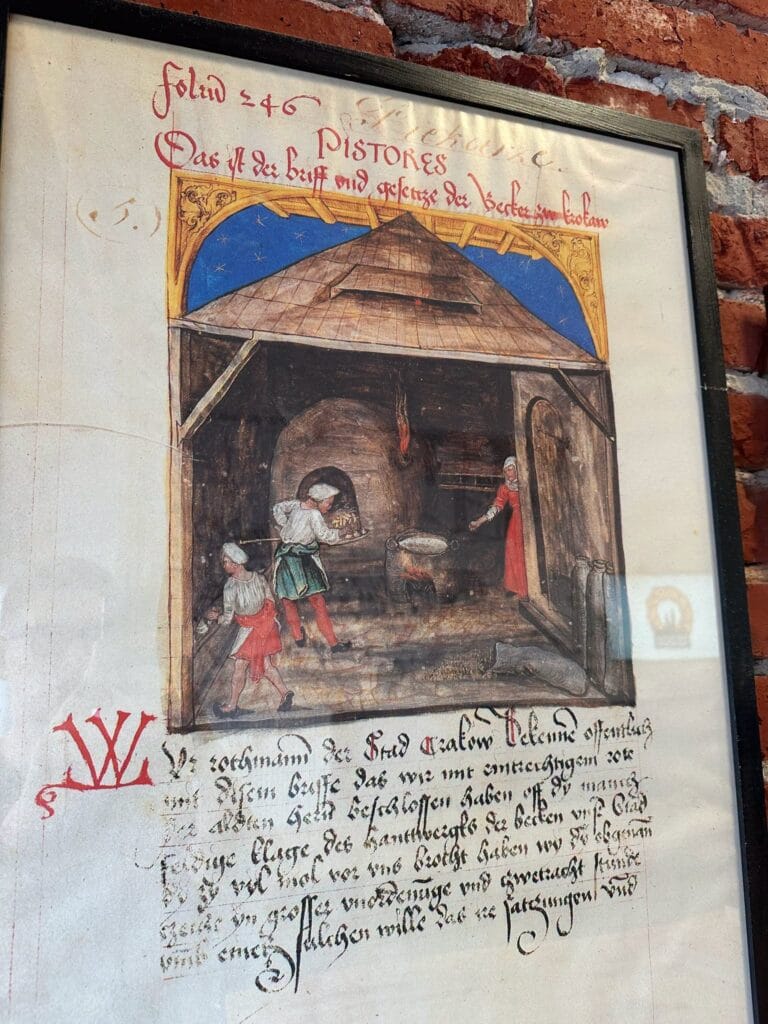
By the late 14th century this technique, adapted by Kraków’s bakers into a braided ring shape distinct from the knotted pretzel, had risen from the kitchens of German settlers to the tables of Polish royalty. The earliest known reference to obwarzanek krakowski appears in the court accounts of Queen Jadwiga of Poland on March 2, 1394. The entry in the Rachunki Dworu króla Władysława Jagiełły i królowej Jadwigi z lat 1388 to 1420, the financial accounts of the royal household, reads in Polish Medieval Latin: pro circulis obarzankij, one grosz. For the queen, for rings of obwarzanki, one grosz. One grosz. The most expensive baked good at the royal court of Poland bought at the same price as a loaf of common bread, recorded in the most precise terms possible by the royal accountant, preserved for over 600 years in a Polish archive.
The document establishes that obwarzanek was initially baked exclusively during Lent as a simple, egg- and dairy-free bread suitable for fasting periods. Queen Jadwiga, who would later be canonised as a saint of the Catholic Church, had a documented fondness for the obwarzanek specifically during Lent, when richer breads were prohibited by religious observance. The bread that was humble enough for Lenten fasting was also, apparently, good enough for a queen.
The Guilds, the Monopoly and the Innovation That Changed Everything
The century that followed the 1394 royal accounts transformed the obwarzanek from a Lenten bread with royal endorsement into a legally regulated, commercially significant product with an entire institutional infrastructure built around it.
In 1496, King John I Albert granted Kraków’s white-bread bakers’ guild an exclusive monopoly over the production of obwarzanek. This meant that only members of a specific, privileged guild of Christian bakers within the city walls could legally produce and sell them. The monopoly was not simply economic protectionism, though it was certainly that; it was also a statement about who had the right to participate in Kraków’s food economy and who did not.
By 1720, guild rules permitted year-round baking on Fridays and fast days, and reliable records of pretzel-like production date to 1834, though the item was sold from wicker baskets by street vendors until the mid-20th century. The blue stalls that replaced those wicker baskets in the modern era are the direct institutional continuation of a street vending tradition that is itself centuries old.
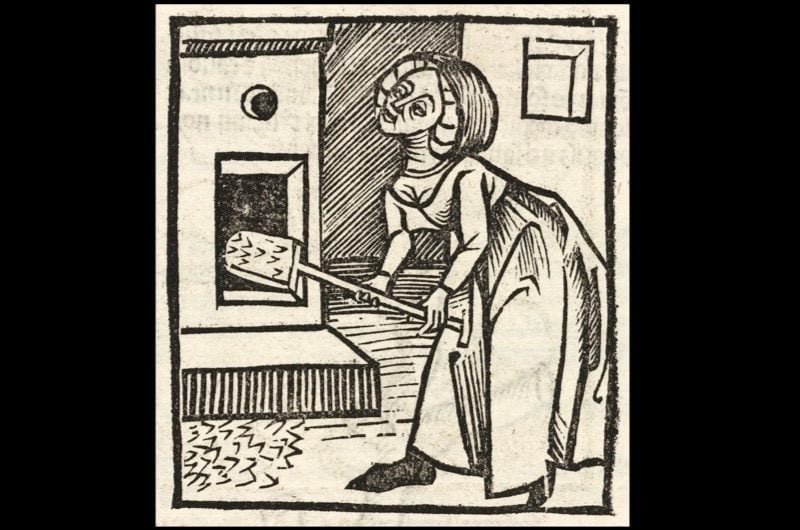
The guild monopoly created a problem for Kraków’s thriving Jewish community. Jewish bakers were barred from the guild and therefore from producing the obwarzanek legally. Medieval European restrictions on Jewish participation in the bread trade were widespread, though Poland was notably more tolerant than most of Western Europe. In 1264, Prince Bolesław the Pious had granted Polish Jews equal rights to buy and sell bread, which was a genuinely progressive position by 13th century European standards. But the specific guild monopoly on obwarzanek production created a legal gap that Jewish bakers had to work around.
Their solution was both practical and brilliant. Jewish bakers in Kraków in the late 16th and early 17th centuries created their own variant of the boiled-then-baked ring, one that did not technically fall within the guild’s monopoly on obwarzanek production because it was different enough to constitute a separate product. They used different proportions, different ingredients, different finishing techniques. They produced something that shared the fundamental technique, the parboiling before baking, but was recognisably its own thing.
The first written mention of the word bagel appears in the 1610 Community Regulations of Kraków, which dictated that these bread rings be given as gifts to women who had recently given birth, symbolizing the circle of life and eternity. The 1610 document is a Jewish community regulation, written in Yiddish, governing the appropriate scale of celebrations for newborn children. The community leaders were concerned that the celebrations were becoming too elaborate and that non-Jewish neighbours might resent the display of wealth. They specified the food that was acceptable to give, and the bagel, the bajgiel, appears in that list as a gift appropriate to the occasion.
Obwarzanek vs Bagel: The Differences That Matter
The relationship between the obwarzanek and the bagel is best explained as the relationship between a parent and a child. They share a fundamental technique, a direct genetic connection, and an unmistakable family resemblance, but they are also clearly different things, and the people of Kraków will tell you this firmly and at length if you call their obwarzanek a bagel.
If you visit Kraków, never, ever call the obwarzanek a bagel or a pretzel. These are two completely different and differently made baked goods with their own long-standing history.
The differences begin with the dough. The traditional obwarzanek is made from wheat flour, water, salt, and yeast. No eggs. No sugar. No honey. No fat of any kind. This is the Lenten heritage of the bread. It was designed to be eaten during fasting periods when eggs, dairy and fat were prohibited by religious observance, and that original constraint produced the specific flavour and texture of the obwarzanek: clean, wheaty, slightly chewy, with the seeds as the primary flavour accent rather than the dough itself.
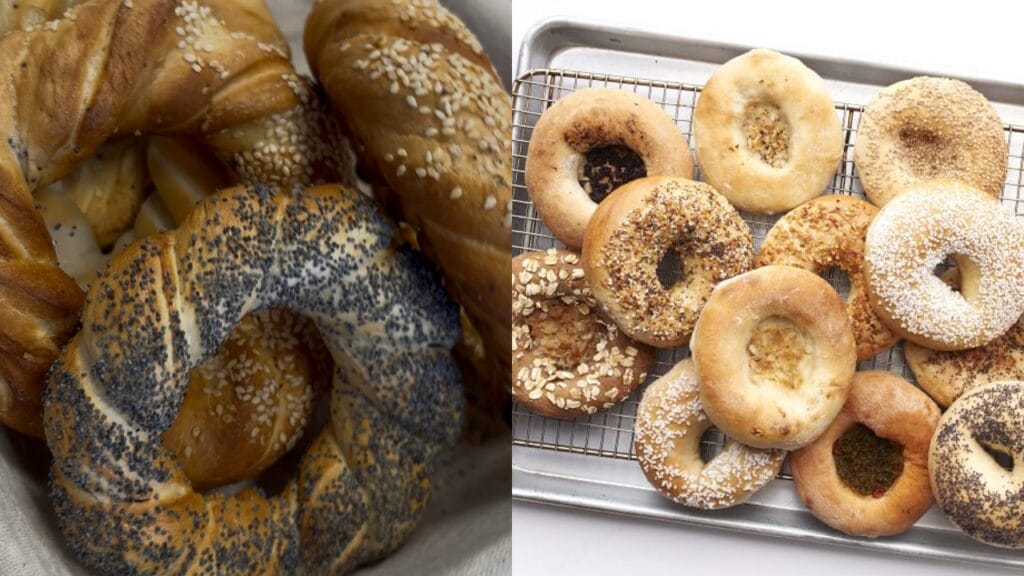
The bagel evolved differently and freely from those religious constraints. Jewish baking tradition incorporated eggs, malt syrup, sometimes honey, producing a dough that was richer, denser, and sweeter than the obwarzanek base. American bagels, particularly the New York bagel that became the global standard, evolved further toward a larger, denser, chewier format that has virtually no physical resemblance to the delicate, braided ring sold at a Kraków street stall.
The shape is the other defining difference. The obwarzanek is braided. The dough is rolled into a long thin rope, twisted around itself, and formed into an oval ring approximately 12 to 17 centimetres across and 2 to 4 centimetres thick. The braiding is not decorative. It is the traditional technique, documented in guild records, that gives the obwarzanek its specific texture, with the twisted surface producing more surface area for caramelisation and seed adhesion than a smooth ring would allow.
The bagel is smooth. The bagel is round rather than oval. The bagel is larger. The bagel is finished with toppings, traditionally sesame or poppy seeds, that are similar to the obwarzanek but applied to a completely different surface. And the bagel, in its American incarnation, has become a vehicle for an extraordinary range of additions, cream cheese, smoked salmon, bacon and eggs, everything bagel seasoning, that the obwarzanek’s Kraków tradition has not adopted and does not need.
The EU recognised the distinction officially in 2010 when it granted the obwarzanek krakowski Protected Geographical Indication status. This means that the authentic obwarzanek krakowski can only legally be produced within Kraków and its surrounding areas, using the traditional method. It is in the same category of protected European food products as Parmigiano Reggiano and Champagne. A street vendor snack at the same legal protection level as the world’s most famous cheese and sparkling wine. Kraków takes its obwarzanek seriously.
From Kraków to New York: The Great Migration
The bridge between the medieval guilds of Kraków and the 29 billion bagels Americans eat every year is one of the most significant migrations in food history, and it is carried entirely in the hands and the knowledge of people rather than in any document or recipe book.
Between 1880 and 1924, approximately two million Jews emigrated from Eastern Europe to the United States, the majority of them settling in New York City. They came from Poland, Russia, Ukraine, Romania, and the Austro-Hungarian Empire, and among everything they carried with them, their food knowledge was the most portable and the most durable. The Kraków bajgiel, the Jewish adaptation of the obwarzanek that had been documented since 1610 and eaten at every birth, circumcision, wedding, and community gathering in the Jewish neighbourhoods of Kraków and across Poland for three centuries, came with them.
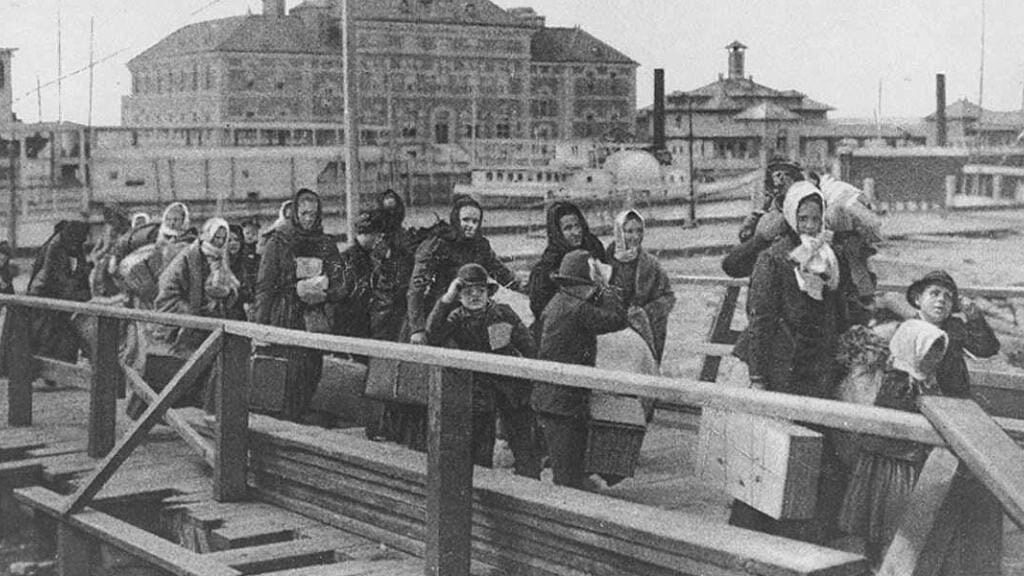
In New York the bagel entered a different economy and a different culture. The Lower East Side of Manhattan in the late 19th and early 20th centuries was one of the most densely populated places on earth, a neighbourhood where Jewish immigrants from dozens of different European communities were compressed into tenements and pushcart markets, and where food from the old country was both a comfort and a commercial opportunity. The bagel, which required the specific technique of boiling before baking, was sold by hand from pushcarts and baskets, made in small bakeries that operated through the night, sold on street corners in exactly the same way that the obwarzanek is still sold from blue stalls on the streets of Kraków today.
The International Bagel Bakers Union, established in New York in 1907, was one of the most fiercely guarded craft unions in American labour history. Bagel baking was a skill transmitted between members, and the union controlled who could and could not learn it with a rigidity that would have been recognisable to a 15th century Kraków guild member. The bagel was not simply food. It was knowledge, protected and transmitted through community in the same way it had been in Kraków for centuries.
The commercial expansion of the bagel across America happened in two stages. The first was the development of bagel-making machines in the 1960s, which broke the union’s control of the craft and allowed mass production for the first time. The second was the decision by companies like Lender’s to freeze and nationally distribute bagels in the 1970s and 1980s, introducing the product to American households that had no connection to the Jewish immigrant communities that had brought it across the Atlantic. By the 1990s the bagel had become a mainstream American breakfast food, and today Americans eat approximately 29 billion of them every year. The blue stall on the corner of Stradomska and Dietla in Kraków and the everything bagel counter of a New York deli are separated by 600 years of documented history and connected by a single technique learned from German merchants in medieval Poland.
The Muzeum Obwarzanka: Where the Tradition Lives
A special thank you is owed to the Muzeum Obwarzanka, the Live Bagel Museum of Kraków, which hosted me for the making session and the historical deep dive that informs everything in this post. The museum does something genuinely important. It keeps the traditional hand-making technique alive and transmits it to visitors in the same practical, hands-on way that it has always been transmitted, by showing rather than telling, by flour on the hands rather than words on a page.
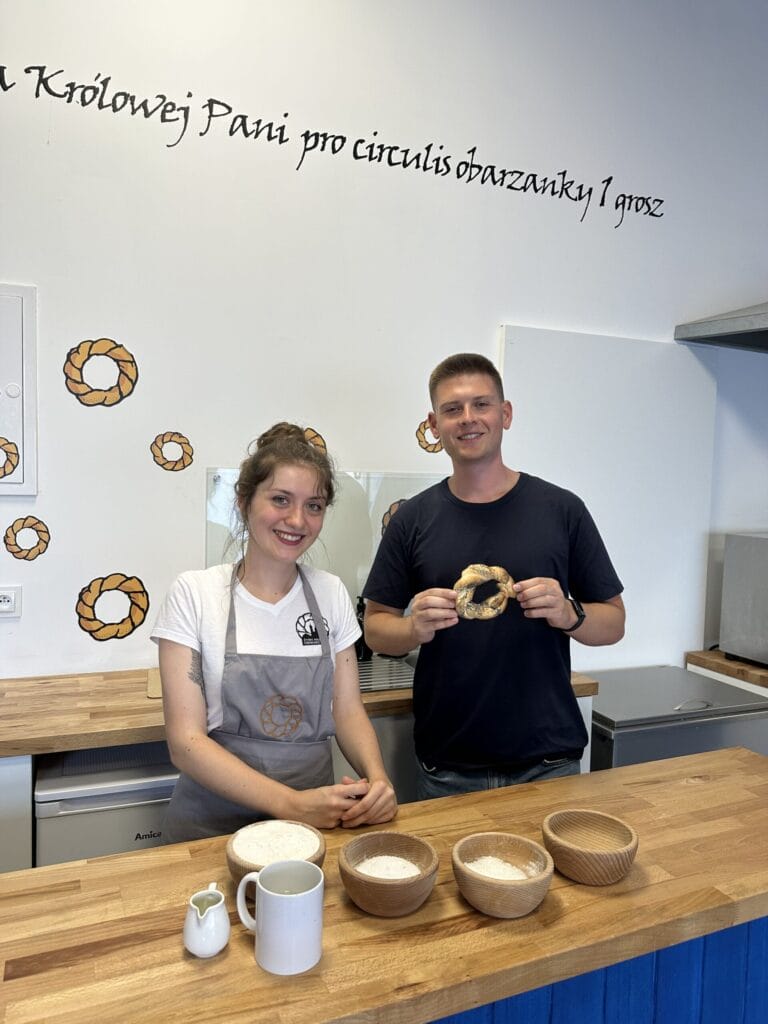
Watching and learning to braid the obwarzanek by hand at the museum gave me something that no amount of reading about the technique could have provided, the specific muscle memory of rolling the dough into a sułka, the thin rope, twisting it around itself, forming the oval ring, and achieving the tension that produces the characteristic braided surface. It is not a complicated technique. It is a precise one. The difference between an obwarzanek made by someone who has done it a thousand times and one made by someone doing it for the first time is immediately visible.
If you are in Kraków, go to the Muzeum Obwarzanka. Make one with your own hands. Then go buy one from a blue stall and eat it on the street the way Kraków has always eaten it. Over your wrist, on the move, with nothing added. Just the bread and the seeds and the city.
The Recipe: Obwarzanek Krakowski
Obwarzanek Krakowski

Don’t lose this one.
I’ll email it to you so it’s waiting when you’re ready to cook.
Ingredients
Instructions
Notes
- The braiding technique takes practice. Your first few will look rough. By the fifth or sixth they will look considerably better. This is exactly the experience of making them at the Muzeum Obwarzanka, where the instructors make it look effortless and the first attempt feels impossible and the fifth attempt feels almost right. Do not be discouraged by the first one.
- The parboiling water sugar is not optional. It contributes to the Maillard reaction during baking, producing the specific amber-gold colour of a properly made obwarzanek. Water alone produces a paler, less visually attractive result.
- The coarse salt version is the most traditional and the most historically grounded. Salt was the topping documented in the earliest records of the obwarzanek. Poppy seeds are the most characteristically Polish addition and the most visually distinctive. Sesame seeds produce a more international flavour profile. All three are traditional. Make a batch with one of each and decide which you prefer.