There are moments in travel that you cannot plan, cannot engineer and cannot fully anticipate. You can put yourself in the right place and show up with genuine curiosity and let what happens happen. What happened to me in a random village on the outskirts of Lublin, Poland is the perfect representation of this.
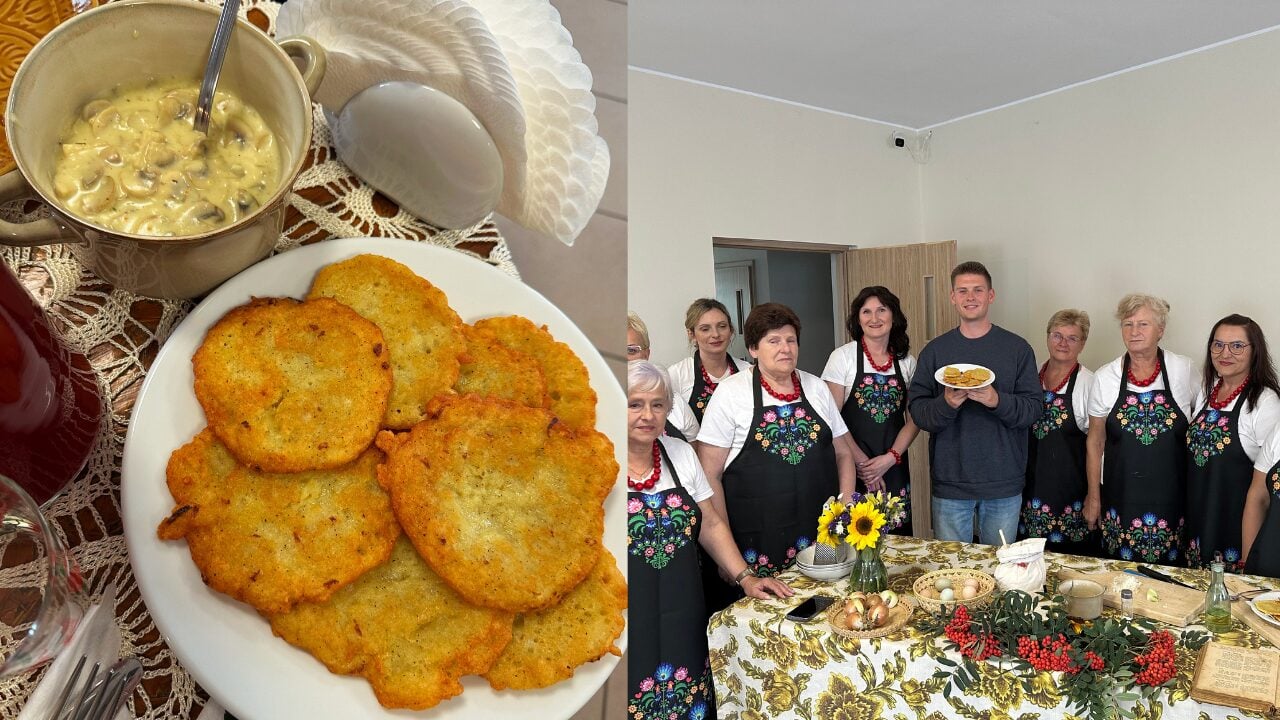
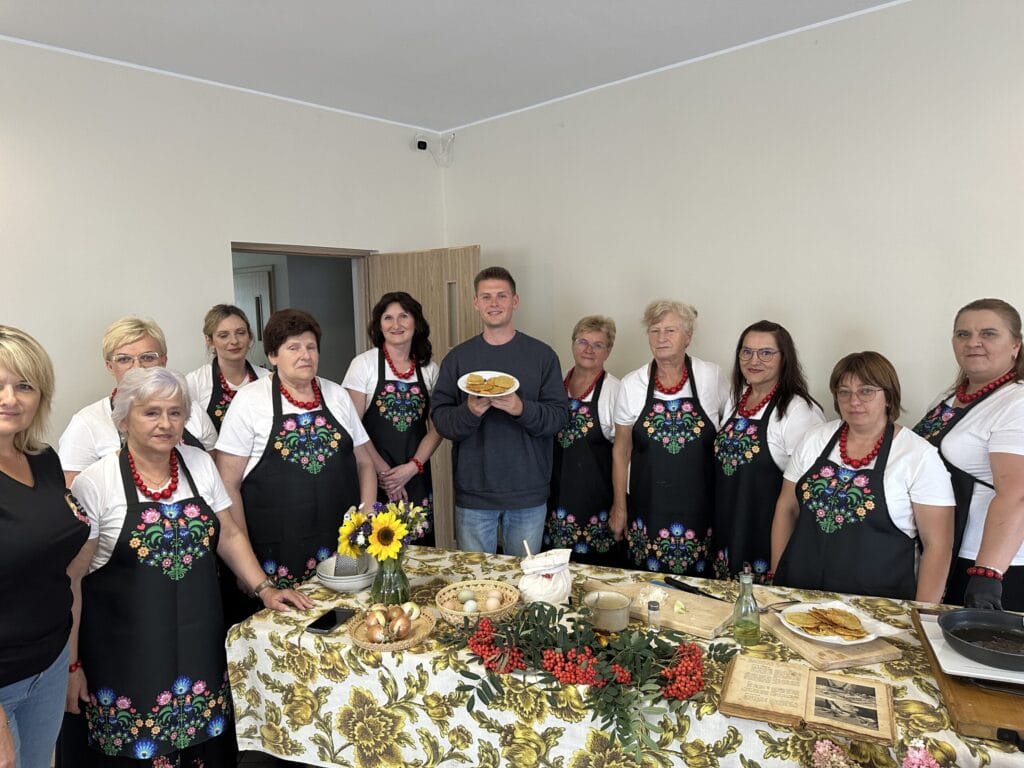
About 20 Polish grandmothers adopted me for an afternoon, taught me their family recipes, showed me their grandmother’s recipe books, accepted the ancient Roman cookbook I am currently writing as a perfectly reasonable contribution to the conversation, and sent me home with a burning throat from a shot of something I am fairly certain was śliwowica, the traditional Polish plum brandy. (But I still don’t know).
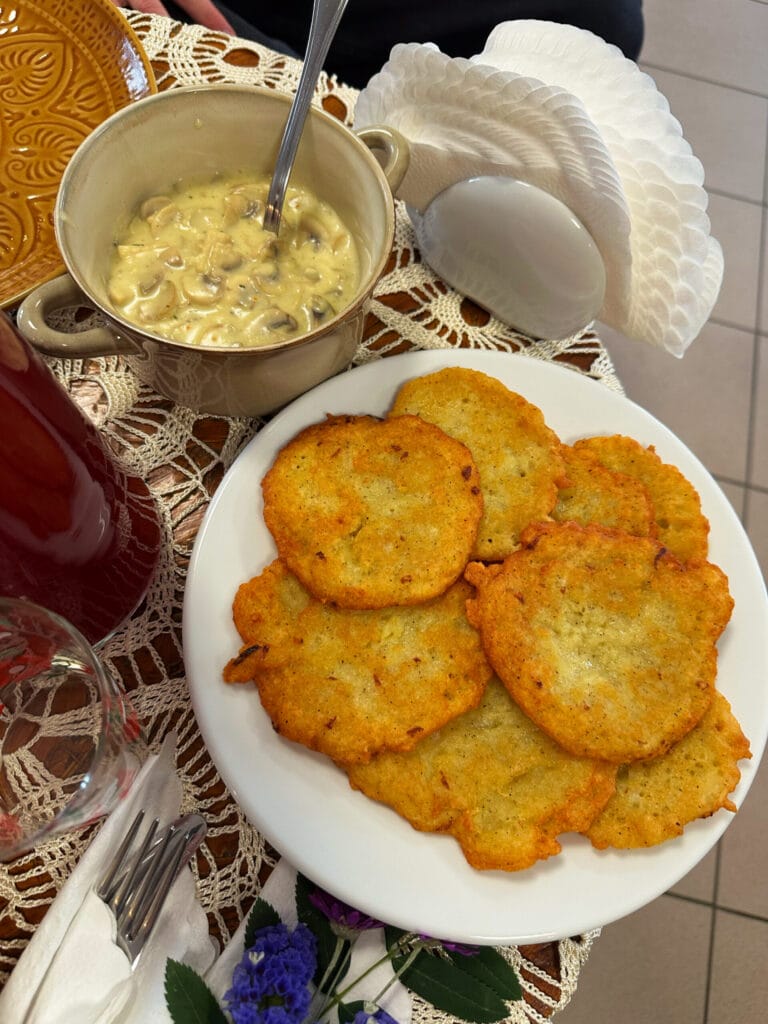
The placki ziemniaczane, the Polish potato pancakes, that they taught me to make are one of the most satisfying things I have produced for this channel. Crisp at the edges, tender in the middle, topped with a Polish forest mushroom cream sauce made from borowik mushrooms and served alongside kompot, the fruit compote that functions in rural Poland as a juice or a drink. The meal is simultaneously simple and completely extraordinary.
The Koła Gospodyń Wiejskich: Poland’s Most Important Food Preservation Society
Next week
I cook these before I write them. Some of it never makes the post.
The failures, the source documents, the version that actually tasted good. That part goes out by email, and next week’s is already on the stove.
 Written and cooked by Donnie
The women who invited me to cook with them are members of the Koła Gospodyń Wiejskich, the Rural Housewives’ Circles, and they are one of the most significant food preservation institutions in Poland. Most people outside Poland have never heard of them.
The first organisation resembling a Rural Housewives’ Circle was established in Piaseczno near Gniew in March 1866 by a landlady named Januaria Kalkstein, more than 50 years before voting rights were granted to Polish women. Her Housewives’ Association, the Towarzystwo Gospodyń, was created with the specific mission of teaching women the skills necessary for running a homestead independently at a time when Polish statehood had been eliminated by the partitions of Russia, Prussia and Austria. The organisation was a practical domestic institution and a quietly political act simultaneously.
The movement grew through the late 19th and early 20th centuries across partitioned Poland, with separate organisations developing in different regions under different political constraints. In the Russian-controlled Congress Kingdom, the work was conducted partly underground due to tsarist restrictions on Polish civic organisation. During the First World War the circles shifted to charitable work, distributing food to Polish families across the fighting fronts. By 1937, in the Second Polish Republic, there were over 4,200 circles encompassing approximately 100,000 women.
The circles survived the Second World War, survived the Nazi occupation and survived forty years of communist rule in the Polish People’s Republic, during which they were co-opted by the state into a quasi-official organisation but continued their core work of preserving rural food traditions and community knowledge at the local level. In the post-communist period they re-established their independent civil society character and have experienced a significant revival, particularly among younger rural women who see them as a genuine alternative to the disappearing oral food traditions of Polish village life.
What the Koła Gospodyń Wiejskich does that no other institution in Poland replicates is provide an organised, continuous, community-based structure for the transmission of pre-industrial rural Polish food knowledge. These are not recreations or academic reconstructions. The women in these circles are making their grandmother’s recipes from their grandmother’s handwritten notebooks, using techniques that were transmitted orally and practically rather than through cookbooks or culinary schools. The recipe books I was shown that afternoon, some dating back to the late 19th century, are the primary sources for a Polish rural food tradition that has survived two world wars, communist collectivisation and forty years of suppressed national identity specifically because these women kept passing the knowledge to each other.
The Afternoon: Cookbooks, Potato Pancakes and Zero Shared Language
I arrived at the farm to find the group already assembled in a large communal kitchen, the kind of space that exists specifically for cooking large amounts of food for large numbers of people, with multiple stoves running and a level of organised activity that immediately communicated that these women had been doing this their entire lives and were not particularly interested in being observed doing it but were entirely willing to let me participate if I kept up.
The language situation was exactly what you would expect from two parties with no shared language and a profound shared interest. We had no common verbal language and absolutely no difficulty communicating. Potatoes went into my hands with a peeler and an expectation. The process of draining the grated potato was communicated through emphatic gesturing toward the cloth and the insistence that I press harder and then harder still until the cloth produced almost no further liquid.
The recipe books came out over the compote break between the grating and the frying. Handwritten notebooks, some with the covers worn smooth from decades of handling, with recipes in the cramped Polish cursive of a previous generation. I showed them the research materials and early manuscript sections of Cooking Ancient Rome, the cookbook I am completing with Ten Speed Press. The specific delight with which one of the older women examined a recipe for garum, the Roman fermented fish sauce, while simultaneously looking at me in a way that communicated very clearly that she considered this somewhat insane but found it extremely interesting.
The common consensus that emerged through the afternoon, communicated through the interpreter, was that grandsons in Poland do approximately 99 percent of the eating and 1 percent of the cooking. The women found this both entirely accurate and somewhat frustrating. Several of them mentioned specifically that their grandsons did not cook for them, which was framed not as a complaint but as a missed opportunity for the grandsons in question. The food was not resentfully withheld. It was generously produced and shared with whoever showed up. But the observation that the knowledge was being transmitted in one direction and not being returned was something several of them mentioned.
The śliwowica at the end was not optional. It appeared after the meal with the kind of ceremonial inevitability that makes it clear that declining would be impolite regardless of your feelings about plum brandy at mid-afternoon. It was strong, it was clearly excellent quality, it burned in the precise way that good plum brandy should burn, and it was the correct send-off for an afternoon that I will think about for a long time.
Placki Ziemniaczane: The History of the Polish Potato Pancake
The potato pancake is one of those dishes that belongs simultaneously to multiple Central and Eastern European food traditions and whose origin story is therefore genuinely disputed in the way that only truly beloved dishes tend to be. The Polish placki ziemniaczane, the German Kartoffelpuffer, the Ukrainian deruny, the Jewish latke, are all variations on the same fundamental preparation of grated potato bound with egg and flour and fried in oil or fat. Each tradition claims historical priority. Each tradition is right that its version is the real one. They are all right simultaneously.
The potato arrived in Poland in the 17th century and was initially regarded, as it was across most of Europe, with suspicion. It was a New World plant in the nightshade family and European farmers were cautious about it for both botanical and theological reasons. By the 18th century the potato had established itself as a staple crop across Central Europe, and by the 19th century it was the primary caloric foundation of the diet of the Polish peasantry, which is why the rural recipe tradition that the Koła Gospodyń Wiejskich women are preserving is so thoroughly built around potato preparations.
The specific version I learned, potato and onion grated together, the liquid pressed out vigorously, bound with egg and a small amount of flour, fried in shallow oil until deeply golden and crisp, is documented in the late 19th and early 20th century recipes of the women’s grandmothers and represents the standard rural Polish preparation of the period. The mushroom cream sauce is a specific addition that reflects the extraordinary importance of wild forest mushrooms in Polish rural cooking, where the late summer and autumn mushroom harvest was a significant source of protein and flavour that was preserved through drying, pickling and jarring for use throughout the year.
The borowik, the Polish forest porcini known also as prawdziwek, the True One, is the most prized of all Polish wild mushrooms. Known elsewhere as Boletus edulis, porcini in Italian and cep in French, the borowik is the king of the Polish forest in the mushroom hierarchy and the mushroom most associated with the finest Polish mushroom preparations. The borowik cream sauce that the babcias made to serve with the placki is the meeting point of two of the most important ingredients in Polish rural cooking: the potato and the forest mushroom. It is not a complicated sauce. It is an extraordinarily good one.
My Rating and Honest Assessment
The placki ziemniaczane I made that afternoon, under the supervision of women who had been making them since childhood and whose mothers and grandmothers had been making them before that, are the best potato pancakes I have ever eaten.
The pressing of the liquid from the grated potato is not a step that can be abbreviated. The women were insistent about this and they were right. Insufficiently pressed potato produces a pancake that steams rather than fries, that is soft throughout rather than crisp at the edges and tender in the middle, and that lacks the golden crust that makes a properly made placek so satisfying. You press until you think you have pressed enough, and then you press again.
The borowik cream sauce is the component that elevates the dish from very good to genuinely extraordinary. The dried borowik, rehydrated and cooked into a cream sauce with butter and the mushroom soaking liquid, produces a depth of flavour that no fresh cultivated mushroom can replicate. The earthy, slightly meaty, intensely aromatic quality of the Polish forest porcini is exactly what the rich but simple potato pancake needs as an accompaniment.
The kompot is something Americans should know about. It is somewhere between a warm fruit juice and a very light fruit tea, made by simmering fruit with water and a small amount of sugar. There is no real American equivalent. It is genuinely worth making.
Rating: 9.2 / 10
The Recipe: Placki Ziemniaczane z Sosem Grzybowym
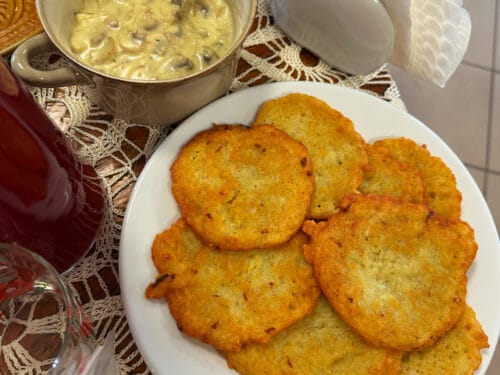
Authentic Polish potato pancakes: Placki Ziemniaczane

Don’t lose this one.
I’ll email it to you so it’s waiting when you’re ready to cook.
Ingredients
Instructions
Notes
- The pressing step is the single most important technique in the recipe and the one most often inadequately done by cooks who have not been corrected by a Polish grandmother. Insufficiently pressed potato produces a soft, steaming pancake rather than a crisp, golden one. The liquid must come out. Take the time to do it properly.
- The dried borowik mushrooms are available at every Polish delicatessen and from online Polish food suppliers. The difference in flavour between dried Polish borowik and fresh cultivated mushrooms is significant enough that the substitution genuinely matters. If you cannot find Polish borowik, dried Italian porcini from a good Italian deli are the most accessible alternative and are botanically the same mushroom.
- The mushroom soaking liquid is not an optional ingredient. It is the deepest, most intensely flavoured liquid in the recipe and the sauce built without it is noticeably less complex. Strain it carefully to remove grit but use all of it.