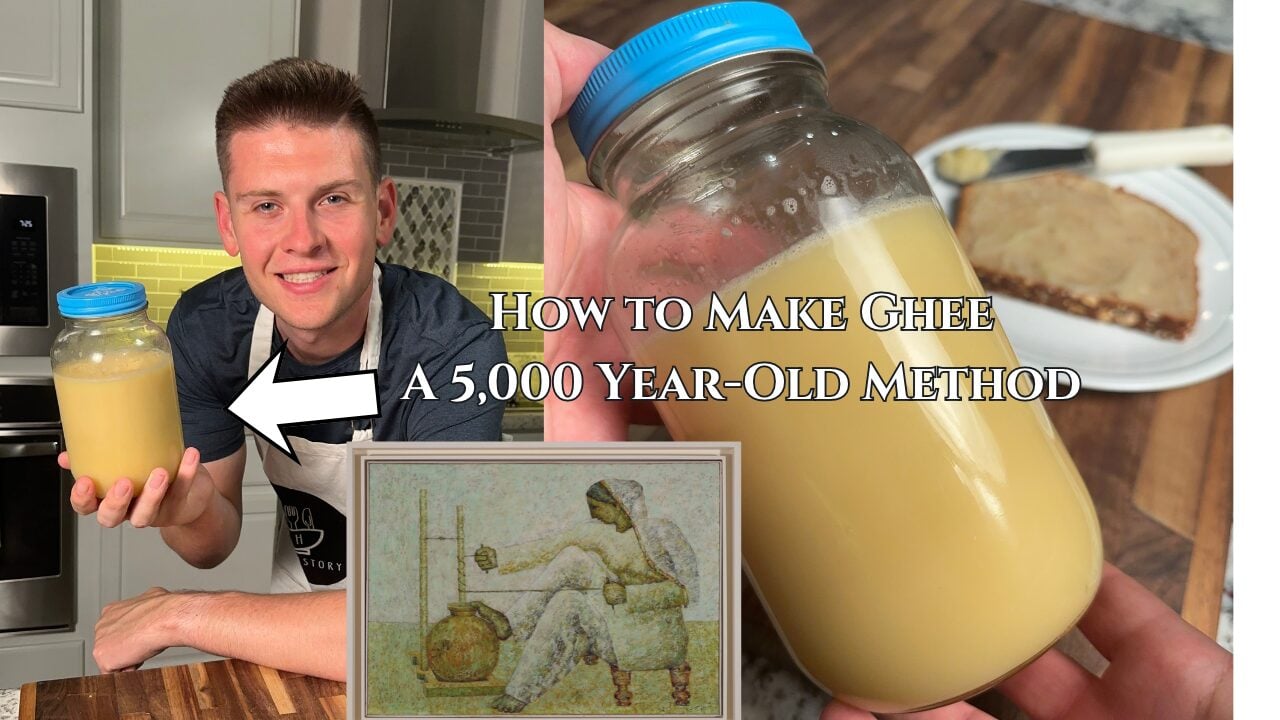
There is a jar of golden, nutty, shelf-stable clarified butter sitting in my kitchen right now that cost me less than six dollars to make, will last for months without refrigeration, and has a smoke point so high I can sear a steak in it without it burning. It took me about an hour of low-effort stirring to produce.
My New Cookbook, Cooking Ancient Rome, is now available for pre-order!
Ghee is one of the oldest continuously used cooking fats in human history. It predates recorded history in some estimations, appears in the oldest surviving Hindu scriptures, was used as medicine, as sacred offering, as currency and as the foundational cooking fat of one of the most sophisticated culinary traditions the world has ever produced. And somehow in the Western kitchen it got filed under speciality ingredient and forgotten. This blog post is the corrective. Here is the full history, the case for why you should be making it at home, and the simple recipe that requires nothing but good butter and patience.
The Oldest Cooking Fat in Human History
Next week
I cook these before I write them. Some of it never makes the post.
The failures, the source documents, the version that actually tasted good. That part goes out by email, and next week’s is already on the stove.
 Written and cooked by Donnie
The documented history of ghee stretches back further than almost any other specifically named food preparation in the archaeological and textual record. Archaeological evidence from the Harappan civilisation of the Indus Valley, which flourished between approximately 3500 and 1900 BC, suggests familiarity with the process of clarifying butter, making ghee potentially 5,000 years old in its earliest forms. The oldest documented textual mentions appear in the sacred songs of ancient India dating to approximately 2000 to 1500 BC.
The Vedas, the ancient Sanskrit scriptures that form the foundational texts of Hindu religious and philosophical tradition, contain numerous explicit references to ghee as both a sacred substance and a daily food. The Rig Veda, the oldest of the four Vedas, references ghee in the context of ritual fire offerings called yajnas, where ghee was poured into sacred flames as an offering to the gods. The Yajur Veda contains a prayer that lists ghee alongside milk, honey and rain as the things the worshipper asks to prosper through sacrifice. The word ghee itself comes from the Sanskrit ghṛta, meaning clarified butter or bright, a word whose root ghṛ means to sprinkle and which is, remarkably, cognate with the ancient Greek word khristós, from which the English word Christ derives. Two of the world’s great religious traditions share a linguistic root in the ancient Sanskrit word for the act of anointing with clarified butter.
The practical reason for ghee’s invention is straightforward and brilliant. Historians believe ghee was invented as a means to store butter, which spoils quickly because of its water content. Without the water, the bacteria that cause spoilage cannot grow. The storage method was necessary because of the subcontinent’s hot weather. In a climate where fresh butter would turn rancid within days, removing the water content and the milk solids that harbour bacteria produced a fat that could last for months or years without refrigeration. Practicality produced a sacred substance. The same logic that made ghee essential for an ancient Indian household has kept it in continuous use for four thousand years.
Ghee in Indian Culture: Sacred, Medical and Culinary
The significance of ghee in Indian culture cannot be reduced to any single category because it has never existed in just one category. It is simultaneously a cooking fat, a medicine, a religious offering and a cultural symbol, and it has been all of those things simultaneously for as long as the written record of Indian civilisation exists.
In Hindu religious practice, ghee is required in Vedic worship as the offering poured into the sacred fire. It is associated with purity, prosperity and the divine in ways that have made it irreplaceable in ritual contexts that have continued uninterrupted from the Vedic period to the present day. No other fat substitutes for ghee in these rituals because no other fat carries the same sacred associations. The cow’s centrality in Hindu religious culture is inseparable from the centrality of ghee, since the most sacred ghee is made from the milk of a cow, and the cow’s products have been considered sacred in the Hindu tradition precisely because of the nourishment and warmth they provide.
In Ayurveda, the ancient Indian system of medicine that has been practised continuously for over two thousand years, ghee is considered one of the most important substances in the entire pharmacopoeia. Ayurvedic texts from approximately 2000 years ago describe ghee’s use in treating skin conditions, repairing ulcers and scars, improving digestion and supporting the immune system. The Ayurvedic understanding of ghee as a beneficial fat, one that nourishes the body’s tissues, improves digestion and carries the medicinal properties of other substances into the body, has been validated in a number of ways by modern nutritional science, which has found that ghee’s butyric acid content does support gut health and that its fat-soluble vitamin profile is genuinely nutritious.
In Indian cooking, ghee is the foundational fat of an enormous range of preparations across every region of the subcontinent. Roti served with ghee across North India. The tempering of spices in ghee that begins countless dishes. Biryani enriched with ghee at the point of serving. The Rig Veda specifically documents barley fried in ghee and fashioned into cakes, making ghee-fried grain one of the oldest documented recipes in human culinary history. The flavour of ghee, nutty, rich, faintly caramel from the mild toasting of the milk solids during cooking, is specific and irreplaceable in the dishes it defines.
Why Ghee Never Conquered the Western Kitchen
The honest answer to why ghee is not standard in Western kitchens is a combination of nutritional fat phobia, unfamiliarity, and cultural bias. The late 20th-century Western demonisation of saturated fat, which reached its peak roughly from the 1970s through the 1990s, created a food culture in which any fat derived from dairy was treated with suspicion. Butter was bad. Ghee, which is essentially concentrated butter, was worse. The fact that Indian and South Asian cooking traditions had been using this fat for four thousand years without the cardiovascular catastrophe that mid-century American nutritional science predicted seemed not to register particularly strongly in mainstream Western dietary advice.
Beyond the fat question, ghee was simply unfamiliar. It was not in Western cookbooks. It was not in Western supermarkets for most of the 20th century. It required a cultural context to understand, and that context was largely absent in mainstream Western food culture until the relatively recent growth of Indian and South Asian cuisine’s influence and the arrival of paleo, keto and ancestral diet movements that rehabilitated animal fats and brought ghee into health food shops and then mainstream supermarkets.
The good news is that this is changing. Ghee is now available in most well-stocked supermarkets. But the commercial versions, which can be quite good, are also genuinely expensive for what they are. A jar of good quality commercial ghee can cost ten to fifteen dollars for a pint. The same quantity made at home from good quality butter costs a fraction of that and takes about an hour of minimal attention. There is no technical difficulty involved. There is only the willingness to stand near a stove for an hour and learn to recognise the smell of perfectly clarified butter.
The Case for Making It at Home: Cost, Quality and the Smoke Point Argument
Eight sticks of unsalted butter at good quality will cost you approximately twelve to fourteen dollars at a regular grocery store and will produce roughly two cups of finished ghee. The same quantity of commercial ghee runs fifteen to twenty-five dollars depending on the brand. The home version tastes better, because you control the quality of the starting butter, and the process of making it is genuinely satisfying in the way that any slow, patient transformation of a simple ingredient into something better is satisfying.
The practical advantages of ghee over regular butter in a Western kitchen are real and significant. The smoke point of regular butter is approximately 300 to 350 degrees Fahrenheit, which limits its usefulness for high-heat cooking like searing meat or stir-frying. The milk solids that make butter burn at lower temperatures are precisely the components removed during ghee production. The smoke point of ghee is approximately 450 to 485 degrees Fahrenheit, putting it in the same range as refined avocado oil and above most vegetable cooking oils. You can sear a steak in ghee at full heat without the burning and bitterness that butter produces at the same temperature.
Without the water content and milk solids, ghee also keeps for months at room temperature in a sealed jar and for a year or more in the refrigerator. You make a batch, put it in a jar, and it is available whenever you need it without any spoilage concern. In this sense the home cook making ghee in 2026 is solving exactly the same problem the Harappan civilisation solved approximately 5,000 years ago: how do you keep butter from going bad in the heat? The answer has not changed.
My Rating
Making ghee at home is one of the most rewarding simple kitchen projects I know. The transformation from pale yellow butter to deep golden, intensely aromatic, nutty ghee over the course of an hour is satisfying to watch and produces something that improves almost any application where butter would otherwise be used. I use it for searing, for roasting vegetables, for cooking eggs, and for spreading on bread. The flavour is richer and more complex than butter, with a toasted nuttiness that comes from the mild caramelisation of the milk solids during cooking.
The only caveat is patience. Ghee made at too high a heat burns. The milk solids on the bottom of the pan go from golden to bitter quickly once the process reaches its final stage. Low and slow for an hour, with regular stirring, is the method that produces the correct result every time. It is genuinely easy. It is just not fast.
Rating 9.1/10
The Recipe: Homemade Ghee
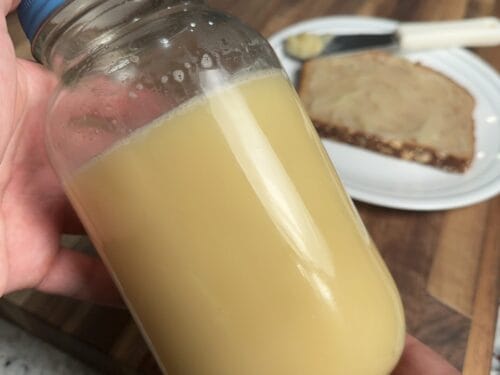
Homemade Ghee

Don’t lose this one.
I’ll email it to you so it’s waiting when you’re ready to cook.
Ingredients
Equipment
Instructions
Notes
- The milk solids left in the pan after straining are not waste. They are deeply flavoured, toasted, nutty and can be stirred into oatmeal, spread on toast or added to vegetables. They are the byproduct of making ghee and they are delicious.
- The single most common mistake in ghee-making is using too high a heat. If your ghee smells bitter or the milk solids are dark brown rather than light golden amber, the heat was too high. Start over with fresh butter and go lower and slower. It is genuinely difficult to burn ghee on a true low heat setting over an hour.
- A wider pan produces ghee faster than a narrow one because the surface area allows water to evaporate more quickly. A heavy-bottomed pan distributes heat more evenly and reduces the risk of burning. Both factors are worth considering if you make this regularly.
- If you want to verify that your ghee is finished without relying entirely on visual cues, drop a small amount of water into the pan while it is still hot. If the ghee spits and crackles violently, there is still water present and it needs more cooking time. If there is almost no reaction, the water has fully evaporated and the ghee is done.