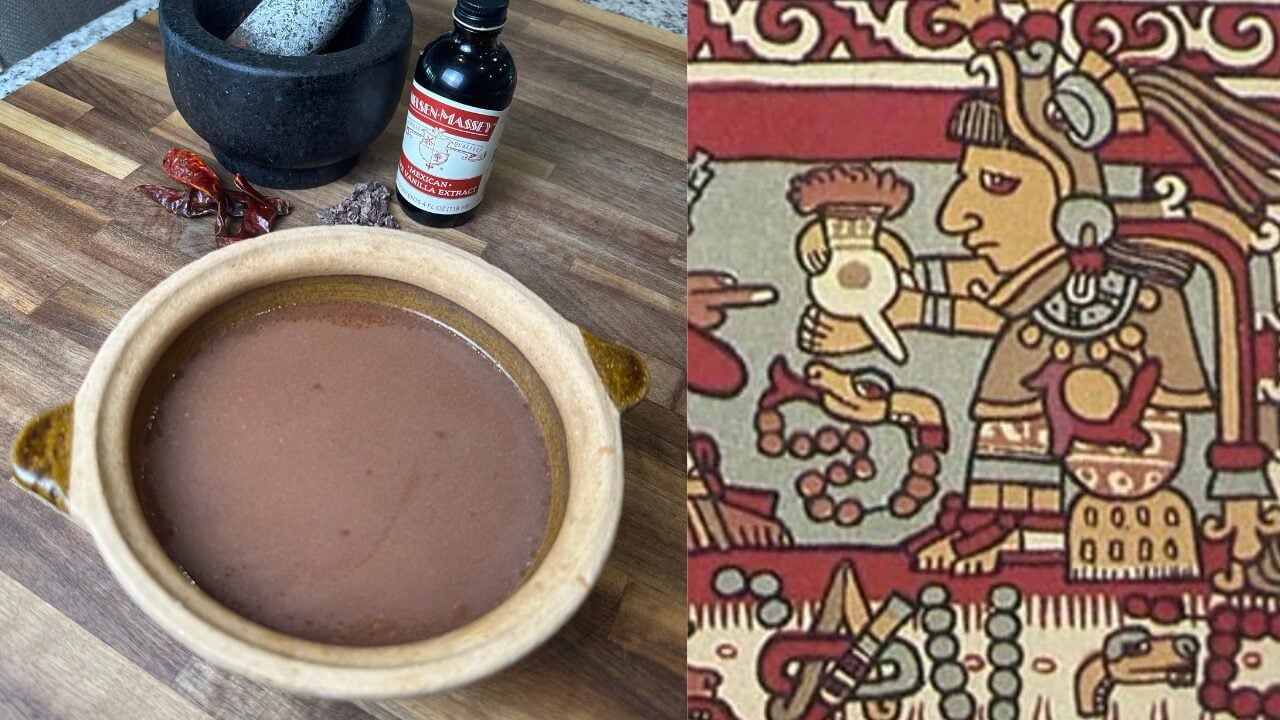
Two of the most popular flavors in the world, chocolate and vanilla, both began in Mexico. For centuries, they were combined in a single cup, long before either one reached Europe. This week I made that drink the way the Aztecs did: I ground toasted cacao nibs by hand, simmered them with rehydrated chile peppers, and finished with vanilla and honey.
Hey, my first cookbook, Cooking Ancient Rome, is now available for pre-order!!! Check it out!
I rated it 8.5 out of 10, and it does not taste like hot chocolate as you know it. It is bitter, dark, and aromatic, closer to an espresso than a chocolate bar. But the flavor is so interesting that I think every food history fan should try it once. Here is the story of the drink, and of the orchid that gave it its perfume.
Thank You, Nielsen-Massey
Next week
I cook these before I write them. Some of it never makes the post.
The failures, the source documents, the version that actually tasted good. That part goes out by email, and next week’s is already on the stove.
 Written and cooked by Donnie
A big thank you to Nielsen-Massey Vanillas for sponsoring this video, and for supplying the vanilla for this recipe. I used their Mexican Pure Vanilla Extract, which feels like the right choice for a drink invented in Mexico.
Nielsen-Massey has been family-owned since 1907. It began in Illinois as a company called Massey’s, which made aromas for the cleaning industry, before shifting into vanilla. Today it is based in Waukegan, Illinois. Its signature approach is a slow cold extraction that takes weeks rather than days, because vanilla’s flavor compounds, which number in the hundreds, are sensitive to heat. The company describes its Mexican vanilla as creamy and spicy-sweet with woody after-tones, which suits a recipe full of chile and cacao. You can learn more and find their vanillas at nielsenmassey.com.
Where Vanilla Comes From: The Totonac and the Orchid
Vanilla is the fruit of an orchid, a climbing vine native to the tropical forests of eastern Mexico. For centuries it was cultivated by the Totonac people of the Veracruz coast, and no one outside the region knew it existed. The Totonac have their own origin story, a legend that vanilla grew from the blood of a princess and her forbidden lover, and I will leave it as exactly that, a legend.
What is historically documented is what happened next. In the mid-1400s, the Aztecs conquered the Totonac, and vanilla became part of the tribute the Totonac were forced to send. The Aztecs called it tlilxochitl, and they prized it as a flavoring for their finest drink. The Spanish later renamed it vainilla, “little pod,” from the Spanish word for a sheath or pod, vaina. That is where our word comes from.
The Aztecs and Their Chocolate
The Aztecs inherited a chocolate tradition far older than their empire. Chemical traces of cacao drinks in pottery from Mesoamerica date back at least 3,500 years, to cultures like the Olmec and Mokaya. By the time of the Aztecs, cacao was so valuable that its beans were used as currency. Reported market values include about one bean for a tomato and around 30 for a rabbit, though the exact figures vary by source and time.
The drink itself was called xocolatl, commonly translated as “bitter water,” and the name fits. A 16th-century Spanish friar, Bernardino de Sahagún, recorded Aztec accounts in the Florentine Codex. His informants described fine chocolate as the drink of nobles and rulers, “finely ground, soft, foamy, reddish, bitter.” They list the flavorings: chile water, flowers, vanilla, and wild bee honey. That is exactly the combination I used.
Bernal Díaz del Castillo, a soldier with Cortés, wrote that he saw roughly fifty large jugs of frothed chocolate brought in for Moctezuma, who drank a little of it, served with great ceremony. The froth mattered. It was made by pouring the liquid from one vessel into another from a height, and it was considered the best part of the drink.
A note on temperature. Accounts differ, but many describe the Aztec version as served cold or at room temperature, while the Maya are more often associated with warm chocolate. The steaming mug we know today is largely a Spanish colonial adaptation. My recipe is served hot, so it is a modern adaptation of an Aztec drink rather than a perfect replica.
How Vanilla Escaped Mexico: The Boy Who Solved the Puzzle
For about three hundred years after the Spanish conquest, Mexico had a monopoly on vanilla. The vines could be grown elsewhere, and French colonists planted them on islands like Réunion, but the plants flowered and almost never produced pods. The reason was the pollinator. In the wild, vanilla is pollinated by a bee found only in Mexico, the Melipona. In the mid-1830s, a Belgian botanist named Charles Morren worked out this link. He even managed to pollinate vanilla by hand with a microscope and tiny scissors, but the process took about 20 minutes per flower, which made it useless for farming.
The real solution came in 1841 on the island of Réunion, from a 12-year-old enslaved boy named Edmond Albius. Using a slender stick and a quick motion, he found a way to lift the thin membrane inside the flower and press the pollen to the female part in a matter of seconds. His method is still used today, because almost all vanilla in the world is hand-pollinated. It is one of the reasons vanilla is so expensive.
Albius did not benefit from his discovery. He gained his freedom in 1848, when France abolished slavery, not as a reward for the method, and he died in poverty in 1880. Réunion became a vanilla powerhouse, along with nearby Madagascar, which is why so much vanilla is called Bourbon vanilla, after the island’s old name. Today a street, a school, and a bronze sculpture on Réunion honor him.
Making Aztec Hot Chocolate: The Process
The Aztecs did not have a blender. They ground toasted cacao on a stone grinding tool called a metate. I used a mortar and pestle, which is the closest thing in my kitchen, and it is hard work. Toasting the nibs first is the key step, because it develops the chocolate aroma.
Once I had ground the nibs into a rough, oily paste, I boiled rehydrated dried chile peppers in water to extract their flavor. Then I whisked in the cacao paste, let it simmer, and finished off the heat with Nielsen-Massey vanilla and honey. The vanilla goes in at the end because heat dulls its aroma.
My Rating
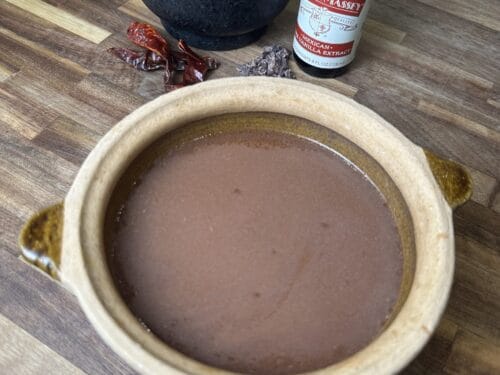
The result surprised me. It reminded me more of an espresso than of dark chocolate, bitter and deep, with the chile giving it a slow warmth and the vanilla and honey softening the edges. It is not sweet or creamy, and it will not satisfy someone looking for a cozy mug of cocoa. But the flavor profile is complex and unlike anything else I have tried, and I think it is worth making at least once.
Rating: 8.5 / 10
The Recipe: Aztec-Style Hot Chocolate
Aztec-Style Hot Chocolate

Don’t lose this one.
I’ll email it to you so it’s waiting when you’re ready to cook.
Ingredients
Instructions
Notes
- The grind: A spice grinder or hand blender is faster, but the paste will be smoother. Stone-ground is closer to the original.
- Strain it if you like: The texture is gritty, so straining through a fine sieve gives a smoother cup.
- To make it more Aztec: Skip the heat and serve it at room temperature or cold, with plenty of froth.